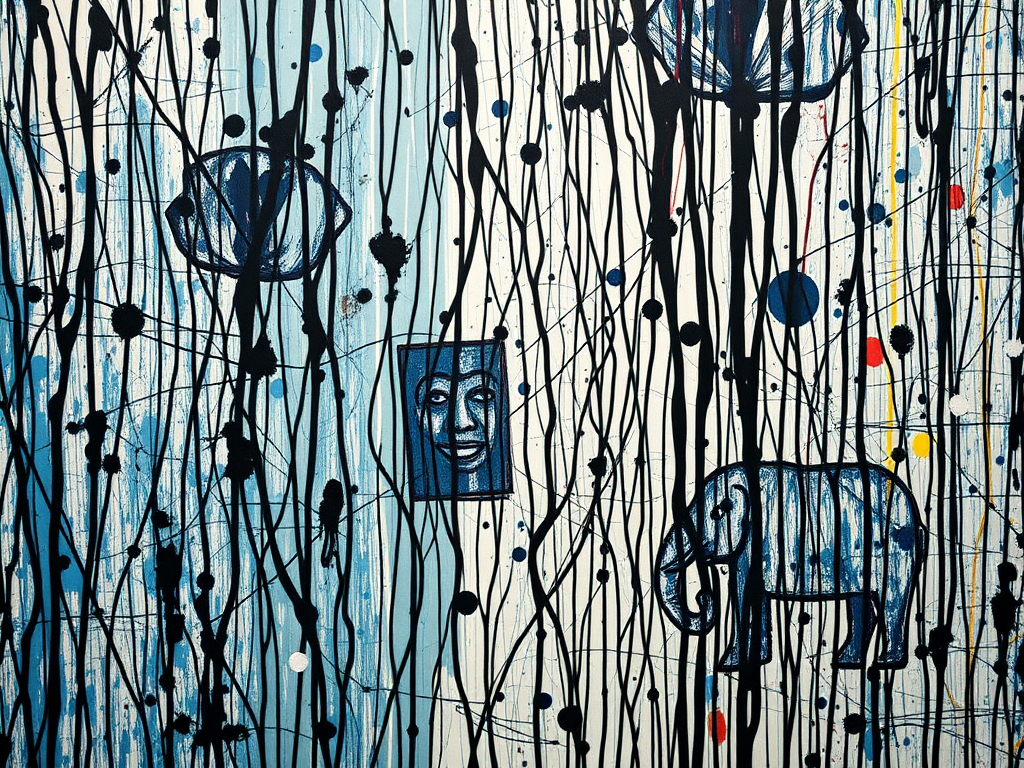
According to new research published by leading psychiatry professor, Stephen M. Stahl, artist Jackson Pollock clearly incorporated images into his pre-drip paintings and repeatedly used the same images in multiple drip paintings, potentially as a result of “extraordinary” spatial skills related to his bipolar disorder. These findings appear in a research paper by Professor Stahl, published in Cambridge University Press journal CNS Spectrums.
The paper emphasises that Pollock met the diagnostic criteria for bipolar disorder; that he didn’t paint when he was intoxicated or depressed; and that he both had extensive exposure to Rorschach ink blots during his psychiatric treatment and had visual images and hallucinations of images.
Dr Stahl, currently a professor at the University of California, San Diego, argues that Pollock either consciously or unconsciously encrypted images in his paintings to tell a story.
“Certain images make their way repeatedly into his paintings – including booze bottles, images of himself, monkeys, clowns, elephants and more. We consequently have good reason to believe Pollock encrypted these images into his paintings, whether consciously or otherwise.
“His remarkable ability to hide these images in plain sight may have been part of his creative genius, and could also have been enhanced by the endowment of extraordinary visual spatial skills that have been described in some bipolar patients.”
Sign up for the Daily Dose Newsletter and get every morning’s best science news from around the web delivered straight to your inbox? It’s easy like Sunday morning.
Although Pollock was variably diagnosed by his psychiatrists as having “alcoholic psychosis,” being “schizoid”, or possessing “a schizophrenia-like disorder characterised by alternating periods of violent agitation and paralysis or withdrawal”, in today’s world he would more likely be diagnosed as bipolar. Chronic and severe mental illnesses such as bipolar disorder can be associated with creativity and genius, with good outcomes possible especially with effective treatment.
Seeing images in Pollock’s drip paintings has been both a popular pastime and a controversy ever since these paintings were created. Some art critics argue emphasise the formal elements of Pollock’s work, arguing that no images are present and that viewers can find whatever they are looking for within the paintings’ abstract lines and composition. This line of reasoning suggests that perhaps Pollock’s paintings merely prompt viewers to project their own emotions onto these works, and that no actual images are hidden between the lines.
Dr Stahl, however, says: “Seeing an image once in a drip painting could be random; seeing the same image twice in different paintings could be a coincidence; seeing it three or more times – as is the case for booze bottles, monkeys and gorillas, elephants, and many other subjects and objects in Pollock’s paintings – makes those images very unlikely to be randomly provoked perceptions without any basis in reality.”


Leave a Reply