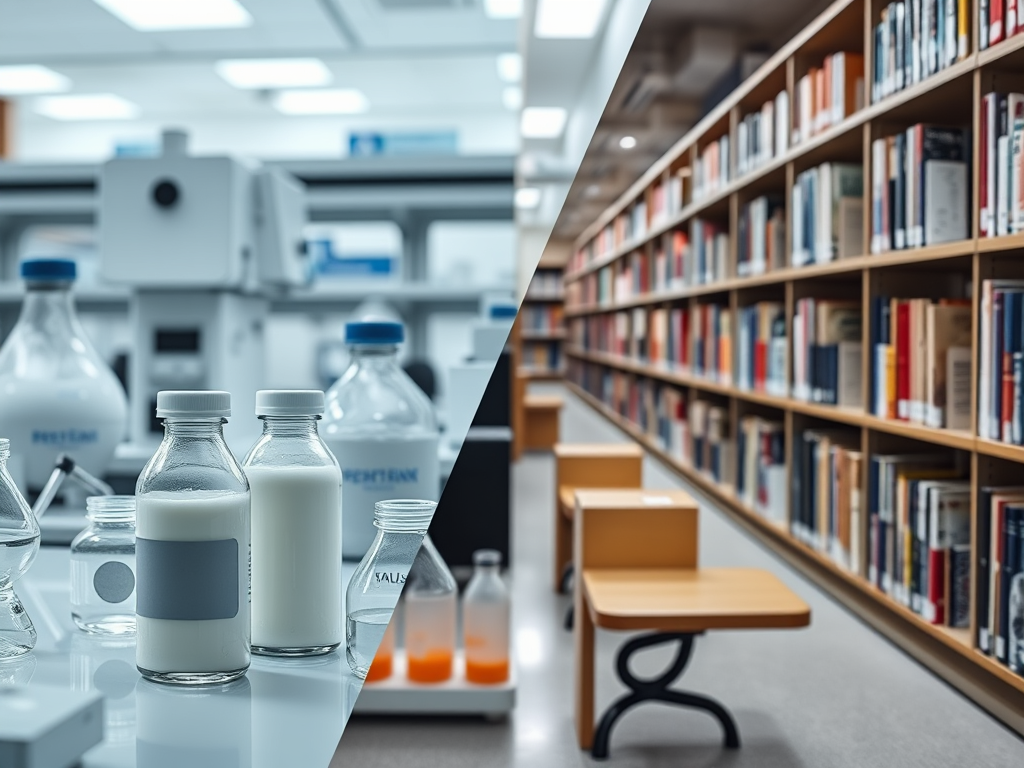
FDA HALTS BIRD FLU TESTING DUE TO STAFF CUTS
The U.S. Food and Drug Administration (FDA) has suspended efforts to improve bird flu testing in milk, cheese, and pet food due to significant staff cuts. These cuts are part of a broader initiative by the Department of Health and Human Services (HHS) to reduce the federal workforce by 10,000 employees, a move supported by President Trump and Elon Musk. The FDA’s testing showed that pasteurization kills the bird flu virus in dairy products, but raw pet food has caused bird flu deaths in at least two house cats. The suspended program was designed to enhance food safety and animal health by coordinating more than 40 laboratories, including FDA, USDA, and private industry labs. The program’s suspension undermines the reliability of bird flu testing in dairy products and pet food, which has been crucial amid an ongoing outbreak in dairy cattle affecting nearly 1,000 herds. (Reuters)
TRUMP ADMINISTRATION CUTS FUNDING FOR MUSEUM LIBRARY SERVICES
The Trump administration, in collaboration with Elon Musk’s Department of Government Efficiency, has significantly reduced funding for the Institute of Museum and Library Services (IMLS), which supports libraries and museums nationwide. As part of the cuts, 77 IMLS employees were placed on paid administrative leave, and the agency’s operations were reduced to the bare minimum. This move threatens student field trips, senior classes, and access to digital services like the ebook app Libby. The IMLS, which awarded over $269.5 million last year, plays a crucial role in providing funding to libraries and museums, especially in underserved areas. The cuts come after Trump’s executive orders aimed at reducing government spending and curbing “waste” in federal agencies. The suspension has left grants, including those for Native American libraries, in limbo, jeopardizing funding for vital services. The future of IMLS funding may be determined through legal and political battles. (Wired)
PUBLIC HEALTH LEADERS URGE CONGRESS TO PROTECT CDC
Over 100 public health leaders have sent a letter to U.S. Congressional leaders, urging them to stop the Trump administration’s efforts to dismantle the Centers for Disease Control and Prevention (CDC) and weaken public health infrastructure. The leaders, organized by the American Public Health Association’s For Our Health group, expressed concerns about proposed cuts to the Department of Health and Human Services (HHS), which would include reducing 10,000 positions and shifting responsibilities to a new agency. These cuts threaten the nation’s ability to respond to health emergencies, including outbreaks like avian flu and measles. The letter also called for oversight hearings, reinstatement of health funding, and protection of public health programs. Additionally, cuts have delayed vaccine approvals, including the Novavax COVID-19 vaccine, and led to the closure of CDC labs for sexually transmitted diseases, disrupting vital testing and outbreak response. The FDA’s vaccine advisory group was also affected by staff reductions. (CIDRAP)
NINDS REINSTATES PRINCIPAL INVESTIGATORS AFTER TERMINATION ERROR
Ten principal investigators (PIs) at the National Institute of Neurological Disorders and Stroke (NINDS) who were part of recent federal workforce cuts have been reinstated temporarily after being mistakenly terminated. A “coding error” led to their accidental firing, according to the Department of Health and Human Services (HHS), which is working to resolve the issue. The scientists, leading research on conditions like Parkinson’s disease and multiple sclerosis, were placed on paid leave with a 60-day notice for official termination. While NINDS has not formally reinstated them, staff worked quickly to reverse the decision. The incident highlights broader confusion and administrative issues within the Department of Health and Human Services, which is reorganizing to address these problems. Some affected researchers were over 60 years old and may have been targeted due to their retirement eligibility. The error also impacted lab staff and students, further straining NIH operations amid broader restructuring efforts by the Department of Government Efficiency (DOGE), overseen by Elon Musk. (Science)

GLOBAL ANTIBIOTIC USE IN LIVESTOCK SET TO RISE 30%
Global antibiotic use in livestock is projected to increase by nearly 30% by 2040, reaching over 140,000 tons, according to new estimates from the UN Food and Agriculture Organization (FAO) published in *Nature Communications*. While 47 countries have pledged to reduce antimicrobial use in food-producing animals by 30-50% by 2030, the FAO study highlights concerns with previous methods for calculating antibiotic use. The FAO’s new livestock biomass conversion (LBC) method offers more accurate projections based on live weight data across species, production systems, and herd sizes. Without interventions, antibiotic use in livestock is expected to rise to 143,481 tons by 2040. However, optimizing livestock productivity—through improved animal health, management, and efficiency—could reduce use by up to 57%, potentially lowering global consumption to around 62,000 tons by 2040. The FAO’s RENOFARM initiative aims to help countries reduce antibiotic use by promoting sustainable livestock practices. (CIDRAP)
AI HUMANOID ROBOTS SET TO ASSIST IN SILICON VALLEY HOMES
Humanoid robots powered by AI, like Neo, are becoming a part of daily life, with companies aiming to place them in homes to assist with chores. Bernt Børnich, the CEO of 1X, plans to introduce Neo to over 100 homes in Silicon Valley by year’s end. Humanoid robots, which can perform tasks like opening refrigerators and wiping counters, have attracted substantial investment, with $7.2 billion poured into over 50 start-ups since 2015. However, these robots still require significant remote control and guidance from technicians. Despite impressive advancements, tasks like loading dishwashers are challenging for them due to the complexity of real-world actions. Børnich’s company aims to improve Neo’s skills by gathering data from real homes, allowing the robot to learn through experience. However, questions about privacy, safety, and the robot’s ability to handle unpredictable household environments remain. The journey to a fully functional humanoid assistant is still in its early stages. (New York Times)
YANKEES EXPERIMENT WITH TORPEDO BAT DESIGN TO INCREASE HOME RUNS
The New York Yankees have begun using a new bat design called the “torpedo bat,” which has led to a surge in home runs. Designed by a former physics professor, the bat is thicker in the middle, redistributing mass to the sweet spot, where most hitters make contact. This design allows for faster swings and more efficient energy transfer. In physics, the sweet spot is where a collision between the bat and ball results in minimal hand recoil, thanks to the conservation of both linear and angular momentum. When the bat’s sweet spot is hit, it minimizes vibrations, making contact feel better and enhancing the distance the ball travels. The torpedo bat’s design optimizes this effect by placing the sweet spot at the bat’s widest point. While the bat currently meets regulation dimensions, it could face rule changes, but its effectiveness in countering modern pitching challenges suggests it may stay in the game for a while. (Wired)
YANKEES USE TORPEDO BAT DESIGN TO INCREASE HOME RUNS
The New York Yankees have begun using a new bat design called the “torpedo bat,” which has led to a surge in home runs. Designed by a former physics professor, the bat is thicker in the middle, redistributing mass to the sweet spot, where most hitters make contact. This design allows for faster swings and more efficient energy transfer. In physics, the sweet spot is where a collision between the bat and ball results in minimal hand recoil, thanks to the conservation of both linear and angular momentum. When the bat’s sweet spot is hit, it minimizes vibrations, making contact feel better and enhancing the distance the ball travels. The torpedo bat’s design optimizes this effect by placing the sweet spot at the bat’s widest point. While the bat currently meets regulation dimensions, it could face rule changes, but its effectiveness in countering modern pitching challenges suggests it may stay in the game for a while. (Nature)
BIRDS USE HUMAN WASTE TO BUILD NESTS IN AMSTERDAM
In 1996, a McDonald’s McChicken wrapper discarded in Amsterdam was repurposed by a nesting coot, symbolizing the lasting impact of human waste on the environment. Biologist Auke-Florian Hiemstra, who studies animal architecture, found various packaging materials in bird nests around Amsterdam’s canals, dating back to the early 1990s. These items, such as Mars bar wrappers and face masks, document the birds’ adaptation to urban environments where natural materials are scarce. The presence of plastic in nests reflects how birds, like coots and swans, have utilized human waste, turning it into valuable resources. Hiemstra emphasizes that while this phenomenon highlights our throwaway society, it also suggests that humans could learn from these animals’ resourcefulness in rethinking material use and sustainability. The success of these nests, even when made with discarded plastic, challenges our perception of waste and the potential for reusing materials. (The Guardian)
Thanks for reading. Let’s be careful out there.
WORDS: The Biology Guy.


Leave a Reply