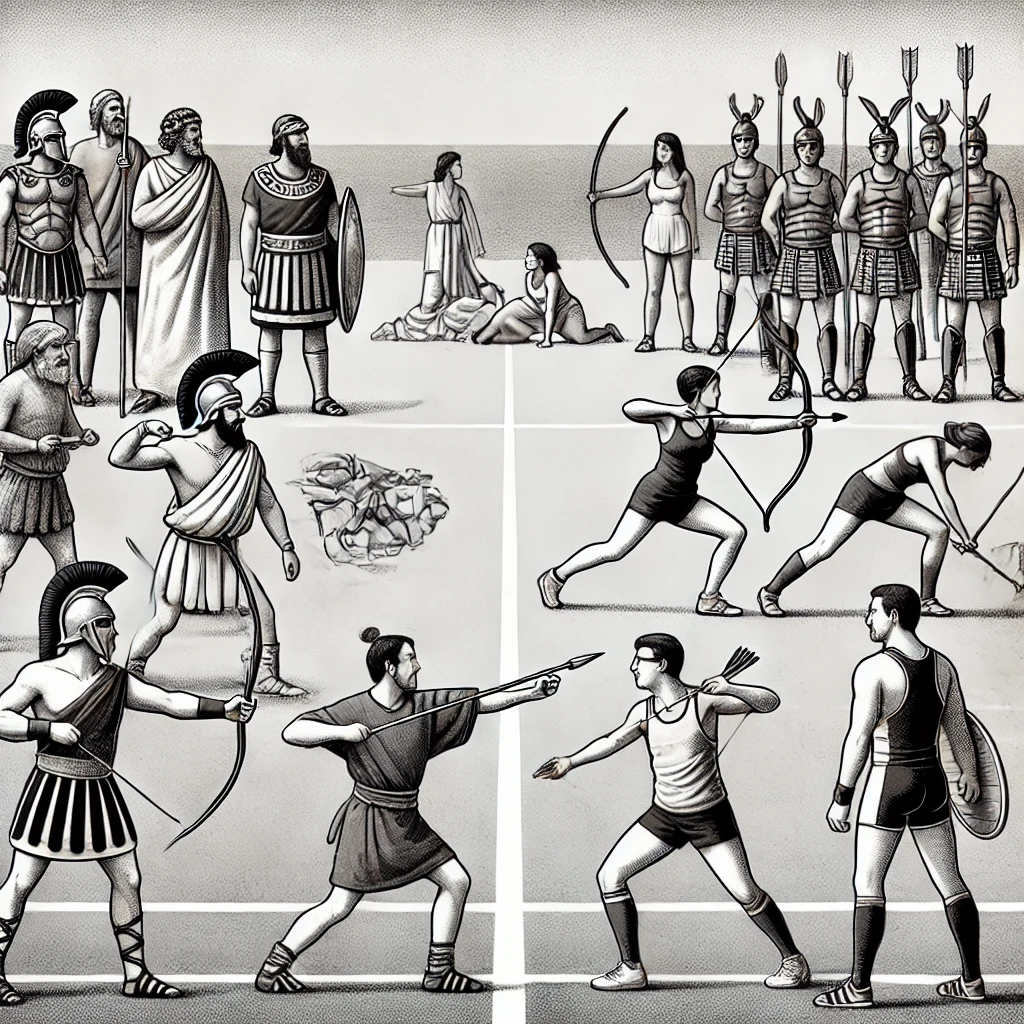
Traditional sports aren’t just cultural pastimes—they’re living laboratories of physics in action. From ancient competitions to modern games played worldwide, these activities showcase fundamental scientific principles in dynamic, accessible ways. Here are ten traditional sports that brilliantly demonstrate advanced physics concepts.

1. Archery: Projectile Motion and Energy Transfer
Dating back thousands of years, archery exemplifies projectile motion physics with exceptional clarity. When an archer draws a bow, potential energy is stored in the bow’s limbs. Upon release, this energy transfers to kinetic energy, propelling the arrow forward. The arrow’s trajectory follows a parabolic path affected by initial velocity, launch angle, and gravitational acceleration. Advanced archers intuitively account for variables like wind resistance and the Coriolis effect during long-distance shooting.

2. Cricket: Angular Momentum and Fluid Dynamics
Cricket bowling demonstrates complex physics principles, particularly in “swing bowling.” Bowlers manipulate the ball’s position, exploiting the Magnus effect to create sideways movement through the air. The asymmetric airflow around the ball (keeping one side polished while roughening the other) creates pressure differentials that affect trajectory. Meanwhile, batting exemplifies impulse and momentum transfer, with timing and positioning determining how energy transfers from bat to ball.

3. Javelin Throw: Aerodynamics and Center of Mass
This ancient Olympic sport showcases aerodynamics in action. The javelin’s design—with its center of mass positioned specifically to create stability in flight—allows for maximum distance when thrown correctly. Throwers must optimize release angle (typically 35-38 degrees), while the javelin’s aerodynamic profile reduces drag. The implement’s slight flexibility also creates oscillation that helps stabilize flight when properly executed.


4. Sumo Wrestling: Static Equilibrium and Friction
Japan’s traditional wrestling form brilliantly demonstrates principles of equilibrium and center of gravity. Sumo wrestlers seek to disrupt their opponent’s stability by forcing them outside a circular ring or causing any body part other than the soles of their feet to touch the ground. Wrestlers maximize stability by lowering their center of mass and widening their base of support. The sport also showcases friction principles through foot positioning and the clay ring surface.

5. Ice Hockey: Conservation of Momentum and Elastic Collisions
Ice hockey provides clear demonstrations of momentum conservation and near-frictionless motion. The puck’s behavior on ice approximates ideal elastic collisions, with minimal energy loss during rebounds off boards or sticks. Players intuitively calculate trajectories and use banking angles when passing. The sport also illustrates Newton’s Third Law—when players push against the ice with their skates, the ice pushes back, propelling them forward.

6. Traditional Boomerang Throwing: Gyroscopic Precession
Aboriginal boomerang throwing demonstrates one of physics’ most fascinating phenomena: gyroscopic precession. The boomerang’s rotation creates angular momentum, while its airfoil shape generates lift. The combination produces gyroscopic precession, causing the boomerang to travel in a circular path. The principles at work mirror those in aerospace navigation systems and planetary rotation.

7. Sailing: Vector Forces and Bernoulli’s Principle
Traditional sailing vessels demonstrate Bernoulli’s principle through their sail design. The pressure differential between the curved sides of the sail creates lift—similar to an airplane wing but vertical. Sailors harness vector resolution of forces to travel against the wind direction (tacking), effectively decomposing wind forces into useful components. The sport also illustrates concepts of buoyancy, fluid dynamics, and the conservation of energy.

8. Billiards/Pool: Elasticity and Angular Momentum
This centuries-old game provides textbook examples of elastic collisions, momentum transfer, and angular momentum. Players apply spin (English) to create angular momentum that affects the ball’s path after collision. The circular motion of balls demonstrates conservation of angular momentum, while the rebound angles off cushions follow the law of reflection. Players also utilize the concept of the collision line to direct the cue ball’s path.

9. Lacrosse: Centripetal Force and Energy Transfer
This Native American game showcases centripetal force through the lacrosse stick’s cradling motion. Players maintain ball possession by creating a centripetal force that keeps the ball in the pocket while running. The throwing motion demonstrates energy transfer from the player’s body through the flexible stick, which acts as a lever, amplifying force and velocity in a whip-like action.

10. Pole Vaulting: Energy Conversion and Elasticity
These traditional sports reveal how fundamental physics principles have been intuitively understood and applied by cultures worldwide, long before these concepts were formally articulated by scientists. They serve as engaging, accessible demonstrations of complex physics, bridging the gap between cultural practices and scientific understanding. By recognizing the physics embedded in these activities, we gain deeper appreciation for both the scientific principles and the cultural wisdom embodied in traditional sports.


Leave a Reply