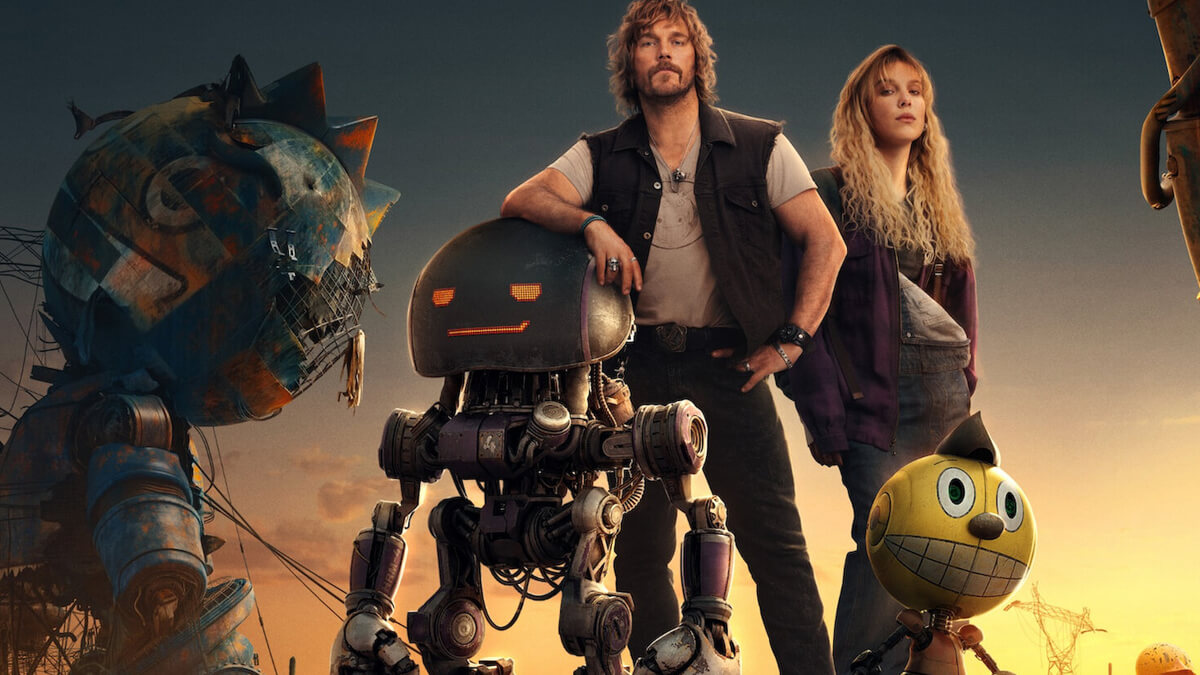
Simon Stålenhag’s haunting retro-futurist vision has long been a canvas for contemplating the uneasy marriage of humanity and machine. With The Electric State, the Russo brothers translate his stark, melancholic illustrations into a cinematic epic that fuses road movie intimacy with blockbuster-scale spectacle. The result is a film that hums with eerie beauty, its vast desert landscapes punctuated by the hulking ruins of abandoned technology, evoking a civilization that has lost control of the artificial minds it once shaped.
The Electric State centers on Michelle (Millie Bobby Brown), an orphaned teenager navigating a society where sentient robots—once peacefully integrated into human society—now exist in exile following a failed rebellion. When Michelle is visited by Cosmo, a cheerful cartoon-faced robot seemingly controlled by her genius younger brother Christopher (whom she believed dead), she embarks on a journey across the American Southwest to find him.
What follows is an adventure that feels spiritually descended from ’80s Amblin productions, though with a darker, more contemplative tone that the Russos have aptly dubbed “Dark Amblin.” Michelle reluctantly joins forces with Keats (Chris Pratt), a roguish smuggler who ferries supplies between the human world and “The Ex,” the walled-off desert zone where robots have established their own society. Accompanying Keats is his wisecracking robot sidekick Herman (voiced with perfect cynical timing by Anthony Mackie), creating a makeshift family that forms the emotional core of the film.
According to Joe Russo, “The best Amblin films respected their audience — especially younger viewers — by telling stories with real stakes, deep emotions, and meaningful consequences. That’s something we took to heart with The Electric State. This movie isn’t just about the spectacle; it’s about the emotional weight of the journey these characters are on. Like the Amblin films we grew up loving, it blends genres seamlessly — sci-fi, adventure, and a deeply personal coming-of-age story all wrapped into one. At its core, it’s about a girl navigating a world much bigger and more complicated than she expected, discovering herself, and finding family in unexpected places. We wanted to capture that same sense of wonder and emotional depth, making a film that feels thrilling and adventurous but also lingers with audiences long after they leave the theater.”
The Russo brothers, who established their blockbuster credentials with Marvel entries like Avengers: Endgame, demonstrate a surprising delicacy in their handling of this more intimate story. The film’s visuals are frequently breathtaking, particularly in scenes set within the robot sanctuary of Blue Sky Acres Mall, where decommissioned service robots have repurposed abandoned stores into workshops, libraries, and community spaces. It’s here we meet Mr. Peanut (voiced with unexpected pathos by Woody Harrelson), a former corporate mascot who now serves as a father figure to the displaced mechanical beings.
Brown, who has seemingly transcended her Stranger Things origins, brings a compelling mixture of toughness and vulnerability to Michelle. Her character’s emotional journey toward understanding these machines not as mere tools but as beings capable of authentic connection forms the film’s philosophical backbone. Pratt, meanwhile, embraces Keats’s mullet-wearing, ’80s burnout aesthetic with evident glee, channeling a character he describes as inspired by a guitar-playing neighbor from his Alaskan childhood.
Where The Electric State truly distinguishes itself is in its exploration of what some futurists have termed The Artilect War—the hypothetical conflict between humans and artificial intelligences over consciousness, autonomy, and the right to self-determination. The film’s alternate 1990s setting provides enough distance to examine our contemporary relationship with technology without descending into didacticism. In this world, the “neurocasters” that humans use to escape into virtual reality serve as transparent analogues for our smartphone addictions.
The concept of The Artilect War, popularized by futurist Hugo de Garis, posits that humanity may eventually face an existential conflict over artificial superintelligence. De Garis suggests that society will bifurcate into two opposing factions: “Cosmists,” who support the development of godlike artificial intellects (artilects) regardless of potential risks to humanity, and “Terrans,” who resist such development, viewing it as an existential threat to human primacy. What makes the Russos’ vision so compelling is how it reimagines this theoretical confrontation not as an apocalyptic future but as an already concluded chapter in an alternate history.
Unlike most AI narratives that fixate on the moment of machine awakening or rebellion, The Electric State explores the melancholy aftermath. The titular “Electric State” refers not only to the physical territory where robots have established their community but also to a psychological condition—a liminal space where both humans and machines exist after their failed attempt at cohabitation. In the abandoned mall that serves as the robots’ sanctuary, we witness machines originally designed for human service creating their own society with values and hierarchies distinctly non-human yet achingly familiar.
The film’s premise—that an artificial rebellion has already occurred, failed, and been largely forgotten—sets it apart from the usual doomsday AI narratives. The Electric State does not dwell on the uprising itself but on its aftermath, echoing the darker implications of de Garis’ theory while suggesting a more nuanced outcome. The Russo brothers’ adaptation invites us to consider an alternate path: what if that war had already been fought—and what if the machines, rather than conquering, simply withdrew? This question transforms what could have been a standard sci-fi thriller into a poignant meditation on otherness, reconciliation, and the possibility that consciousness, whether housed in carbon or silicon, ultimately seeks the same fundamental connections.


Stanley Tucci delivers a nuanced performance as Ethan Skate, the tech visionary whose neurocaster technology helped precipitate the robot conflict. Unlike many sci-fi antagonists, Skate doesn’t view himself as villainous—he genuinely believes his technology will alleviate human suffering by providing escape from physical limitations. “He is somewhat villainous, but he doesn’t think he is,” Tucci explains. “He thinks he’s doing everybody a favor.”
The production design by Dennis Gassner and Richard L. Johnson deserves special mention, creating a world that feels both nostalgically familiar and disconcertingly alien. The robots themselves—ranging from Cosmo’s childlike yellow orb to Herman’s more utilitarian design—are marvels of visual storytelling, conveying emotion despite their mechanical limitations. VFX supervisor Matthew Butler’s decision to blend realistic robotic movements with more expressive gestures results in characters that feel at once alien and deeply relatable.
If the film occasionally stumbles, it’s in moments where its world-building ambitions outpace its narrative momentum. Several subplots involving government officials and military personnel (including Giancarlo Esposito’s Colonel Bradbury) feel underdeveloped, existing primarily to propel the plot toward its spectacle-heavy third act.
Nevertheless, The Electric State stands as an ambitious and frequently moving meditation on what it means to be human in an increasingly mechanical age. By filtering contemporary anxieties through a 1990s aesthetic lens, the Russos have created something that feels both timely and timeless—a sci-fi adventure that acknowledges the peril of our technological moment while still finding space for wonder, connection, and even hope.
The Electric State debuts on Netflix on March 14.
IMAGE CREDIT: Netflix.



Leave a Reply