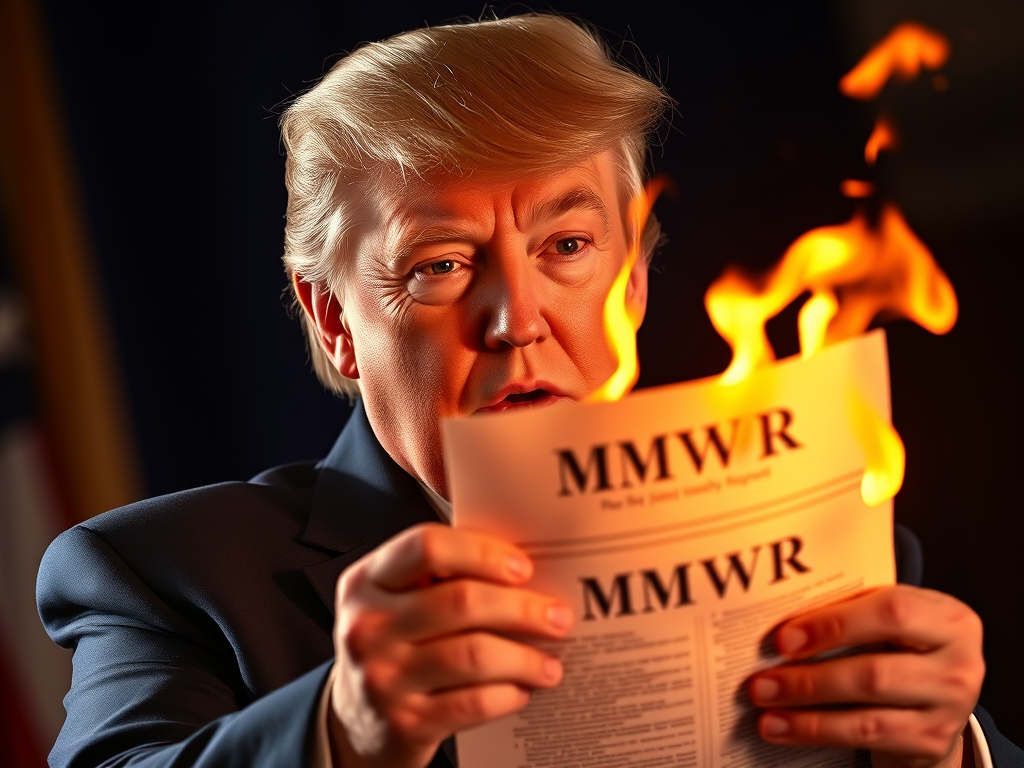
TRUMP APPOINTEES EXERT UNPRECEDENTED CONTROL OVER CDC PUBLICATION
Recent reports reveal that Trump administration political appointees have exerted unprecedented control over the CDC’s flagship publication, the Morbidity and Mortality Weekly Report (MMWR), which had been independent for decades. This intervention involved dictating what to publish, including withholding studies on the bird flu outbreak. The delay in releasing critical bird flu research, including studies on infected pet cats and antibody testing for veterinarians, is attributed to a communications “pause” ordered by the Department of Health and Human Services (HHS), though political interference became evident as the pause lifted. The Trump administration also directed the CDC to prioritize research on wildfire health risks, unrelated to scheduled studies. This interference has raised concerns about the loss of autonomy for the MMWR, which is considered a respected source for public health research. Scientists within the CDC have expressed frustration, fearing political influence over scientific data, and uncertainty remains over when the delayed research will be published. (CBS News)
NEW JOURNAL SPARKS CONTROVERSY OVER PUBLIC HEALTH RESEARCH
The newly launched Journal of the Academy of Public Health (JAPH), co-founded by NIH nominee Jay Bhattacharya and Martin Kulldorff, has sparked controversy despite its aim to promote “open and transparent scientific discourse.” The journal, which has published articles on COVID-19 and other public health issues, operates with an unconventional approach: it lacks a subscription paywall, posts peer reviews alongside articles, and compensates reviewers. However, its membership requirement, limiting submissions to members of the newly formed Academy of Public Health, has raised concerns. Critics, including scientists like Carl Bergstrom, argue that the journal is dominated by contrarian views, particularly on COVID-19, and may spread misinformation. Members can publish any public health research without the usual peer review process, which some fear undermines scientific rigor. While the journal’s proponents argue it addresses issues in scientific publishing, skeptics worry it could be used to promote fringe views, especially on vaccine safety and public health measures. (Science)
RESEARCHERS BACK UP CRITICAL CDC DATA AMID TRUMP ADMINISTRATION CONCERNS
In late January 2020, rumors spread that the Trump administration might remove key public health data from federal websites, particularly those managed by the CDC. In response, bioinformatician Niema Moshiri and other researchers began backing up critical information from the CDC and other government sites to preserve it. Moshiri, along with collaborators, created a backup of over 7,000 CDC web pages and datasets, some of which were archived through the Internet Archive’s Wayback Machine. This effort was part of a broader initiative involving various scientists and researchers, concerned about the potential loss of important health data, such as surveys on chronic disease and HIV. Although some data has been restored, including gender-related surveys, other datasets remain unavailable, raising concerns about the future availability of essential public health information. Legal experts argue that backing up and sharing such data is generally permissible, especially for research, advocacy, or historical preservation. (Nature)
OPENAI DEVELOPING IN-HOUSE AI CHIPS TO REDUCE RELIANCE ON NVIDIA
OpenAI is advancing its plan to reduce reliance on Nvidia by developing its own AI chips. The company is finalizing the design of its first in-house chip, expected to be sent for fabrication at Taiwan Semiconductor Manufacturing Co. (TSMC) in the coming months. This first chip, designed for training AI models, is a strategic move to strengthen OpenAI’s negotiating power with chip suppliers. If successful, it could lead to mass production in 2026, though there are risks, such as the possibility of failure during the tape-out process. OpenAI’s in-house team, led by Richard Ho, is collaborating with Broadcom on the design. While OpenAI’s efforts are smaller than those of major companies like Google or Amazon, the new chip aims to reduce dependency on Nvidia, which currently holds 80% of the market share. The chip will initially be used on a limited scale for running AI models, with plans to expand its capabilities over time. (Channel News Asia)

DEEPEEK RISES AS SYMBOL OF CHINA’S EDUCATIONAL SUCCESS IN AI
DeepSeek, a Chinese AI start-up, has become a symbol of China’s growing educational success, particularly in science and technology. Its core team, all educated in China, contrasts with many Chinese tech firms that recruit talent from abroad. The company’s success has sparked praise for China’s education system, with some even suggesting that China has surpassed the U.S. in AI research. China produces more STEM graduates, especially in AI, than the U.S., and its top universities are producing increasingly skilled researchers. However, the country’s corporate culture and political constraints, particularly under Xi Jinping, present challenges for innovation. DeepSeek has managed to avoid some of these pressures by maintaining a low profile and focusing on intellectual exploration rather than profit. Despite these successes, China’s future AI competitiveness may depend on balancing its education system, government policies, and private sector freedom. Innovation, according to DeepSeek’s founder, requires minimal intervention from the government. (New York Times)
EUCLID TELESCOPE CAPTURES RARE EINSTEIN RING REVEALING DARK MATTER
The Euclid space telescope has captured a rare and stunning Einstein ring, a phenomenon where light from a distant galaxy is bent around the gravity of a foreground galaxy, revealing the effects of extreme space-time warping. The image shows NGC 6505, a nearby galaxy, surrounded by a perfect circle of light from a more distant galaxy behind it. This find is significant because Einstein rings are extremely rare and offer insights into dark matter, as they allow astronomers to study mass distribution, including hidden dark matter. In this case, the foreground galaxy contains about 11% dark matter. The Euclid mission, funded by the European Space Agency, aims to map the distribution of dark matter and reveal the effects of dark energy across the universe. While it can observe galaxies up to 10 billion light-years away, this discovery of a previously unnoticed ring around NGC 6505 shows Euclid’s powerful ability to uncover new cosmic structures. (The Guardian)
Thanks for reading. Let’s be careful out there.
WORDS: The Biology Guy.




Leave a Reply