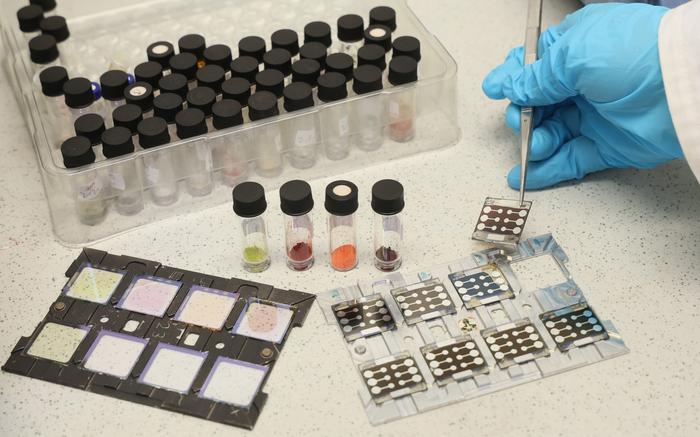
In order to find out which of a million different molecules would conduct positive charges and make perovskite solar cells particularly efficient, one would need to synthesize and test all of them – or do as the researchers headed by Tenure-track Professor Pascal Friederich, who specializes in the applications of AI in materials science at KIT’s Institute of Nanotechnology, and Professor Christoph Brabec from the Helmholtz Institute Erlangen-Nürnberg (HI ERN). “With only 150 targeted experiments, we were able to achieve a breakthrough that would otherwise have required hundreds of thousands of tests. The workflow we have developed will open up new ways to quickly and economically discover high-performance materials for a wide range of applications,” Brabec said. With one of the discovered materials, they increased the efficiency of a reference solar cell by approximately two percentage points to 26.2 percent. “Our success shows that enormous amounts of time and resources can be saved by applying skillful strategies for the discovery of new energy materials,” Friedrich said.
The starting point at HI ERN was a database with structural formulae for approximately one million virtual molecules that could be synthesized from commercially available substances. From these virtual molecules, 13,000 were selected at random. The KIT researchers used established quantum mechanical methods to determine their energy levels, polarity, geometry and other properties.
From the 13,000 molecules, the scientists chose 101 with the greatest differences in their properties, synthesized them with robotic systems at HI ERN, used them to produce otherwise identical solar cells, and then measured the efficiency of the solar cells. “Being able to produce truly comparable samples thanks to our highly automated synthesis platform, and thus being able to determine reliable efficiency values, was crucial to our strategy’s success,” said Brabec, who headed the work at HI ERN.
The researchers at KIT used the achieved efficiencies and the properties of the associated molecules to train an AI model, which suggested 48 other molecules to synthesize. Its suggestions were based on two criteria: high expected efficiency and unforeseeable properties. “When the machine learning model is uncertain about the predicted efficiency, it’s worthwhile to synthesize the molecule and take a closer look at it,” Friederich said, explaining the second criterion. “It might surprise us with a high efficiency level.”
Using the molecules suggested by the AI, it was indeed possible to build solar cells with above-average efficiency, including some exceeding the capabilities of the most advanced materials currently used. “We can’t be sure we’ve really found the best one of a million molecules, but we’re certainly close to the optimum,” Friederich said.
Sign up for the Daily Dose Newsletter and get every morning’s best science news from around the web delivered straight to your inbox? It’s easy like Sunday morning.
Since the researchers used an AI that indicates which of the virtual molecules’ properties its suggestions were based on, they were able to gain some insight into the molecules it suggested. For example, they determined that the AI-suggestions are based in part on the presence of certain chemical groups, such as amines, that chemists had previously neglected.
Brabec and Friederich believe that their strategy holds promise for other applications in materials science or can be extended to the optimization of entire components.
The findings, which are the result of research conducted in collaboration with scientists from FAU Erlangen-Nürnberg, South Korea’s Ulsan National Institute of Science, and China’s Xiamen University and University of Electronic Science and Technology, were published recently in the prestigious journal Science. (ffr)



Leave a Reply