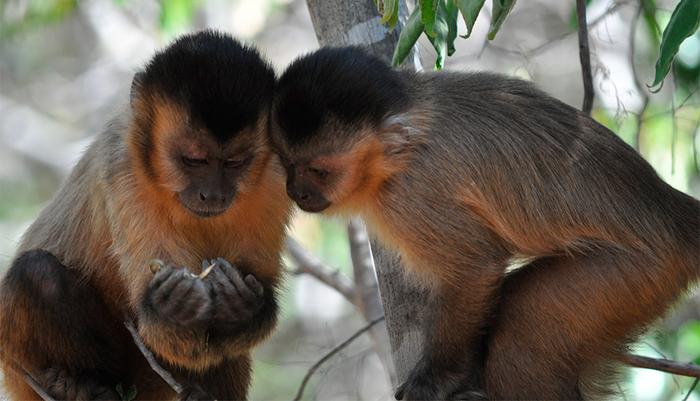
A study of capuchin monkeys (Sapajus libidinosus) in the Serra da Capivara National Park – located in the state of Piauí, Brazil, in the semi-arid biome called Caatinga – shows that tolerance is extremely important for social learning, which is acquired by observing other members of the same group. The results have been published in the journal PNAS.
Researchers from the University of São Paulo (USP), supported by FAPESP, and Durham University in the United Kingdom, observed that partners in collective activities, such as searching for parasites and playing games, are more likely to learn new skills from their companions.
“Our observations fed into a mathematical model that showed that monkeys learn from others mainly through direct observation, by looking closely at another individual doing the task. In addition, social tolerance, especially between partners in collective activities, turned out to be a good way to predict which individuals would learn from which,” says Camila Galheigo Coelho, one of the main authors of the study, which was conducted during her doctorate at USP’s Institute of Psychology (IP) with a scholarship from FAPESP.
Part of the analysis was carried out during an internship at Durham University under the co-supervision of Professor Rachel Kendal.
“The most important aspect was to prove, using network-based diffusion analysis [NBDA], that the diffusion of a new technique for obtaining a resource spread through socially-mediated learning, and not simply through gradual individual learning by new individuals,” states Eduardo Ottoni, a professor at IP-USP who supervised the study.
In addition to the influence of social tolerance, youngsters who had not yet learned the task were more likely to observe and learn from successful adult males in the group.
Sign up for the Daily Dose Newsletter and get every morning’s best science news from around the web delivered straight to your inbox? It’s easy like Sunday morning.
The work is part of the project “Effects of social dynamics on the diffusion of new behaviors in groups of capuchin monkeys (Sapajus libidinosus) inhabiting the Caatinga of the Serra da Capivara National Park”.
The project was coordinated by Ottoni, who in the late 1990s led the first studies in Brazil on tool use and social learning by capuchin monkeys at the Tietê Ecological Park in the state of São Paulo.
“The discovery of tool use and social learning among capuchin monkeys was a fluke for us that turned into the discovery of a series of non-human cultural processes. The more we study, the more we realize that cultural evolution is part of something bigger in the context of biological evolution itself,” states Ottoni, co-author of the study, which is part of a special issue of the journal celebrating the 50th anniversary of cultural evolution studies.
After the studies at the Tietê Park of capuchin monkeys rescued from animal trafficking seizures, the researchers pointed to similar behaviors in wild populations in Piauí, in the Serra da Capivara National Park and at Fazenda Boa Vista, beginning in 2003.
Over the years, other populations with different traditions have been located in the Serra das Confusões National Park, also in Piauí, and in the Chapada dos Veadeiros, in the state of Goiás.
The capuchin monkeys that inhabit savannah regions typically use stones to crack coconuts and other seeds. In the Serra da Capivara, they also use stones as tools in other contexts, such as digging up roots or insect nests, as well as sticks as probes to catch lizards or small mammals. These populations have been the subject of several wildlife studies and documentaries (read more at: agencia.fapesp.br/42137 and agencia.fapesp.br/40081).
Experiment
To arrive at their findings, the researchers observed two groups in the Serra da Capivara for nine months each. The groups live eight kilometers apart.
In order to carry out the experiment, it was necessary for one individual to learn an activity without the knowledge of their companions. In this way, the learning process could be analyzed from the beginning and passed on to others.
For three days, the researchers presented a box to a member of the group who had strayed from the troop in an area they use for feeding.
The object had two mechanisms for releasing an edible reward: a blue door that released the food when pushed, and a green lever that had to be pulled to achieve the same result. The representative of each group was shown one of the two ways to activate it.
Once the animals had learned how to operate the mechanism in one of the two ways, the box was made available to each group. After some tried breaking it with rocks and poking at the inside with sticks, the individual who had learned from the researchers how to get the reward performed the task while the others approached and watched.
“Our expectation was that one group would learn to push and the other to pull, creating two different traditions. But in both groups, they learned to release the reward in both ways,” says Coelho, who was hired as a producer for the BBC as a result of the experiment and now produces wildlife documentaries at the Natural History Unit in Bristol.
The researchers also observed that learning was easier to observe in the larger, highly subdivided group. When one member of a subgroup learned, the others in the same group soon learned as well. As a result, 57.5% of the individuals learned to perform the task.
In the smaller, more cohesive group, a dominant male prevented many from approaching. As a result, only 36.7% of the group learned to perform the task. This finding highlights the importance of tolerance of other group members for social learning.
IMAGE CREDIT: Camila Galheigo Coelho.



Leave a Reply