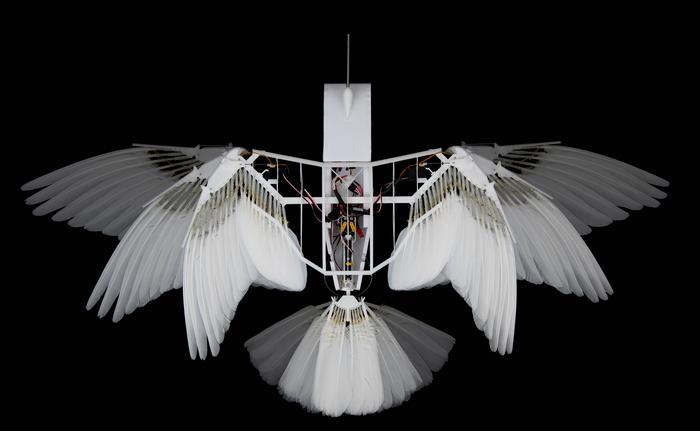
Have you ever wondered why an airplane has a vertical tailfin? The plane needs it to stabilize its flight. Since flying without a vertical tail is much more energy-efficient, the aviation industry has worked hard to accomplish this – so far without much success. However, birds don’t need a vertical fin, which raises the question: how do they do it?
David Lentink, Professor of Biomimetics at the University of Groningen, has developed a robotic bird model with real pigeon feathers to show how they do it. In previous work, he found that birds continuously adjust the shape of their wings and tail. In his latest paper, he shows that his pigeon-like robot can replicate these movements.
An algorithm controls nine servo motors which move the feathers to continuously change the shape of the wings and tail. The algorithm mimics reflexes, which are thought to be used by birds to stabilize themselves. In 1929, German scientist Franz Groebbels proposed that this enables birds to fly like ‘automatic airplanes’. Almost a century later, the robotic bird ‘PigeonBot II’ confirms his idea, as it was successfully tested in a wind tunnel, and then flown autonomously in the open air.
Sign up for the Daily Dose Newsletter and get every morning’s best science news from around the web delivered straight to your inbox? It’s easy like Sunday morning.
Apart from showing how birds manage to fly without vertical tailfins, Lentink opened the way to designing more fuel-efficient airplanes: ‘The European Airbus group created a concept, visualizing how such a plane should look. Our study provides the knowledge to realize their ideas.’ Furthermore, the new design concept reduces a plane’s radar signature, which can improve jet fighters operations.
IMAGE CREDIT: Eric Chang, Lentink Lab.
Leave a Reply