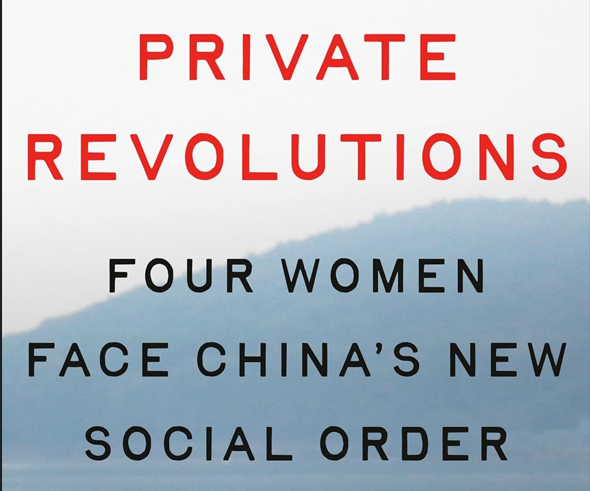
Yuan Yang’s Private Revolutions: Four Women Face China’s New Social Order (Viking) offers a compelling and intimate portrayal of China’s rapid transformation through the eyes of four young women born in the late 1980s and early 1990s. This masterful narrative interweaves personal stories with broader societal shifts, providing a nuanced view of China’s complex socio-economic evolution during the post-Mao era and beyond.
The book centers on Leiya, Siyue, Sam, and June, whose diverse experiences epitomize the challenges and opportunities faced by their generation. Their journeys from rural beginnings to urban roles reflect the nation’s transition from an agrarian society to a global economic powerhouse. Yang, herself a “left-behind child” who later became a journalist, brings a unique perspective to these stories, having witnessed firsthand the transformative power of Deng Xiaoping’s reforms.

Leiya’s story exemplifies the struggle of migrant workers, as she moves from factory work to advocating for workers’ rights and establishing a community care center for her daughter. Siyue’s path from educational struggles to entrepreneurship in the English tutoring industry highlights both the potential for social mobility and the precariousness of success in a rapidly changing regulatory environment. Sam’s journey from a middle-class background to labor activism showcases the idealism of youth confronting systemic challenges. June’s ascent from a rural primary school to university and a tech career in Beijing illustrates the power of education in bridging the urban-rural divide.
Yang skillfully weaves these personal narratives into the larger tapestry of China’s economic boom, capturing both the optimism of the reform era and the anxieties of the present. She explores the consequences of rapid urbanization, including the phenomenon of “left-behind children” and the challenges faced by migrant workers under the hukou system. The author also delves into the intense pressures faced by “Generation Involution,” where increasing efforts often yield diminishing returns in a highly competitive society.

The book doesn’t shy away from addressing critical issues such as labor conditions, the competitive educational landscape, and government surveillance. However, it presents these challenges through the lens of personal experiences, allowing readers to connect emotionally with the broader societal trends. Yang’s narrative style, rich in sensory details and devoid of heavy-handed commentary, allows readers to draw their own conclusions about the complex realities of modern China.
Private Revolutions ultimately paints a picture of resilience and adaptability in the face of rapid change. It celebrates the private victories of individuals while acknowledging the ongoing struggles within a society where personal achievements are often at the mercy of shifting political and economic landscapes. Through these women’s stories, Yang offers a hopeful yet realistic view of China’s future, highlighting the potential for individual agency in shaping the nation’s path forward.
This deeply human account of China’s transformation not only provides valuable insights into the world’s rising superpower but also resonates with global audiences facing similar challenges of economic uncertainty and social change. Yang’s work stands as a testament to the power of personal narratives in illuminating the complexities of national development, offering a unique and vital contribution to our understanding of contemporary China.
Sign up for the Daily Dose Newsletter and get the morning’s best science news from around the web delivered straight to your inbox? It’s easy like Sunday morning.




Leave a Reply