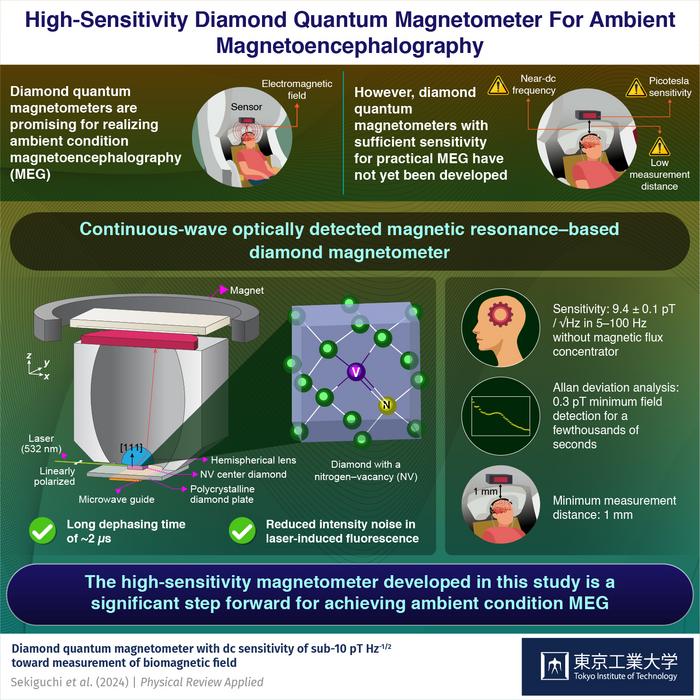
Magnetoencephalography (MEG) is a biomedical imaging technique used for mapping brain activity by recording magnetic fields produced by the naturally occurring electrical currents generated by neurons in the brain, using very sensitive magnetometers. Currently, MEG requires a magnetically shielded room for operation. Achieving MEG that works in normal environments, without the need for magnetic shielding, is a major goal. This would enable daily diagnosis, brain-machine interfaces, and fundamental research on brain function.
Magnetometers using diamond quantum sensors with nitrogen–vacancy (NV) centers are promising candidates for realizing ambient condition MEG. These sensors are expected to offer significantly better millimeter-scale resolution than conventional centimeter-scale MEGs. Notably, NV centers are defects in the structure of a diamond, consisting of a nitrogen atom substituted for a carbon atom, next to a vacancy. One common method for measuring magnetic fields with NV centers is continuous-wave optically detected magnetic resonance (CW-ODMR). In this method, a continuous microwave field is used to manipulate the spin states of the NV centers while they are illuminated by a laser. The intensity of this laser-induced fluorescence changes depending on the external magnetic field. By measuring these changes in fluorescence, the external magnetic field can be detected and measured. Compared with other methods, this method is simpler and easier and can achieve millimeter-scale resolution.
Building upon this technology, a team of researchers from Japan, led by Associate Professor Naota Sekiguchi from the Department of Electrical and Electronic Engineering at Tokyo Institute of Technology, recently developed a novel and sensitive diamond quantum magnetometer. “Clinically acceptable MEG requires sensitivities, at least, in the order of picotesla (pT) in the near-dc frequency range of 5–100 Hz within a reasonable measurement time. Currently, diamond magnetometers require a magnetic flux concentrator (MFC) to achieve this sensitivity. However, MFCs reduce the intrinsic spatial resolution of magnetometers. Additionally, for MEGs, a short measurement distance is required as the decay of magnetic fields increases exponentially with distance. To overcome these challenges, we designed a sensitive CW-ODMR-based diamond magnetometer,” explains Sekiguchi in detail. Their study has been published in the journal Physical Review Applied.

The novel magnetometer uses a single crystalline diamond which was fabricated using a high-pressure high temperature (HPHT) method. After HPHT synthesis, a piece of crystal was cut out parallel to the (111) crystal plane, and negatively charged NV centers were produced in the crystal using electron beam irradiation followed by annealing at 1000 0C. This NV center ensemble was placed in the sensor head, designed to approach the target to about one millimeter with a sensing volume of 4 x 10⁻³ mm3. The ensemble was excited by a linearly polarized green laser with a wavelength of 532 nanometers, and a high refractive index hemispherical lens was used to enhance the collection efficiency of the laser-induced fluorescence.
By carefully tuning the experimental conditions, the researchers achieved a record sensitivity of 9.4 ± 0.1 pT Hz-1/2 in the frequency range of 5 to 100 Hz, without an MFC. Additionally, analysis of Allan deviation showed that the magnetometer can measure magnetic fields as low as 0.3 pT and maintain remarkable sensitivity for a long time. Furthermore, its design is suitable for practical applications such as for MEG of a living animal.
Sign up for the Daily Dose Newsletter and get every morning’s best science news from around the web delivered straight to your inbox? It’s easy like Sunday morning.
The high sensitivities achieved in this study mark a significant step toward realizing ambient condition MEG with millimeter-scale resolution. Looking ahead, Sekiguchi concludes, “In the future, we plan to measure the MEG of animals using the sensors developed in this study and to realize MEG measurements with diamond quantum sensors. Ultimately, we aim to achieve MEG without the need for magnetic shielding.”
IMAGE CREDIT: Tokyo Tech
If you enjoy the content we create and would like to support us, please consider becoming a patron on Patreon! By joining our community, you’ll gain access to exclusive perks such as early access to our latest content, behind-the-scenes updates, and the ability to submit questions and suggest topics for us to cover. Your support will enable us to continue creating high-quality content and reach a wider audience.
Join us on Patreon today and let’s work together to create more amazing content! https://www.patreon.com/ScientificInquirer


Leave a Reply