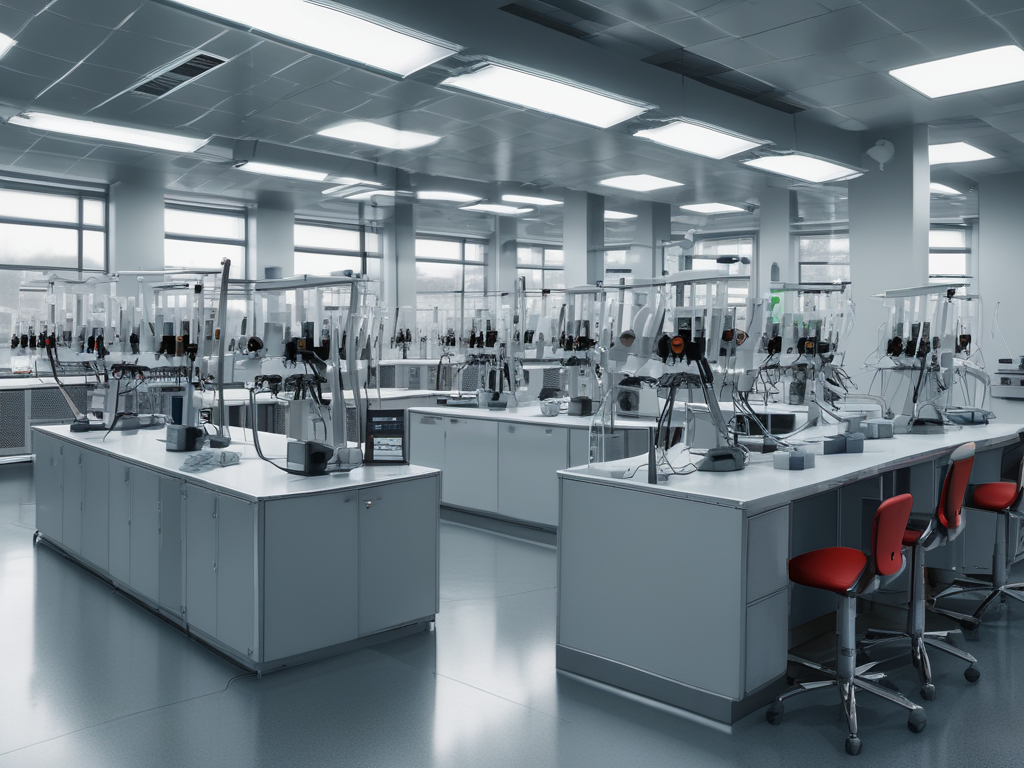
Organic solid-state lasers (OSLs) hold immense promise for a wide range of applications due to their flexibility, colour tunability, and efficiency. However, they are difficult to make, and with over 150,000 possible experiments required to conduct to find successful new materials, discovering them all would be the work of several lifetimes. In fact, in the previous few decades, only 10-20 new OSL materials have been tested. Researchers with the Acceleration Consortium based at the University of Toronto, took up this challenge and used self-driving lab (SDL) technology that, once set up, enabled them to synthesize and test over 1000 potential OSL materials and discover at least 21 top performing OSL gain candidates in a matter of months.
An SDL uses advanced technologies such as artificial intelligence and robotic synthesis to streamline the process of identifying novel materials – in this case, materials with exceptional lasing properties. Up until now, SDLs have usually been confined to one physical lab in one geographic location. This paper titled “Delocalized Asynchronous Closed-Loop Discovery of Organic Laser Emitters” published in the journal Science, showcases how the research team used the concept of distributed experimentation, where tasks are divided among different research sites, to achieve the joint goal faster.
For this research, labs from Toronto and Vancouver in Canada, Glasgow in Scotland, Illinois in the USA, and Fukuoka in Japan were involved.

By using this method, each lab was able to contribute its unique expertise and resources- which ultimately played a key role in the success of this project. This decentralized workflow, managed by a cloud-based platform, not only enhanced efficiency but also allowed for the rapid replication of experimental findings, ultimately democratizing the discovery process, and accelerating the development of next-generation laser technology.
“What this paper shows is that a closed-loop approach can be delocalized, researchers can go all the way down from the molecular state down to devices and you can accelerate the discovery of materials that are very early in the process of commercialization,” said Dr. Alán Aspuru-Guzik, director of the Acceleration Consortium. “The team designed an experiment that went all the way down from molecule to device- with the final devices being made in Japan. They were scaled up in Vancouver and then transferred to Japan for characterization.”
Sign up for the Daily Dose Newsletter and get every morning’s best science news from around the web delivered straight to your inbox? It’s easy like Sunday morning.
The discovery of these novel materials represents a significant advancement in the field of molecular optoelectronics. It has paved the way for enhanced performance and functionality in OSL devices and set a precedent for future delocalized discovery campaigns in the field of materials science and self-driving labs.
If you enjoy the content we create and would like to support us, please consider becoming a patron on Patreon! By joining our community, you’ll gain access to exclusive perks such as early access to our latest content, behind-the-scenes updates, and the ability to submit questions and suggest topics for us to cover. Your support will enable us to continue creating high-quality content and reach a wider audience.
Join us on Patreon today and let’s work together to create more amazing content! https://www.patreon.com/ScientificInquirer




Leave a Reply