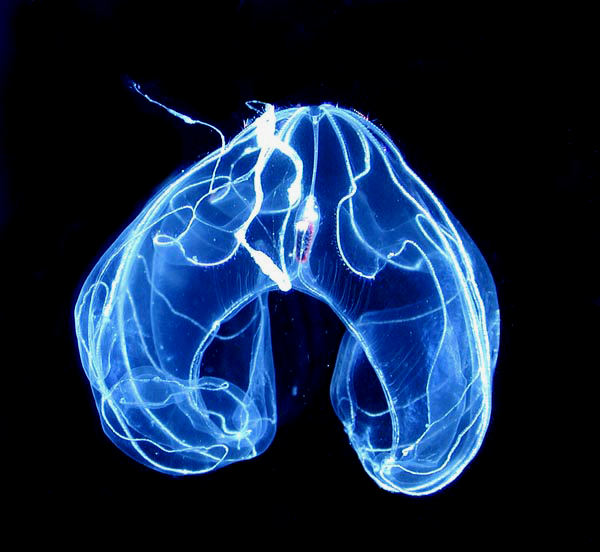

Comb jellies, also known as ctenophores (pronounced “teen-oh-fours”), are a fascinating group of marine invertebrates that have captivated scientists with their unique adaptations and evolutionary history. The phylum Ctenophora, which comprises around 150 known species found in oceans worldwide, includes these delicate, gelatinous creatures that have been the subject of much scientific research.
One of the most striking features of ctenophores is their bioluminescence. Many species, such as the sea walnut (Mnemiopsis leidyi), the sea gooseberry (Pleurobrachia bachei), and the deep-sea ctenophore Bathocyroe fosteri, are capable of producing a mesmerizing blue-green light. This bioluminescence is thought to serve various purposes, such as attracting prey, deterring predators, or even communicating with other comb jellies. The light is produced by specialized cells called photocytes, which contain light-emitting compounds and can be controlled by the animal’s nervous system.
Bathocyroe fosteri, a species discovered in the deep waters off the coast of Puerto Rico, is particularly notable for its unique bioluminescent displays. This ctenophore produces a series of flashing light patterns that are thought to be used for communication and mate attraction in the dark depths of the ocean.
Another unique adaptation of ctenophores is their “combs,” which are rows of cilia that run along their bodies. These cilia beat rhythmically, propelling the animal through the water and creating a shimmering, iridescent effect. The movement of these combs is coordinated by a complex nervous system, which allows the comb jelly to navigate its environment and capture prey with remarkable efficiency.
Ctenophores are also notable for their unique feeding mechanisms. Most species, like the lobed comb jelly (Bolinopsis infundibulum), are carnivorous, preying on small zooplankton and other marine organisms. They capture their prey using sticky cells called colloblasts, which are located on their tentacles or around their mouths. Once the prey is ensnared, the comb jelly can transfer it to its mouth, where it is digested in a specialized gastrovascular cavity.
From an evolutionary perspective, ctenophores have challenged traditional views of animal phylogeny. Recent genetic studies suggest that ctenophores may have diverged from other animals very early in evolutionary history, potentially even before the emergence of sponges, which were previously considered the most basal animal group. This has led to a reevaluation of our understanding of early animal evolution and the development of complex traits such as nervous systems and muscle cells.
As scientists continue to study ctenophores, they are uncovering more fascinating insights into these ancient and adaptable organisms. From the bioluminescent displays of Bathocyroe fosteri to the unique feeding strategies of the beroe comb jelly (Beroe ovata), ctenophores offer a window into the incredible diversity and resilience of life in the world’s oceans.



Leave a Reply