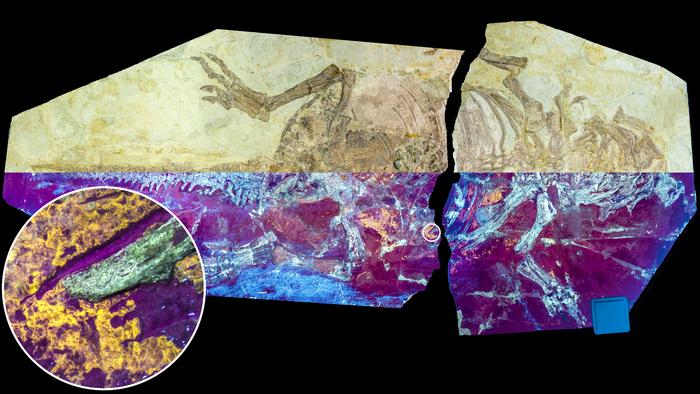
Palaeontologists at University College Cork (UCC) in Ireland have discovered that some feathered dinosaurs had scaly skin like reptiles today, thus shedding new light on the evolutionary transition from scales to feathers.
The researchers studied a new specimen of the feathered dinosaur Psittacosaurus from the early Cretaceous (135–120 million years ago), a time when dinosaurs were evolving into birds. The study shows, for the first time, that Psittacosaurus had reptile-like skin in areas where it didn’t have feathers.
The study, published today in Nature Communications, was led by UCC palaeontologists Dr Zixiao Yang and Prof. Maria McNamara of UCC’s School of Biological, Earth and Environmental Sciences, who teamed with scientists based in Nanjing University (China).

The team used ultraviolet (UV) light to identify patches of preserved skin, which are invisible in natural light. Further investigation of the fossil skin using X-rays and infrared light revealed spectacular details of preserved cellular structure.
Dr Yang says:
“The fossil truly is a hidden gem. The fossil skin is not visible to the naked eye, and it remained hidden when the specimen was donated to Nanjing University in 2021. Only under UV light is the skin visible, in a striking orange-yellow glow.
“What is really surprising is the chemistry of the fossil skin. It is composed of silica – the same as glass. This type of preservation has never been found in vertebrate fossils. There are potentially many more fossils with hidden soft tissues awaiting discovery.”
Sign up for the Daily Dose Newsletter and get every morning’s best science news from around the web delivered straight to your inbox? It’s easy like Sunday morning.
The most exciting aspect of the discovery, however, is what it tells us about the evolution of feathers in dinosaurs. Prof. McNamara, senior author on the study, says:
“The evolution of feathers from reptilian scales is one of the most profound yet poorly understood events in vertebrate evolution. While numerous fossils of feathers have been studied, fossil skin is much more rare.
“Our discovery suggests that soft, bird-like skin initially developed only in feathered regions of the body, while the rest of the skin was still scaly, like in modern reptiles. This zoned development would have maintained essential skin functions, such as protection against abrasion, dehydration and parasites. The first dinosaur to experiment with feathers could therefore survive and pass down the genes for feathers to their offspring.”
IMAGE CREDIT: Dr Zixiao Yang
If you enjoy the content we create and would like to support us, please consider becoming a patron on Patreon! By joining our community, you’ll gain access to exclusive perks such as early access to our latest content, behind-the-scenes updates, and the ability to submit questions and suggest topics for us to cover. Your support will enable us to continue creating high-quality content and reach a wider audience.
Join us on Patreon today and let’s work together to create more amazing content! https://www.patreon.com/ScientificInquirer



Leave a Reply