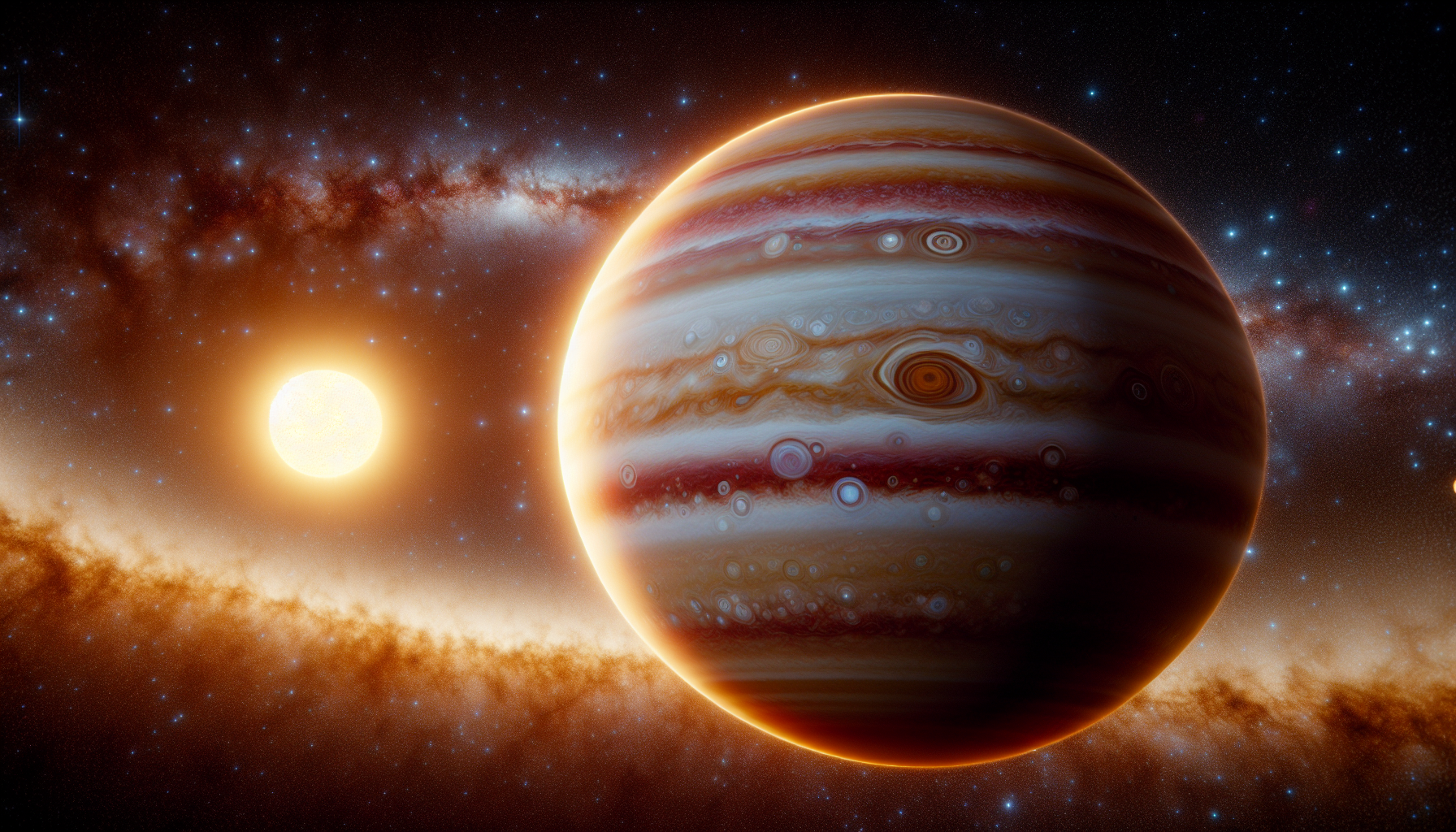
An international team led by researchers from the EXOTIC Laboratory of the University of Liège, in collaboration with MIT and the Astrophysics Institute in Andalusia, has just discovered WASP-193b, an extraordinarily low-density giant planet orbiting a distant Sun-like star.
This new planet, located 1,200 light-years from Earth, is 50% larger than Jupiter but seven times less massive, giving it an extremely low density comparable to that of cotton candy. “WASP-193b is the second least dense planet discovered to date, after Kepler-51d, which is much smaller,” explains Khalid Barkaoui, a Postdcotral Researcher at ULiège’s EXOTIC Laboratory and first author of the article published in Nature Astronomy. Its extremely low density makes it a real anomaly among the more than five thousand exoplanets discovered to date. This extremely-low-density cannot be reproduced by standard models of irradiated gas giants, even under the unrealistic assumption of a coreless structure.”

The new planet was initially spotted by the Wide Angle Search for Planets (WASP), an international collaboration of academic institutions that together operated two robotic observatories, one in the northern hemisphere and the other in the south. Each observatory used an array of wide-angle cameras to measure the brightness of thousands of individual stars across the entire sky. In data taken between 2006 and 2008, and again from 2011 to 2012, the WASP-South observatory detected periodic transits, or dips in light, from the star WASP-193. Astronomers determined that the star’s periodic dips in brightness were consistent with a planet passing in front of the star every 6.25 days. The scientists measured the amount of light the planet blocked with each transit, which gave them an estimate of the planet’s size.
The team used then the TRAPPIST-South and SPECULOOS-South observatories – directed by Michaël Gillon, FNRS Research Director and astrophysicist at ULiège – located in the Atacama Desert in Chile to measure the planetary signal in different wavelengths and to validate the planetary nature of the eclipsing object. Finally, they also used spectroscopic observations collected by the HARPS and CORALIE spectrographs – also located in Chile (ESO)- to measure the mass of the planet. To their great surprise, the accumulated measurements revealed an extremely low density for the planet. Its mass and its size, they calculated, were about 0.14 and 1.5 that of Jupiter, respectively. The resulting density came out to about 0.059 grams per cubic centimeter. Jupiter’s density, in contrast, is about 1.33 grams per cubic centimeter; and Earth is a more substantial 5.51 grams per cubic centimeter. One of the materials closest in density to the new, puffy planet, is cotton candy, which has a density of about 0.05 grams per cubic centimeter.
Sign up for the Daily Dose Newsletter and get every morning’s best science news from around the web delivered straight to your inbox? It’s easy like Sunday morning.
“The planet is so light that it’s difficult to think of an analogous, solid-state material,” says Julien de Wit, professor at Massachusetts Institute of Technology (MIT) and co-author. “The reason why it’s close to cotton candy is because both are pretty much air. The planet is basically super fluffy.”
The researchers suspect that the new planet is made mostly from hydrogen and helium, like most other gas giants in the galaxy. For WASP-193b, these gases likely form a hugely inflated atmosphere that extends tens of thousands of kilometers farther than Jupiter’s own atmosphere. Exactly how a planet can inflate so much is a question that no existing theory of planetary formation can yet answer. It certainly requires a significant deposit of energy deep into the planet’s interior, but the details of the mechanism are not yet understood. “We don’t know where to put this planet in all the formation theories we have right now, because it’s an outlier of all of them. We cannot explain how this planet was formed. Looking more closely at its atmosphere will allow us to constrain an evolutionary path of this planet, adds Francisco Pozuelos, astronomer at the Instituto de Astrofisica de Andalucia (IAA-CSIC, Granada, Spain).”
“WASP-193b is a cosmic mystery. Solving it will require some more observational and theoretical work, notably to measure its atmospheric properties with the JWST space telescope and to confront them to different theoretical mechanisms that possibly result in such an extreme inflation”, concludes Khalid Barkaoui.
If you enjoy the content we create and would like to support us, please consider becoming a patron on Patreon! By joining our community, you’ll gain access to exclusive perks such as early access to our latest content, behind-the-scenes updates, and the ability to submit questions and suggest topics for us to cover. Your support will enable us to continue creating high-quality content and reach a wider audience.
Join us on Patreon today and let’s work together to create more amazing content! https://www.patreon.com/ScientificInquirer




Leave a Reply