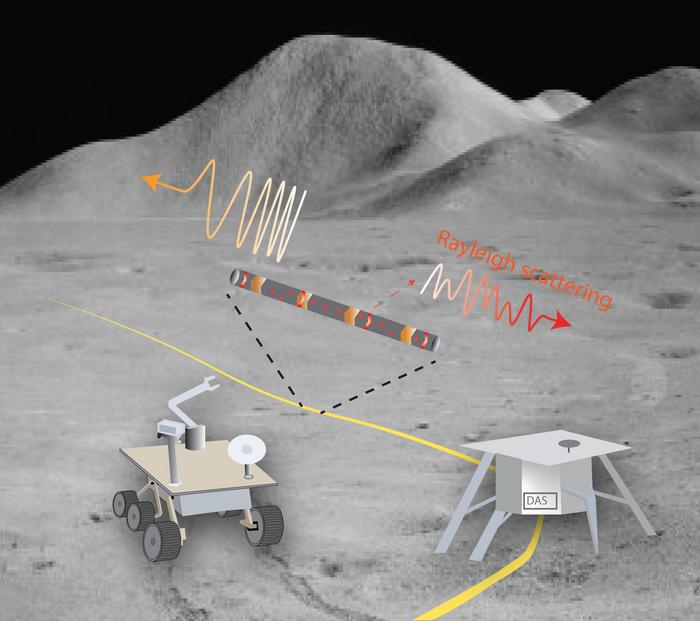
An increasing number of seismologists are using fiber optic cables to detect seismic waves on Earth—but how would this technology fare on the Moon, and what would it tell us about the deep layers of our nearest neighbor in space?
In Seismological Research Letters, Wenbo Wu of Woods Hole Oceanographic Institute and colleagues explore the idea of deploying a fiber seismic network on the Moon, discussing some of the challenges to overcome.

They also test this hypothetical network using artificial seismograms created from data collected by seismometers placed on the Moon’s surface by the Apollo missions. Based on their results, Wu and colleagues say a fiber seismic network could identify the kind of seismic waves that would provide more information about the Moon’s deep core structure.
The four seismometers placed on the Moon between 1969 and 1976 by the Apollo missions detected thousands of seismic events over seven years on the near side of the Moon. These events included shallow and deep moonquakes, as well as meteorite impacts.
Sign up for the Daily Dose Newsletter and get every morning’s best science news from around the web delivered straight to your inbox? It’s easy like Sunday morning.
The Apollo seismic data came with some unanswered questions, however: What explains the mysterious lack of moonquakes detected on the far side of the Moon? And why did the Apollo seismometers detect moonquakes occurring 700 to 1100 kilometers below the surface, at a depth on Earth where heat and pressure would lead to plastic deformation instead of the brittle break of an earthquake?
Answering these questions will require many more seismometers deployed in a harsh environment to collect additional seismic events, a task for which fiber seismic networks are well-suited, the researchers suggest.
Wu and colleagues propose using Distributed Acoustic Sensing, or DAS, for a new Moon network. DAS uses the tiny internal flaws in a long optical fiber as seismic sensors. An instrument called an interrogator at one end of the fiber sends laser pulses down the cable that are reflected off the fiber flaws and bounced back to the instrument. When the fiber is disturbed by seismic activity, researchers can examine changes in the reflected pulses to learn more about the resulting seismic waves.
“It’s a very dense seismic array,” said Wu. “One cable can get you thousands of individual sensors.”
One of the largest challenges for lunar seismology is the porous and fractured blanket of rubble called regolith that covers the surface of the Moon. Some of the first seismic waves detected after a moonquake are scattered by this layer, and the scatter obscures later-arriving waves that could provide more information about the depths of the Moon.
The data collected by the thousands of sensors in a DAS array can be compared in a signal processing technique called array stacking, Wu and colleagues demonstrate. This technique helps to separate “deep signals hidden in the scattered waves” and other sources of extraneous seismic noise, Wu explained.
When the team used the technique on the artificial seismograms, they were able to retrieve a seismic wave phase called ScS, which is a shear or S-wave that travels from the earthquake origin toward the Moon’s core before being reflected up to the surface.
Wu said it’s important to run these kinds of experiments before deploying an actual fiber array on the Moon. “Before a launch there must be robust numerical simulations of wave propagation,” he said. “We do the homework to find out if we can get the data, and what kinds of things we can do with the data.”
If researchers can find ways to provide power and repairs to a lunar fiber seismic network, the array could operate for years, Wu noted. “On Earth if the power is fine, we can keep it running for decades.”
In the SRL paper, the researchers suggest it would be possible to combine DAS with other proposed lunar programs such as placing a radio telescope, which would already need fiber optic cables to connect to an antenna, on the far side of the Moon.
“If we can combine these projects together to save the cost, that would really increase the chance to make it happen and have maximum scientific impact,” said Wu.
IMAGE CREDIT: Wu et al. (2024), Seismological Research Letters
If you enjoy the content we create and would like to support us, please consider becoming a patron on Patreon! By joining our community, you’ll gain access to exclusive perks such as early access to our latest content, behind-the-scenes updates, and the ability to submit questions and suggest topics for us to cover. Your support will enable us to continue creating high-quality content and reach a wider audience.
Join us on Patreon today and let’s work together to create more amazing content! https://www.patreon.com/ScientificInquirer




Leave a Reply