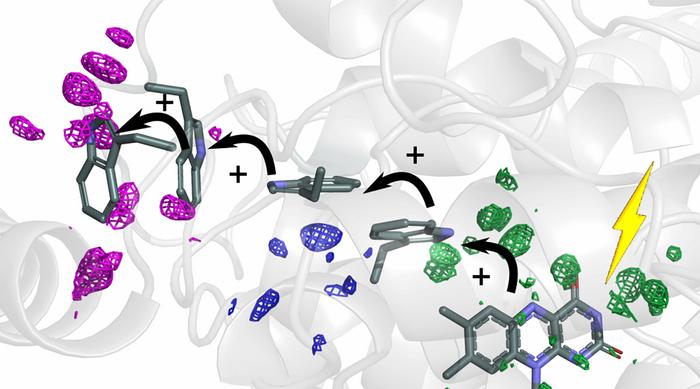
Cells need energy to function. Researchers at the University of Gothenburg can now explain how energy is guided in the cell by small atomic movements to reach its destination in the protein. Imitating these structural changes of the proteins could lead to more efficient solar cells in the future.
The sun’s rays are the basis for all the energy that creates life on Earth. Photosynthesis in plants is a prime example, where solar energy is needed for the plant to grow. Special proteins absorb the sun’s rays, and the energy is transported as electrons inside the protein, in a process called charge transfer. In a new study, researchers show how proteins deform to create efficient transport routes for the charges.

Guided electrons
“We studied a protein, photolyase, in the fruit fly, whose function is to repair damaged DNA. The DNA repair is powered by solar energy, which is transported in the form of electrons along a chain of four tryptophans (amino acids). The interesting discovery is that the surrounding protein structure was reshaped in a very specific way to guide the electrons along the chain,” explains Sebastian Westenhoff, Professor of Biophysical Chemistry.
The researchers noted how the changes in the structure followed precise timings in line with the transfer of the charge – important knowledge that could be used to design better solar panels, batteries or other applications that require energy transport.
Sign up for the Daily Dose Newsletter and get every morning’s best science news from around the web delivered straight to your inbox? It’s easy like Sunday morning.
Better able to imitate nature
“Evolution is nature’s material development and it is always the best. What we have done is basic research. The more we understand about what happens when proteins absorb sunlight, the better we can imitate this conversion of solar energy into electricity,” says Sebastian Westenhoff.
The study, published in Nature Chemistry, is a clear step forward in the research on charge transfer in proteins. Studying the process in the fruit fly, using the Serial Femtosecond Crystallography (SFX) technique, can give researchers an insight into the dynamic interaction of the protein as the electrons move.
“This is going to open up new chapters in our understanding of life’s mysteries at the molecular level,” concludes Sebastian Westenhoff.
IMAGE CREDIT: Sebastian Westenhoff
If you enjoy the content we create and would like to support us, please consider becoming a patron on Patreon! By joining our community, you’ll gain access to exclusive perks such as early access to our latest content, behind-the-scenes updates, and the ability to submit questions and suggest topics for us to cover. Your support will enable us to continue creating high-quality content and reach a wider audience.
Join us on Patreon today and let’s work together to create more amazing content! https://www.patreon.com/ScientificInquirer




Leave a Reply