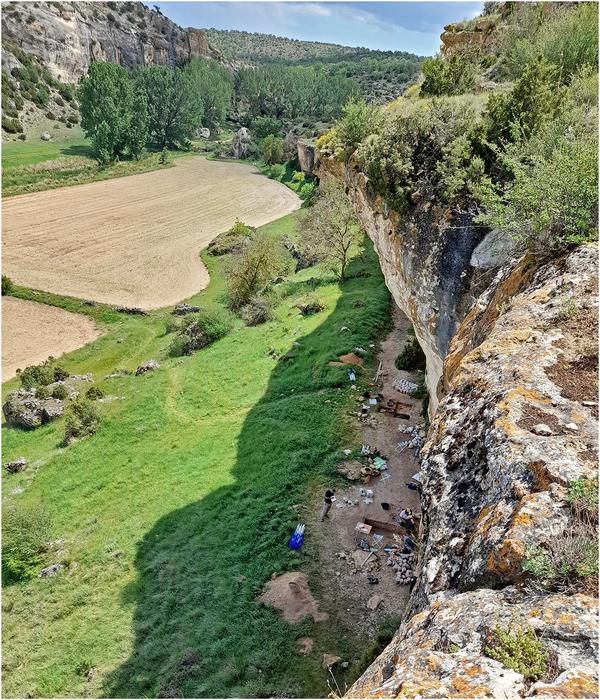
Paleolithic human populations survived even in the coldest and driest upland parts of Spain, according to a study published October 4, 2023 in the open-access journal PLOS ONE by Manuel Alcaraz-Castaño of the University of Alcalá, Spain, Javier Aragoncillo-del Rió of the Molina-Alto Tajo UNESCO Global Geopark, Spain and colleagues.
Research into ancient hunter-gatherer populations of the Iberian Peninsula has mainly focused on coastal regions, with relatively little investigation into the inland. A classic hypothesis has been that the cold and dry conditions of inland Iberia would have been too harsh for such populations to inhabit during the coldest periods of the Last Glacial, but recent findings have begun to challenge this view. In this study, researchers report new evidence for high-altitude human occupation from the Upper Paleolithic of Spain.
This evidence comes from a site called Charco Verde II, located in the Guadalajara province. This site is situated over 1,000 meters above sea level, in one of the coldest regions of Spain. Despite this, the abundance of tools and ornaments at the site reveals a recurring sequence of human occupation between around 21,000 and 15,000 years ago. This time span is especially notable since it includes two of the coldest periods of the Last Glacial.

This discovery further challenges the idea that Upper Palaeolithic humans avoided inland Iberia due to its harsh climate, and instead shows that the inland hosted complex and relatively dense settlements even during very cold and arid periods. These findings add to the growing evidence for Middle and Upper Paleolithic occupations throughout this region, altogether indicating that the historic lack of evidence for hunter-gatherer sites in inland Iberia is not an accurate reflection of prehistoric human distributions, but instead a result of modern research hitherto prioritizing study of coastal regions and neglecting the inland.
IMAGE CREDIT: Aragoncillo-del Río et al.
Sign up for the Daily Dose Newsletter and get the morning’s best science news from around the web delivered straight to your inbox? It’s easy like Sunday morning.

.jpg)

Leave a Reply