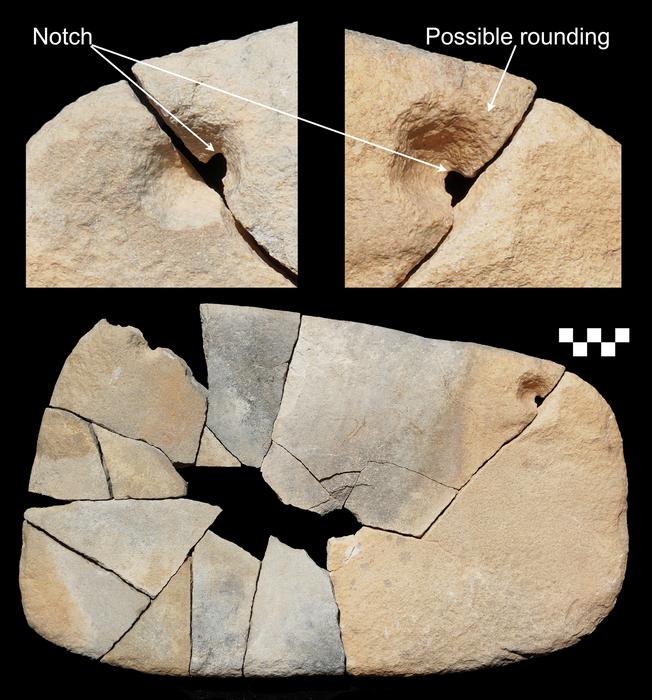
In recent years, studies have revealed that the now-arid region of northern Arabia was once much wetter and greener, providing Neolithic human populations with access to both water and game. The present aridity of the region, however, preserves little organic matter, making a reconstruction of the Neolithic lifestyle difficult.
Now, in a new study published in the journal PLOS ONE, researchers from the Max Planck Institute of Geoanthropology, the National Research Council of Italy, Institute of Heritage Science (CNR ISPC), and University College London present use-wear analysis of grinding tools recovered from Jebel Oraf in the Nefud desert of Saudi Arabia, revealing new insights into this little-understood chapter of the human story. Use-wear analysis shows that grinding tools were used for the processing of bone, pigment and plants, and were sometimes re-used for different purposes during their life span, before finally being broken up and placed on hearths.
In the new study, researchers use high-powered microscopes to compare use-wear patterns on the archaeological tools with those on experimental tools. In experiments, the grinding of grains, other plants, bone or pigment produces distinctive macro- and micro-traces on the tools’ used surface, including fractures, edge rounding of individual grains, levelled areas, striations, and different types of polish. These distinctive traces were also identified on the Neolithic grinding tools, allowing the scientists to determine which materials were being processed.

Although faunal remains have previously revealed that meat was cooked and consumed at Jebel Oraf, wear patterns indicate that meat and bones were first processed on grindstones, revealing the possibility that bones were broken to access bone marrow.
Grinding tools were also used to process plants. While there is no evidence for domesticated grains in northern Arabia in this period, the authors argue that wild plants were ground and perhaps baked into simple breads.
“The hearths where we found the grinding tools were extremely short-lived, and people may have been very mobile – breads would have made a good and easily transportable food for them,” says Maria Guagnin, researcher at the Max Planck Institute of Geoanthropology and one of the study’s lead authors.
The researchers also found evidence of pigment processing, which they argue may be linked to Neolithic paintings. Their findings reveal that pigment was ground and processed on a much larger scale than previously assumed, suggesting there may have been more painted Neolithic rock art than the few surviving panels suggest.
“It is clear grinding tools were important for the Neolithic occupants of Jebel Oraf. Many were heavily used, and some even had holes in them that suggest they were transported. That means people carried heavy grinding tools with them and their functionality must have been an important element in daily life,” says Giulio Lucarini of the National Research Council of Italy, the study’s other lead author.
This type of analysis has only rarely been applied to archaeological materials from the Arabian peninsula, but can provide important information on the manufacture, use, and re-use of grinding tools, which in turn provides insight into the subsistence, economy, and art of the people who produced them.
Researchers involved in this study work in close partnership with the Saudi Ministry of Culture. Additional partners include King Saud University and key institutions in the United Kingdom, Ireland and Australia.
IMAGE CREDIT: Ceri Shipton
Sign up for the Daily Dose Newsletter and get the morning’s best science news from around the web delivered straight to your inbox? It’s easy like Sunday morning.



Leave a Reply