HAVE YOUR SAY.
Join us in The Bullpen, where the members of the Scientific Inquirer community get to shape the site’s editorial decision making. We’ll be discussing people and companies to profile on the site. On Wednesday, March 8 at 5:30pm EST, join us on Discord and let’s build the best Scientific Inquirer possible.
Micro/nanorobots with self-propelling and -navigating capabilities have attracted extensive attention in drug delivery and therapy owing to their controllable locomotion in hard-to-reach body tissues.
However, developing self-adaptive micro/nanorobots that can adjust their driving mechanisms across multiple biological barriers to reach distant lesions is still a challenge.
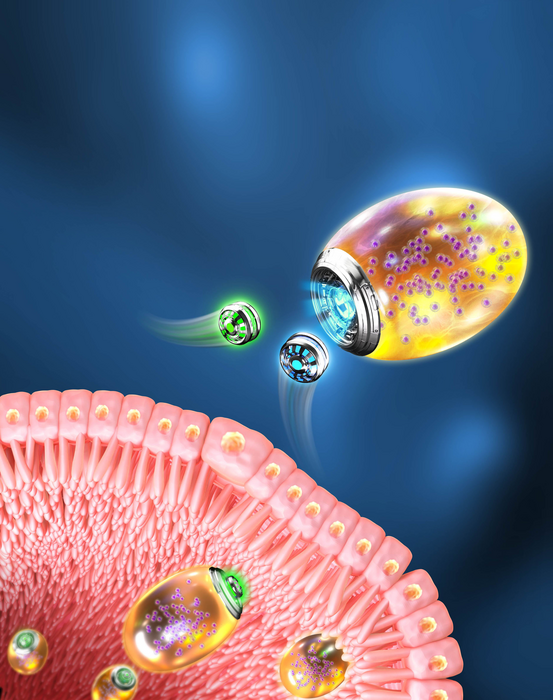
Recently, a research team led by Prof. CAI Lintao from the Shenzhen Institute of Advanced Technology (SIAT) of the Chinese Academy of Sciences has developed a twin-bioengine yeast micro/nanorobot (TBY-robot) with self-propelling and self-adaptive capabilities that can autonomously navigate to inflamed sites to provide gastrointestinal inflammation therapy via enzyme-macrophage switching (EMS).

This study was published in Science Advances on Feb. 22.
The researchers constructed the TBY-robot by asymmetrically immobilizing glucose oxidase and catalase onto the surface of anti-inflammatory nanoparticle-packaged yeast microcapsules. At a homogeneous glucose concentration, the Janus distribution of enzymes can catalyze the decomposition of glucose to generate a local glucose gradient that induces TBY-robot self-propelling motion.
In the presence of an enteral glucose gradient, the oral TBY-robots move toward the glucose gradient to penetrate the intestinal mucus barrier and then cross the intestinal epithelial barrier by microfold cell transcytosis. “We found that TBY-robots effectively penetrated the mucus barrier and notably enhanced their intestinal retention using a dual enzyme-driven engine moving toward the enteral glucose gradient,” said Prof. CAI.
After in situ switching to the macrophage bioengine in Peyer’s patches, the TBY-robots autonomously migrate to inflamed sites of the gastrointestinal tract through chemokine-guided macrophage relay delivery. “Encouragingly, TBY-robots increased drug accumulation at the diseased site by approximately 1000-fold, markedly attenuating inflammation and ameliorating disease pathology in mouse models of colitis and gastric ulcers,” said Prof. CAI.
This twin-bioengine delivery strategy is a sequence-driven process using EMS, with Peyer’s patches as transfer stations. This process can precisely transport therapeutics across multiple biological barriers to distant, deep-seated disease sites.
“The transport route is similar to that of the Express Mail Service, which precisely delivers parcels to a distant destination using different transportation facilities,” said Prof. CAI. These self-adaptive TBY-robots represent a safe and promising strategy for the precision treatment of gastrointestinal inflammation and other inflammatory diseases.
IMAGE CREDIT: SIAT

Leave a Reply