HAVE YOUR SAY.
Join us in The Bullpen, where the members of the Scientific Inquirer community get to shape the site’s editorial decision making. We’ll be discussing people and companies to profile on the site. On Wednesday, March 8 at 5:30pm EST, join us on Discord and let’s build the best Scientific Inquirer possible.
Green leaves and photosynthesis were once considered key features of plants. However, some plants have since abandoned this process, obtaining their nutrients from other organisms. One such plant is the genus of Thismia, commonly known as fairy lanterns, which is characterised by its unusual appearance, elusiveness, and lack of photosynthesis. Fairy lanterns are rare and only grow in specific places. They live underground with their colourful flowers rising above the soil, which can sometimes make them look like mushrooms. Around 90 species of Thismia have been found, but many are only known from their original discovery location, and some have likely become extinct.
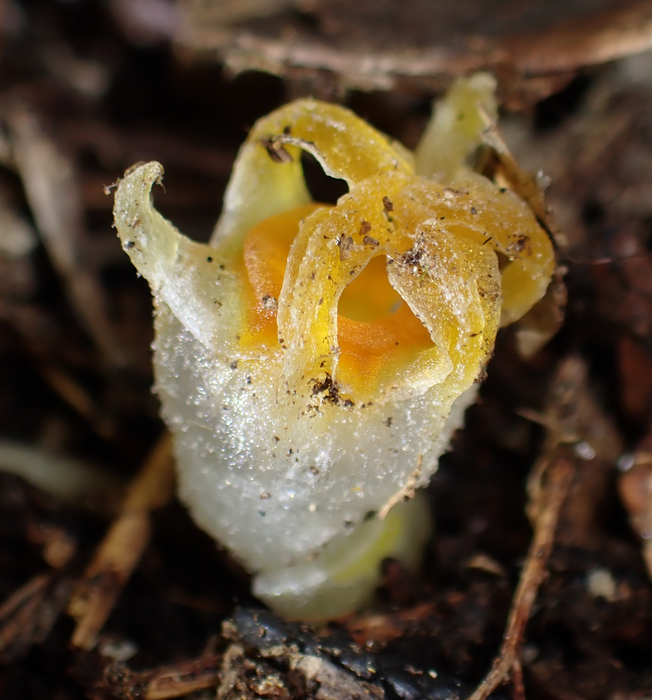
One such species, Thismia kobensis was originally discovered in Kobe City, Japan in 1992. Unfortunately, its habitat was destroyed by an industrial complex and it was subsequently presumed extinct. After more than 30 years, Professor Kenji Suetsugu and his colleagues report its rediscovery in Sanda City, located approximately 30 km away (Fig. 1). This unexpected find and subsequent investigations have shed new light on this remarkable genus and its evolutionary history.
The researchers provided an updated description of Thismia kobensis to flesh out the original description that was based on an incomplete museum specimen. Their close examination highlighted how Thismia kobensis differs from the similar species Thismia huangii. The rediscovered species can be distinguished by its short and wide ring as well as the many short hairs on its stigma (Fig. 2). Based on their analysis of various characteristics, the researchers determined that Thismia kobensis is a distinct species, with unique characteristics and evolutionary history.

The newly discovered location of Thismia kobensis makes it the northernmost known Asian fairy lantern species. This discovery may offer new insights into the systematic affinity and biogeography of the mysterious fairy lantern, Thismia americana, which was originally thought to be related to some species in Australia and New Zealand. Thismia americana discovered over 100 years ago is the only North American fairy lantern species and was observed for a few years on a prairie near Chicago, but is now considered extinct. The presence of the mainly tropical genus Thismia in temperate North America remains a mystery, especially since the species considered to be its closest relative, Thismia rodwayi, is found in Australia and New Zealand. This strange distribution pattern continues to puzzle botanists.
However, a detailed morphological investigation suggested that Thismia kobensis is indeed the closest relative of Thismia americana (Fig. 3). Thus, the similarity in outer floral morphology between Thismia americana and the Australia-New Zealand species may have evolved independently based on pollinator preferences. This suggests that Thismia americana may actually be unrelated to the Australia-New Zealand species. In contrast, the striking similarity in inner floral morphology, such as the lack of nectar glands in both species, suggests a closer relationship between Thismia americana and Thismia kobensis (Fig. 3B & D). Plant species in Eastern Asia and North America having close relationships and disjunct distributions across these regions is not uncommon and can often be attributed to migration through the Beringia land bridge. Therefore, the disjunct distribution of Thismia americana may be due to migration through Beringia (Fig. 4).
Overall, the rediscovery of the Thismia kobensis after three decades has significantly advanced our understanding of fairy lanterns. As the northernmost species of Asian fairy lantern found so far, it also provides crucial insight into the biogeography and evolutionary history of fairy lanterns as a whole. The paper also includes information on conservation measures to help protect these rare plants from human activities. It was published in Phytotaxa on February 28, 2023.
IMAGE CREDIT: Kenji Suetsugu

Leave a Reply