HAVE YOUR SAY.
Join us in The Bullpen, where the members of the Scientific Inquirer community get to shape the site’s editorial decision making. We’ll be discussing people and companies to profile on the site. On Wednesday, March 8 at 5:30pm EST, join us on Discord and let’s build the best Scientific Inquirer possible.
Since the 1970s, scientists have known that copper has a special ability to transform carbon dioxide into valuable chemicals and fuels. But for many years, scientists have struggled to understand how this common metal works as an electrocatalyst, a mechanism that uses energy from electrons to chemically transform molecules into different products.
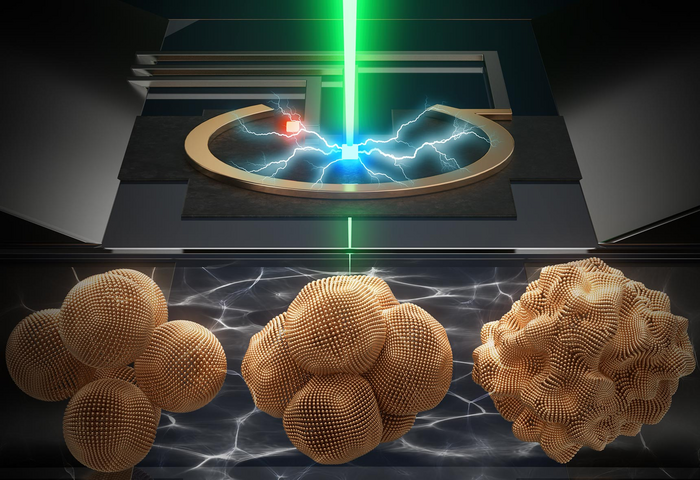
Now, a research team led by Lawrence Berkeley National Laboratory (Berkeley Lab) has gained new insight by capturing real-time movies of copper nanoparticles (copper particles engineered at the scale of a billionth of a meter) as they convert CO2 and water into renewable fuels and chemicals: ethylene, ethanol, and propanol, among others. The work was reported in the journal Nature last week.
“This is very exciting. After decades of work, we’re finally able to show – with undeniable proof – how copper electrocatalysts excel in CO2 reduction,” said Peidong Yang, a senior faculty scientist in Berkeley Lab’s Materials Sciences and Chemical Sciences Divisions who led the study. Yang is also a professor of chemistry and materials science and engineering at UC Berkeley. “Knowing how copper is such an excellent electrocatalyst brings us steps closer to turning CO2 into new, renewable solar fuels through artificial photosynthesis.”

The work was made possible by combining a new imaging technique called operando 4D electrochemical liquid-cell STEM (scanning transmission electron microscopy) with a soft X-ray probe to investigate the same sample environment: copper nanoparticles in liquid. First author Yao Yang, a UC Berkeley Miller postdoctoral fellow, conceived the groundbreaking approach under the guidance of Peidong Yang while working toward his Ph.D. in chemistry at Cornell University.
Scientists who study artificial photosynthesis materials and reactions have wanted to combine the power of an electron probe with X-rays, but the two techniques typically can’t be performed by the same instrument.
Electron microscopes (such as STEM or TEM) use beams of electrons and excel at characterizing the atomic structure in parts of a material. In recent years, 4D STEM (or “2D raster of 2D diffraction patterns using scanning transmission electron microscopy”) instruments, such as those at Berkeley Lab’s Molecular Foundry, have pushed the boundaries of electron microscopy even further, enabling scientists to map out atomic or molecular regions in a variety of materials, from hard metallic glass to soft, flexible films.
On the other hand, soft (or lower-energy) X-rays are useful for identifying and tracking chemical reactions in real time in an operando, or real-world, environment.
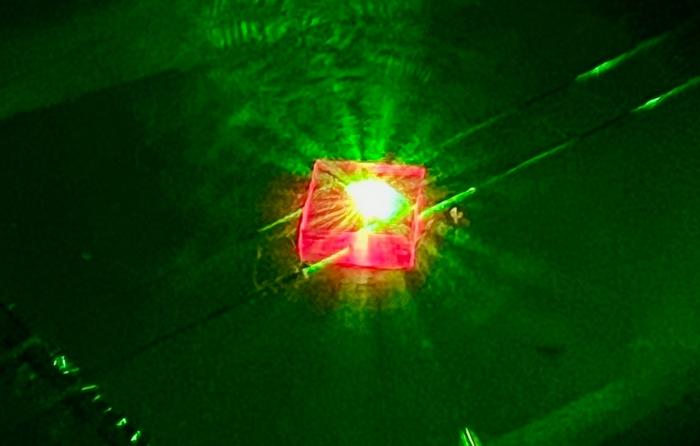
But now, scientists can have the best of both worlds. At the heart of the new technique is an electrochemical “liquid cell” sample holder with remarkable versatility. A thousand times thinner than a human hair, the device is compatible with both STEM and X-ray instruments.
The electrochemical liquid cell’s ultrathin design allows reliable imaging of delicate samples while protecting them from electron beam damage. A special electrode custom-designed by co-author Cheng Wang, a staff scientist at Berkeley Lab’s Advanced Light Source, enabled the team to conduct X-ray experiments with the electrochemical liquid cell. Combining the two allows researchers to comprehensively characterize electrochemical reactions in real time and at the nanoscale.
Getting granular
During 4D-STEM experiments, Yao Yang and team used the new electrochemical liquid cell to observe copper nanoparticles (ranging in size from 7 nanometers to 18 nanometers) evolve into active nanograins during CO2 electrolysis – a process that uses electricity to drive a reaction on the surface of an electrocatalyst.
The experiments revealed a surprise: copper nanoparticles combined into larger metallic copper “nanograins” within seconds of the electrochemical reaction.
To learn more, the team turned to Wang, who pioneered a technique known as “resonant soft X-ray scattering (RSoXS) for soft materials,” at the Advanced Light Source more than 10 years ago.
With help from Wang, the research team used the same electrochemical liquid cell, but this time during RSoXS experiments, to determine whether copper nanograins facilitate CO2 reduction. Soft X-rays are ideal for studying how copper electrocatalysts evolve during CO2 reduction, Wang explained. By using RSoXS, researchers can monitor multiple reactions between thousands of nanoparticles in real time, and accurately identify chemical reactants and products.
The RSoXS experiments at the Advanced Light Source – along with additional evidence gathered at Cornell High Energy Synchrotron Source (CHESS) – proved that metallic copper nanograins serve as active sites for CO2 reduction. (Metallic copper, also known as copper(0), is a form of the element copper.)
During CO2 electrolysis, the copper nanoparticles change their structure during a process called “electrochemical scrambling.” The copper nanoparticles’ surface layer of oxide degrades, creating open sites on the copper surface for CO2 molecules to attach, explained Peidong Yang. And as CO2 “docks” or binds to the copper nanograin surface, electrons are then transferred to CO2, causing a reaction that simultaneously produces ethylene, ethanol, and propanol along with other multicarbon products.
“The copper nanograins essentially turn into little chemical manufacturing factories,” Yao Yang said.
Further experiments at the Molecular Foundry, the Advanced Light Source, and CHESS revealed that size matters. All of the 7-nanometer copper nanoparticles participated in CO2 reduction, whereas the larger nanoparticles did not. In addition, the team learned that only metallic copper can efficiently reduce CO2 into multicarbon products. The findings have implications for “rationally designing efficient CO2 electrocatalysts,” Peidong Yang said.
The new study also validated Peidong Yang’s findings from 2017: That the 7-nanometer-sized copper nanoparticles require low inputs of energy to start CO2 reduction. As an electrocatalyst, the 7-nanometer copper nanoparticles required a record-low driving force that is about 300 millivolts less than typical bulk copper electrocatalysts. The best-performing catalysts that produce multicarbon products from CO2 typically operate at high driving force of 1 volt.
The copper nanograins could potentially boost the energy efficiency and productivity of some catalysts designed for artificial photosynthesis, a field of research that aims to produce solar fuels from sunlight, water, and CO2. Currently, researchers within the Department of Energy-funded Liquid Sunlight Alliance (LiSA) plan to use the copper nanograin catalysts in the design of future solar fuel devices.
“The technique’s ability to record real-time movies of a chemical process opens up exciting opportunities to study many other electrochemical energy conversion processes. It’s a huge breakthrough, and it would not have been possible without Yao and his pioneering work,” Peidong Yang said.
IMAGE CREDIT: Yao Yang/Berkeley Lab


Leave a Reply