HAVE YOUR SAY.
Join us in The Bullpen, where the members of the Scientific Inquirer community get to shape the site’s editorial decision making. We’ll be discussing people and companies to profile on the site. On Wednesday, February 8 at 5:30pm EST, join us on Discord and let’s build the best Scientific Inquirer possible.
New UC Riverside research suggests nitrogen released by gas-powered machines causes dry soil to let go of carbon and release it back into the atmosphere, where it can contribute to climate change.
Industrial manufacturing, agricultural practices, and significantly, vehicles, all burn fossil fuels that release nitrogen into the air. As a result, levels of nitrogen in Earth’s atmosphere have tripled since 1850. The research team wanted to understand whether this extra nitrogen is affecting soil’s ability to hold onto carbon and keep it from becoming a greenhouse gas.
“Because nitrogen is used as a fertilizer for plants, we expected additional nitrogen would promote plant growth as well as microbial activity, thereby increasing carbon put into soils,” said Peter Homyak, study co-author and assistant professor in UCR’s Department of Environmental Sciences.

In dryland soil, the type that covers much of Southern California, this is not what they saw.
Instead, the team found that under certain conditions, extra nitrogen causes dryland soil to acidify and leach calcium. Calcium binds to carbon, and the two elements then leave the soil together. This finding is detailed in the journal Global Change Biology.
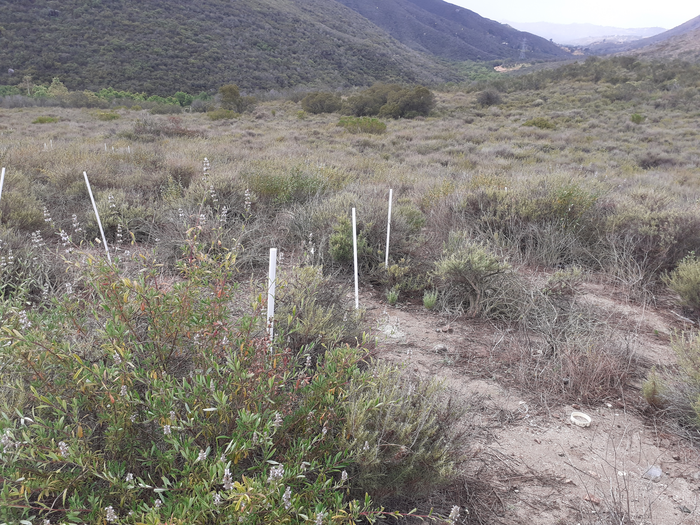
To obtain their results, the research team sampled soil from ecological reserves near San Diego and Irvine that have been fertilized with nitrogen in long-term experiments. This allowed them to know precisely how much nitrogen was being added, and account for any effects they observed.
In many cases, nitrogen can affect biological processes that in turn influence how soil stores carbon. Such processes include the fueling of plant growth, as well as slowing down the microbes that help decompose dead things in the soil.
What the researchers did not expect was a big effect on carbon storage through abiotic, or non-biological means.
The pH scale measures how acidic or alkaline — basic — something is. In general, soils resist dramatic changes in pH by releasing elements like calcium in exchange for acidity. As nitrogen acidified soils at some of the sites in this study, the soil attempted to resist this acidity by releasing calcium. As it did so, some of the carbon stabilized by association with the calcium was lost.
“It is a surprising result because the main effect seems to be abiotic,” said Johann Püspök, UCR environmental sciences graduate student and first author of the study. “That means bare patches of soil with no plant cover and low microbial activity, which I always thought of as areas where not much is going on, appear to be affected by nitrogen pollution too.”
Dryland soil, characterized by limited ability to retain moisture and low levels of organic matter, covers roughly 45% of Earth’s land area. It is responsible for storing a large amount of the world’s carbon.
Future studies may shed more light on how much dryland soil is being affected by nitrogen pollution in the way the study plots were. “We need more information as to how widespread such acidification effects are, and how they work under non-experimental conditions of nitrogen deposition,” Püspök said.
However, since there is no quick fix for this phenomenon, and no clear way to reverse the process once it has begun, researchers recommend reducing emissions as much as possible to help soil retain its carbon stores.
“Air pollution generated by fossil fuel combustion has an impact on many things, including human health by causing asthma,” Homyak said. “It can also impact the amount of carbon these dryland systems can store for us. For many reasons, we have to get a handle on air pollution.”
IMAGE CREDIT: Johann Püspök/UCR




Leave a Reply