HAVE YOUR SAY.
Join us in The Bullpen, where the members of the Scientific Inquirer community get to shape the site’s editorial decision making. We’ll be discussing people and companies to profile on the site. On Wednesday, January 11 at 5:30pm EST, join us on Discord and let’s build the best Scientific Inquirer possible.
The Chang’e-5 mission touched down in the Mons Rümker region of the northern Oceanus Procellarum of the Moon and returned 1.731 kg of lunar regolith.
Recognizing exotic clasts (i.e., non-Chang’e-5 locally derived materials) in the Chang’e-5 regolith could provide critical information about the lithological diversity and regolith gardening process in the young mare region of the Moon.
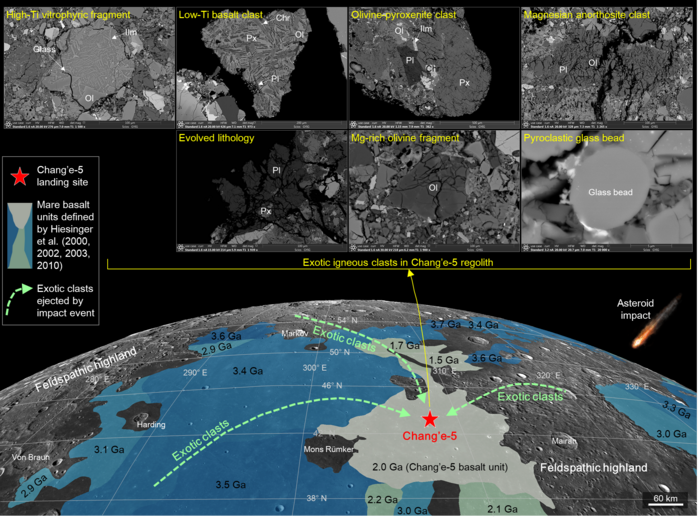
Recently, Dr. ZENG Xiaojia, Prof. LI Xiongyao and Prof. LIU Jianzhong from the Institute of Geochemistry of the Chinese Academy of Sciences (IGCAS) have identified seven exotic igneous clasts in Chang’e-5 samples from more than 3,000 Chang’e-5 regolith particles.

This work was published in Nature Astronomy on Dec. 22.
Specifically, the seven exotic clasts identified are: a high-Ti vitrophyric fragment, a low-Ti basalt, an olivine-pyroxenite, a magnesian anorthosite, an evolved lithology, a Mg-rich olivine fragment, and a pyroclastic glass bead. The researchers associated these exotic igneous clasts with impact-ejected materials from other regions of the Moon, over 50–400 km away from the Chang’e-5 mare unit.
By comparison with lunar rocks from the U.S. Apollo mission, the researchers found that three exotic igneous clasts in the Chang’e-5 regolith exhibited unusual petrological and compositional features.
The high-Ti vitrophyric fragment showed unique mineralogy among lunar basalts, probably representing a new type of lunar basalt.
The magnesian anorthosite clast, which was not observed in Apollo samples, provides evidence that magnesian anorthosite is also an important component of the near-side lunar crust.
The pyroclastic glass records a compositionally unique volcanic eruption on the Moon.
This study was the first to obtain exotic igneous lithologies from the 2 Gyr-aged basalt unit of the Moon. This information will provide ground truth for modeling the provenance of regolith at the young mare unit of the Moon. Moreover, the identification of unusual lunar rocks in the Chang’e-5 sample provides evidence that the lithological components and magmatic activities of the lunar crust are more diverse than previously thought.
This research suggests there are still unknown geological units on the moon, which may help in planning future lunar exploration missions.
IMAGE CREDIT: IGCAS




Leave a Reply