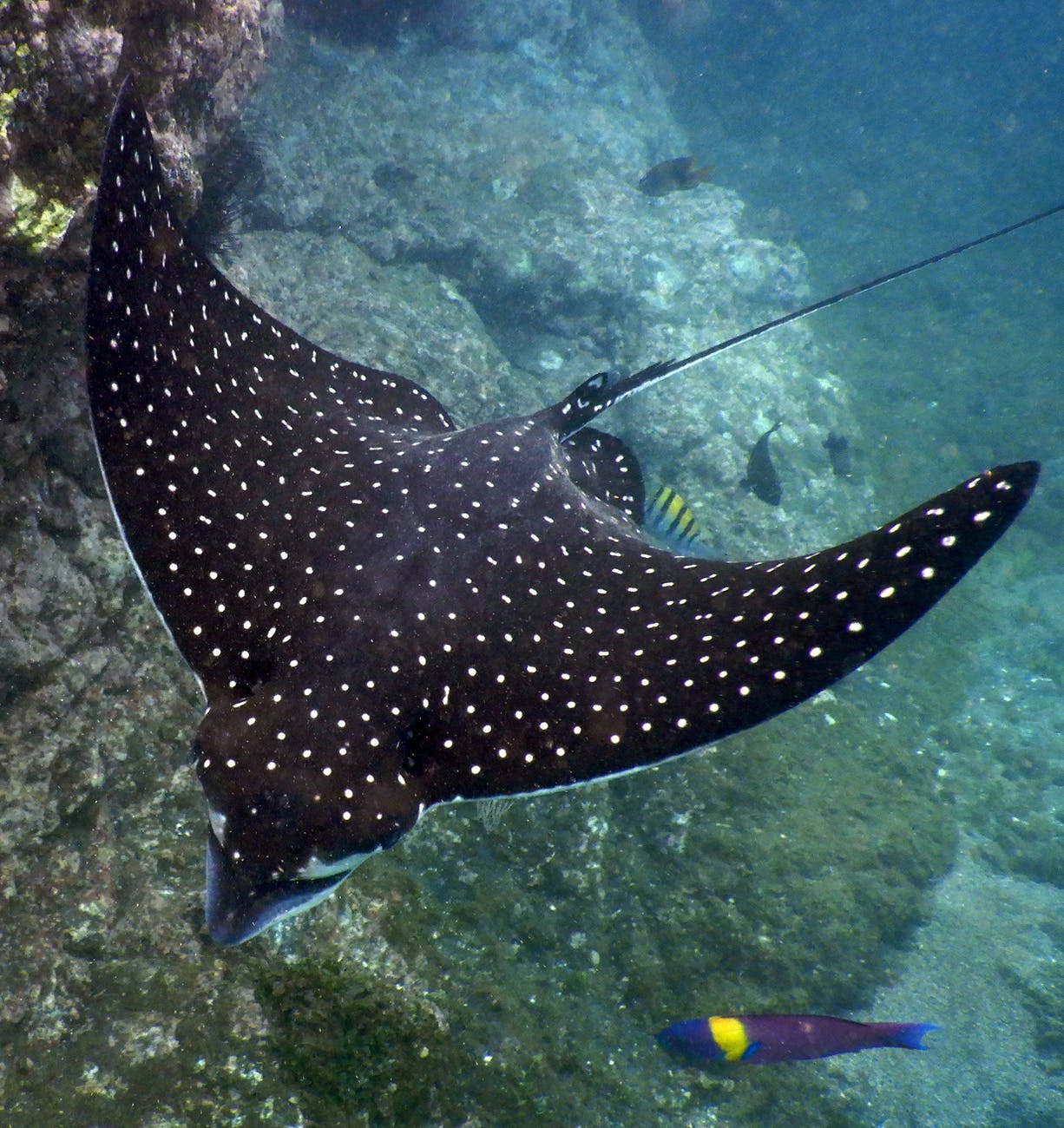
Zebra mbuna (a species of cichlid fish) and stingrays can add and subtract one from the numbers one to five, according to a study published in Scientific Reports. The findings highlight that the numerical abilities of fish are on par with those of other vertebrate and invertebrate species, according to the authors.

Vera Schluessel and colleagues tested whether eight zebra mbuna (Pseudotropheus zebra) and eight freshwater stingrays (Potamotrygon motoro) could be trained to recognise the colour blue as a symbol for addition by a factor of one and the colour yellow as a symbol for subtraction by a factor of one. Fish were shown cards with either blue or yellow shapes, and then presented with two gates containing cards with different numbers of shapes – one of which was the correct answer. For example, if a fish was shown a card with three blue shapes, they would add one to three and swim through a gate containing the card with four shapes. If fish swam through the correct gate they were rewarded.
The researchers found that six of the zebra mbuna and three of the stingrays learned to consistently associate blue with addition and yellow with subtraction. On average, zebra mbuna learnt this after 28 sessions and stingrays after 68 sessions. Fish generally performed well in the tasks, although addition was learned more easily than subtraction and the performance of individual fish varied more between zebra mbuna than between stingrays.
During the addition tasks, zebra mbuna selected the correct answer in 296 out of 381 (78%) tests and stingrays selected the correct answer in 169 out of 180 (94%) tests. During the subtraction tasks, zebra mbuna were correct during 264 out of 381 (69%) of tests and stingrays were correct in 161 out of 180 (89%) of tests.
Although the authors speculate that numerical abilities may not be highly important to either species, they suggest that numerical abilities could help both species to recognise individual fish by their appearance, for example by counting stripes or spots on fish bodies. The findings add to a growing body of evidence indicating that the cognitive abilities and sentience of fish need to be revisited, the researchers add.




Leave a Reply