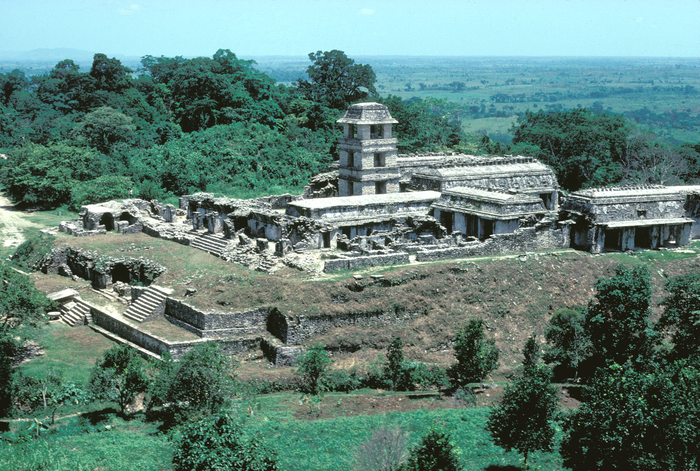
For more than a century written language was seen by anthropologists and other social scientists as a definitional feature of societal complexity or “advancement” (a term that is tinged with colonialism and racism). But in a new study in the Journal of Social Computing, researchers have found that societies don’t need written languages to be large or have complex governments. In a systematic, comparative survey of precolonial Mesoamerican societies, the study’s authors found that some large population centers had written systems of communication, but others did not. At the same time, the centers that had more elaborate computational and writing systems tended to be more autocratic (top-down ruler-dominated governance) than the ones without.

“The development of writing was thought to be a characteristic of civilizations or large-scale societies,” says Gary Feinman, the MacArthur curator of anthropology at Chicago’s Field Museum and the study’s first author. “Our findings both question and refine that long-entrenched assumption by illustrating that the relationship between the scale of social networks and computation systems also must take into account how people were organized and the resultant networks of communication. This relationship is not simply a matter of efficiency; history and how people were organized and communicated are key.”
The upshot, Feinman says, is that “in pre-Hispanic Mesoamerica, the overall elaboration of computational systems like writing, mathematics, and calendars are not directly correlated with the scale of societies. They do not necessarily become more elaborate or efficient over time.”
“Many of the dominant paradigms in the study of the human past have a Western or Eurasian bias that does not hold up to close scrutiny with data from other parts of the world. Being primarily Americanists, we know that certain favored models don’t work for the Western Hemisphere,” says co-author David Carballo of Boston University. Some of the largest Indigenous empires in the Americas had no written language, and “these cases, which seem anomalous in a Eurasian context, prompted us to prompted us to probe why people wrote and what sorts of things they wrote about, rather than assuming a close correlation with other forms of social complexity.”
For the study, Feinman and Carballo compared large population centers in what’s now Mexico and Central America from 1250 BCE to 1520 CE, looking at factors like population size, the size of the area governed, and political organization. Even in societies without written records, researchers are able to determine political structure by examining the archaeological remains of buildings and features like palaces. By comparing the remains of residences, public buildings, settlement layout, burial contexts, and monuments, researchers are able to glean information about how a society was governed and how power and wealth were distributed.
Feinman and Carballo then cross-referenced these data points with the computational systems (writing, mathematics, and calendars) used by the populations of these settlements. The relationships they found between writing and societal complexity were, in a word, complex. There wasn’t a clear linear relationship between the size of a society and whether it had writing. But they did find a link between writing and political organization. Writing tended to appear more often in societies with autocratic rulers (think all-powerful leaders) than in societies where power was more evenly shared.
That might seem backwards– knowledge is power, right? Surely, you might think, societies with writing would be better able to communicate across vast distances and give more people the opportunity for knowledge. However, that’s not what Feinman and Carballo found.
“If we take the cases of the most elaborate writing systems, like the Classic Maya, a lot of their writing was to convey messages between high status people,” says Feinman. “Because it’s a complex writing system, the number of people who could absorb it was restricted by wealth or class, and you were conveying to those people information that both legitimized your leadership role and may have expressed your relationship to other elites.” In this case, writing wasn’t a great equalizer, it was the opposite.
They also found that writing systems weren’t necessarily correlated with societies that needed to communicate with people far away. “I don’t think writing was primarily to convey messages to people over long distances. Most written texts were not portable at that time. If you wanted to convey information to a large number of people, they would come to a place and you’d have some sort of activity in that place, which would rely on mostly verbal speechifying,” says Feinman.
In previous work, Feinman (with colleagues) has shown that societies with big power imbalances tend to be the ones that are somewhat less sustainable, and that seems to align with the findings in this study. “In Mesoamerica I think it’s pretty clear that the more collectively organized polities with less quote-unquote ‘complex’ writing systems actually tend to be more endurable, more sustainable,” he says.
Another key finding of the study is that even when societies developed an elaborate writing system (like the Classic Maya), they didn’t always stick with it. “Technological adoption and spread are social processes,” says Feinman. “Technologies that seem to be more elaborate or ‘efficient’ are not always embraced or retained.”
“The study is important in a broader context of understanding the human past in showing that the evolution and spread of technologies, including in communication and computation, don’t always happen in a linear way,” says Carballo. “They are developed and adopted or rejected by people within specific social and historical contexts.”
The researchers aim to reframe the way that archaeologists look for and define social complexity. “I think it’s important not just to look at the presence-absence or elaborateness of communication systems, but it’s important to look at who communicated with who and the kinds of messages sent,” says Feinman. “The study illustrates the importance of how we’re organized. Humans are a really unique combination of being really good cooperators but also selfish. Our work helps show the complexity of that balance, which underpins the ebbs and flows of human history.”
IMAGE CREDIT: Linda M. Nicholas, Field Museum




Leave a Reply