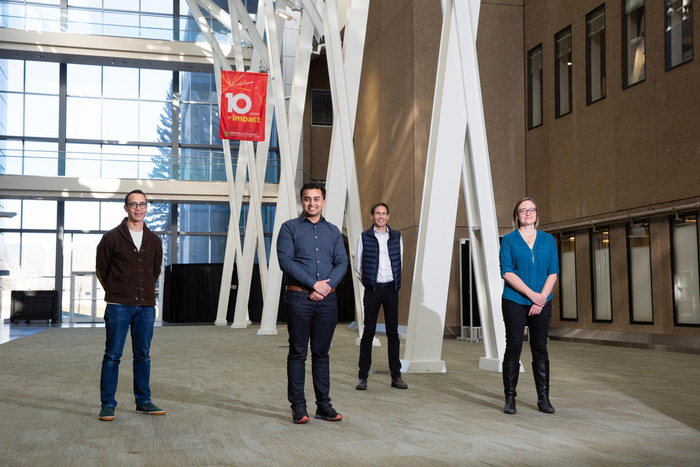
A new study from the University of Calgary shows how dexamethasone, the main treatment for severe COVID-19 lung infections, alters how immune cells work, which may help male patients, but has little to no benefit for females.

These remarkable findings are the result of a multidisciplinary study published in Nature Medicine, led by Dr. Jeff Biernaskie, PhD, professor, Comparative Biology and Experimental Medicine in the Faculty of Veterinary Medicine (UCVM) and Dr. Bryan Yipp, MD, associate professor, Department of Critical Care Medicine, Cumming School of Medicine.
“We found that the males derived benefit from the steroids, and the females, at both the cellular level and at the population level, received limited benefit,” says Yipp, Tier II Canada Research Chair in Pulmonary Immunology, Inflammation and Host Defense. “Currently, it’s possible the mainstay therapy for severe COVID-19 that we’re giving everybody is only benefiting half the population. This is a big problem.”
How do our bodies battle COVID-19 infection?
At the onset of the pandemic, hospitals’ treatments of the severely ill were not yet informed by research into how effective the drugs were under COVID-19 conditions. Steroids were the first identified drugs with proven benefit, but they were only moderately successful at reducing deaths, and exactly what they did was not understood.
In addition, when the study began, no one knew exactly how immune cells would react to COVID-19 infection at a cellular level. Why did some people get really sick while others did not? Why did certain drugs help some but not others?
“To be able to develop new treatments, we wanted to study how different people respond to SARS-CoV2 infection and how different immune responses dictate the severity of their disease,” says Biernaskie, the Calgary Firefighters Burn Treatment Society Chair in Skin Regeneration and Wound Healing.
Yipp and Biernaskie sought to better understand how steroids helped and, at the same time, evaluate why a clinical trial of steroids in COVID-19 showed they only helped some males, but not females.
When Yipp accessed the provincial eCRITICAL database of all ICU admissions during the pandemic, he discovered that the introduction of dexamethasone therapy in Alberta reduced the number of males dying but had no affect on the female population. “That was an unsettling observation.”
Analyzing thousands of immune cells from ICU patients
Blood was collected from both COVID-19 and non-COVID-19 patients who were admitted to Calgary ICUs in severe respiratory distress. Researchers in the Biernaskie lab used cutting-edge single cell RNA sequencing and bioinformatics techniques to simultaneously analyze the functional states of thousands of immune cells from each patient. This allowed them to document cellular behaviours at different stages of the disease (COVID-19 or non-COVID infections) and to measure treatment effects.
“We sampled as many patients as we could, not just at one time point but at a follow-up time point so we could get an idea of the evolution of the disease and the evolution of the immune response,” says Biernaskie.
In most viral infections, proteins called interferons work to clear the virus quickly. But with COVID-19, rather than working fast, “the interferon response trickles along, which actually fuels the fire of inflammation, and then you get worse organ damage,” says Yipp.
“What we found was that specifically in males, we see an exaggerated neutrophil interferon response, that is significantly restrained when a patient is given dexamethasone,’’ says Biernaskie. “But with females, relative to males, their neutrophil interferon response was much more tempered, so dexamethasone had little effect.”
Find therapies that benefit more people
After identifying the reasons why there’s a sex bias in the way dexamethasone works, Yipp believes that the way forward is for researchers to figure out how to make therapies that benefit more people, or individualized therapies, also known as precision or personalized medicine, so that a blanket approach isn’t being used.
Biernaskie and Yipp credit significant contributions from the trainees and junior scientists involved in the research, including Dr. Nicole Rosin and Sarthak Sinha who spent countless hours managing the project and analyzing the results.
The project was supported by a grant Biernaskie and Yipp received from the Thistledown Foundation and by the Calgary Firefighters Burn Treatment Society, “who enthusiastically supported my request to divert some of the CFBTS Chair funds to support this initiative early on in the pandemic,” Biernaski says.
Study participants:
- Leads: Jeff Biernaskie, Bryan Yipp and Nicole Rosin
- Biernaskie Lab: Sarthak Sinha, Rohit Arora, Elodie Labit, Arzina Jaffer, Leslie Cao
- Yipp Lab: Angela Nguyen, Raquel Farias
Intensive care unit (ICU) collaborators:
- Braedon McDonald, Cassidy Codan, Kirsten Fiest, Zdenka Slavikova, Olesya Dmitrieva
ICU clinical teams: Registered nurses, nurse practitioners, clinicians, physicians:
- Marvin Fritzler, Mitogen Lab, Haiyan Hou
- Antoine Dufour, Luiz Almeida, Daniel Young
- Mark Gillrie
- Amy Bromley and Alberta Precision Laboratories
Jeff Biernaskie is a professor in the Department of Comparative Biology and Experimental Medicine, in the Faculty of Veterinary Medicine and the Department of Surgery at the Cumming School of Medicine. He is a member of the Alberta Children’s Hospital Research Institute (ACHRI) and Hotchkiss Brain Institute.
Bryan Yipp is an intensive care physician and associate professor in the Department of Critical Care Medicine, in the Cumming School of Medicine. He is a member of Snyder Institute for Chronic Diseases.
IMAGE CREDIT: Riley Brandt, University of Calgary



Leave a Reply