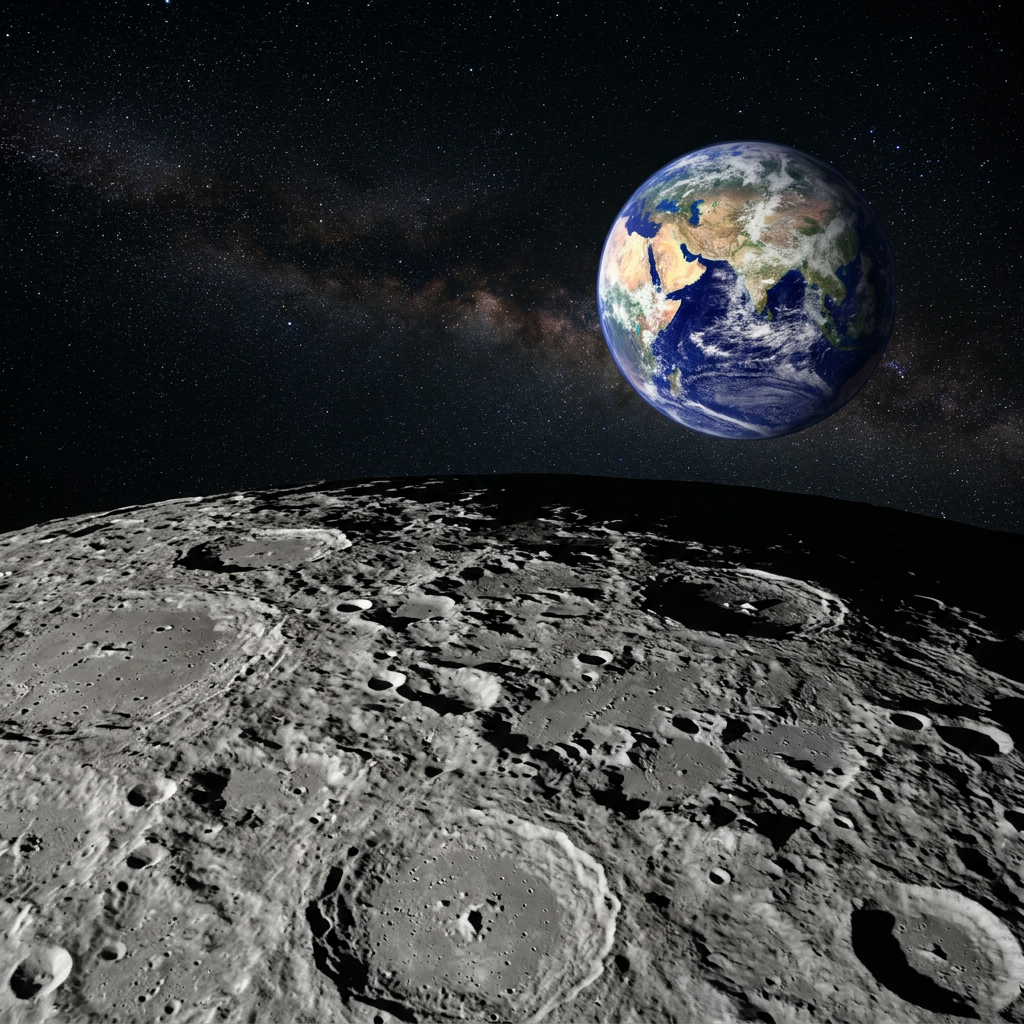
For most of the history of lunar science, humanity’s understanding of the moon’s ancient bombardment has come almost entirely from one hemisphere. The near side — the face that has stared at Earth for billions of years — is where the Apollo missions landed and where nearly every lunar sample analyzed in a laboratory originated. The far side, permanently turned away from us, remained largely a blank slate. New research analyzing rock fragments retrieved from that far side is now challenging decades of assumptions about when, and how intensely, the young solar system pelted the moon with asteroids.
The samples come courtesy of China’s Chang’e-6 mission, the first to return material from the lunar far side. Researchers led by the State Key Laboratory of Deep Earth Processes and Resources at the Guangzhou Institute of Geochemistry, part of the Chinese Academy of Sciences, analyzed tiny fragments of impact melt rock from the site, dating events that span an enormous stretch of lunar history — from roughly 4.33 billion years ago to about 1.13 billion years ago. Rather than the short, intense burst of bombardment long assumed by planetary scientists, the fragments point to a decline in asteroid impacts that played out gradually over billions of years.
Dr. Fred Jourdan, a co-author on the study from Curtin University’s School of Earth and Planetary Sciences and John de Laeter Centre, said the moon functions as a kind of geological time capsule precisely because it lacks the forces that erase such records on Earth. “The Moon is like a time capsule — it has preserved a record of events that have been erased from Earth by erosion, plate tectonics and other geological processes,” Jourdan said.
What makes the Chang’e-6 samples especially valuable, according to Jourdan, is the chance to compare two halves of the moon that have had very different geological lives. “Samples collected from the Moon’s far side are particularly significant because they allow us to compare two very different parts of the Moon for the first time,” he said. “Until now, almost everything we knew came from the side facing Earth.” That matters because the far side has been comparatively undisturbed by the volcanic activity and other processes that reshaped much of the near side over time, leaving what Jourdan describes as a cleaner record of the solar system’s earliest, most violent chapter.
“By analysing these ancient rocks, we can better understand when major asteroid impacts occurred and how the early Solar System evolved,” Jourdan said. “The far side preserves a cleaner record of those earliest impacts because it was much less affected by later geological events than the side facing Earth. These samples are helping us rewrite parts of the Moon’s history and suggest the early Solar System experienced a long decline in asteroid impacts rather than a single catastrophic bombardment.”
That reframing has implications well beyond lunar geology. Because the moon and Earth formed together and share a common early history, the impact record preserved in lunar rock offers an indirect window into conditions on the young Earth — conditions that have long since been erased by our planet’s own restless geology. “The Moon and Earth share a common history, but the evidence of early impacts has largely disappeared from our planet,” Jourdan said. “Because the Earth and Moon formed together, every major impact recorded on the Moon tells us something about the conditions experienced by the young Earth.”
Jourdan connects that record directly to one of the biggest open questions in planetary science: how the ingredients for life ever came together on Earth in the first place. “Studying lunar rocks allows us to look back billions of years and better understand the events that shaped the environments of both worlds and helps us understand the role asteroid impacts played in planetary evolution and the conditions that may have influenced the emergence of life on Earth,” he said.
The findings land as lunar science enters what researchers are calling a new era of exploration, driven in large part by fresh sample-return missions to parts of the moon that were previously unreachable. “The findings come amid a new era of lunar exploration and science, with China’s Chang’e-6 mission being the first to return samples from the Moon’s far side,” Jourdan noted.
Before Chang’e-6, essentially every dated lunar impact event in the scientific literature traced back to near-side material, leaving open the possibility that the record scientists had assembled was skewed by geography rather than representative of the moon as a whole. By dating impact melt rocks from a genuinely different part of the lunar surface, the research team has begun to test whether the near-side story holds up — and, so far, the far side is telling a somewhat different tale: not a single overwhelming bombardment early in the solar system’s history, but a long, uneven tapering off of impacts across more than three billion years.
That distinction may sound like a technical footnote, but it goes to the heart of long-standing debates about the “Late Heavy Bombardment,” a hypothesized spike in asteroid and comet impacts across the inner solar system roughly 3.9 billion years ago. Evidence for a gradual decline, rather than a discrete spike concentrated in a narrow window, would push researchers to reconsider models of how the early solar system’s leftover debris was swept up by the planets and moons that formed within it — and, by extension, how long the inner solar system remained a genuinely hazardous place for any young world trying to hold onto the conditions life would eventually require.
Endnotes
1. “The bombardment history on the lunar farside revealed by 40Ar/39Ar geochronology of Chang’e-6 impact melt rocks.” Science Advances (2026). DOI: 10.1126/sciadv.aee8718
2. Curtin University press release, July 23, 2026, via EurekAlert!: https://www.eurekalert.org/news-releases/1137407



Leave a Reply