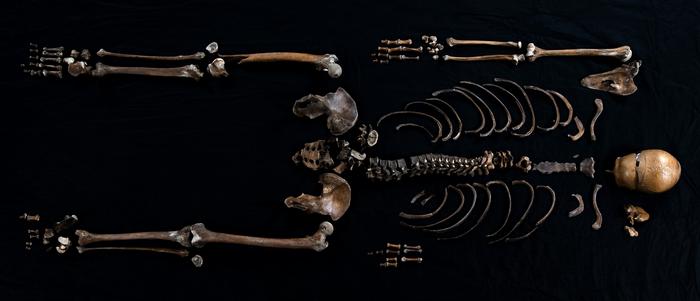
Historical cookbooks and archaeological trash pits can tell researchers a lot about how premodern societies ate in general terms, but they’re much less useful for answering a more specific question: what did any particular person actually put in their mouth? A new study from researchers at the Graduate University for Advanced Studies (SOKENDAI), Aomori Public University, Kyushu University, and other institutions finds a surprisingly rich answer preserved in an unlikely place — the hardened dental plaque still clinging to the teeth of skeletons buried centuries ago.
The study, published in Anthropological Science, applied palaeoproteomic analysis — the identification of ancient proteins preserved in archaeological material — to dental calculus from eight adult commoners buried in the Umeda cemetery, located near present-day JR Osaka Station. The results paint a picture of dietary diversity among ordinary, relatively poor city residents that traditional archaeological methods, including stable isotope analysis of bone collagen, simply can’t resolve at the level of individual food species.
Why bones alone aren’t enough
Conventional approaches to reconstructing ancient diets, including isotope analysis of skeletal remains, are good at identifying broad dietary categories — heavy reliance on marine fish versus land plants, for instance — but they can’t distinguish which specific species a person ate or how food access varied between social classes in a stratified society. Osaka during the premodern period offers an especially interesting test case for that kind of question: the city functioned as what was known as the “Kitchen of the Realm,” a central hub for producing, redistributing, and trading food from across western Japan. Whether that role actually translated into dietary variety for the city’s poorer residents — not just its elites — was an open question.
To find out, the research team combined stable carbon and nitrogen isotope analysis of bone collagen with proteomic analysis of dental calculus from the same eight individuals. The isotope data confirmed what researchers expected: a typical urban premodern diet built around a mix of terrestrial plants and marine resources. It was the calculus proteomics that produced the more granular picture.
Thirty-eight proteins, seventeen species, one surprising pattern
From the eight individuals studied, the researchers identified 38 distinct dietary proteins representing 17 different taxa — nine fish species, several terrestrial and marine mammals, and multiple plants. Muscle proteins from red sea bream (Pagrus major), a fish historical sources describe as a luxury item, turned up in six of the eight individuals — direct evidence that this prized fish wasn’t reserved exclusively for the wealthy. Proteins from flatfish species such as tonguefish, still a staple of Kansai and Seto Inland Sea cuisine today, also appeared in the samples.
Perhaps the most striking finding involved fish that couldn’t have come from local waters at all: proteins from salmonids, cold-water fish that don’t naturally inhabit Osaka Bay, showed up in some individuals’ dental calculus. That’s direct physical evidence that these commoners were eating marine products transported over substantial distances — likely carried along coastal shipping routes connecting Hokkaido and the Japan Sea coast to Osaka.
The calculus also complicated the historical record in another way. Three individuals carried proteins from non-human terrestrial mammals, supporting historical accounts that meat from wild quadrupeds was consumed under the euphemism of “medicinal meat” — a workaround for formal Buddhist-influenced taboos against eating meat that were nominally in effect during parts of the premodern period. And proteins from cotton seeds — not directly edible on their own, but processable into cottonseed oil — suggest that oil products derived from cotton, a crop widely cultivated around Osaka during the Edo period, made their way into ordinary commoners’ diets as well.
A small sample with outsized implications
The researchers are careful to note the limits of their sample size: eight individuals represent a tiny fraction of the thousands of burials at Umeda cemetery alone, let alone the hundreds of thousands of people who lived in premodern Osaka. But taken together, the findings show that even relatively poor urban commoners had access to a genuinely diverse range of foods — including species regarded as luxuries and products sourced from far outside the immediate region — challenging any assumption that dietary variety in premodern Japan was strictly a marker of wealth or status.
The team frames the work as a proof of concept for a broader comparative project. Future studies applying the same dental calculus proteomics technique to samurai households, to rural communities with less-developed food distribution networks, and to other premodern cities such as Edo and Kyoto could allow researchers to compare dietary diversity systematically across social status, geography, and time period — mapping food access in premodern Japan with a level of individual-level detail that isotope analysis and archaeological trash deposits alone can’t provide.
More broadly, the findings trace a line from the present back into deep culinary history. Kansai’s long-standing regional taste for sea bream and tonguefish, the researchers note, isn’t a recent culinary preference — it has roots that extend back centuries, roots that only become visible through careful analysis of what the researchers describe as irreplaceable cultural heritage material: the bones, and the plaque, of people who ate these foods themselves.
Endnotes
- The Graduate University for Advanced Studies, SOKENDAI, “Ancient dental calculus reveals diverse diets of commoners in premodern Osaka, Japan, the ‘Kitchen of the Realm,’” news release, August 25, 2026, https://www.eurekalert.org/news-releases/1140971.
- “Dietary reconstruction of individual premodern commoners in Osaka, Japan, through the palaeoproteomic analysis of human dental calculus,” Anthropological Science, 2026, https://doi.org/10.1537/ase.260519.



Leave a Reply