An international team of quantum researchers has shown how machine learning can be used to filter a practically infinite number of possible material combinations to identify candidates for superconductivity. Thanks to the breakthrough, new superconductors can now be found much faster, says Aalto University Professor Päivi Törmä, who leads the SuperC consortium behind the research.
Superconductors carry electric current with zero resistance, thanks to a quantum effect appearing only at extremely low temperatures. They power not only quantum computers, but many other things, from neuroimaging to fusion reactors and maglev trains.
However, these unicorn materials are prohibitively hard to identify. Any endlessly variable combination of elements could be a superconductor––yet, few actually are. And the ones already discovered require expensive cooling equipment to bring them to the near absolute zero temperatures that give them their quantum properties.
For scientists the world over, the race is on to find a scalable superconductor that works at room temperature.
‘Superconductive materials that can operate at room temperature would forever change the way we consume energy,’ explains Törmä. ‘If such a material could replace regular conductors in applications like computers and data centres, global energy consumption could be slashed and the heat footprint of the ICT sector vastly reduced.’

Driven by a shared desire to harness quantum physics in the fight against climate change, Professor Törmä and a team of renowned physicists formed the SuperC consortium in 2023. It is the first coordinated global collaboration to find new superconductors––and they aim to find a room-temperature superconductor by 2033.
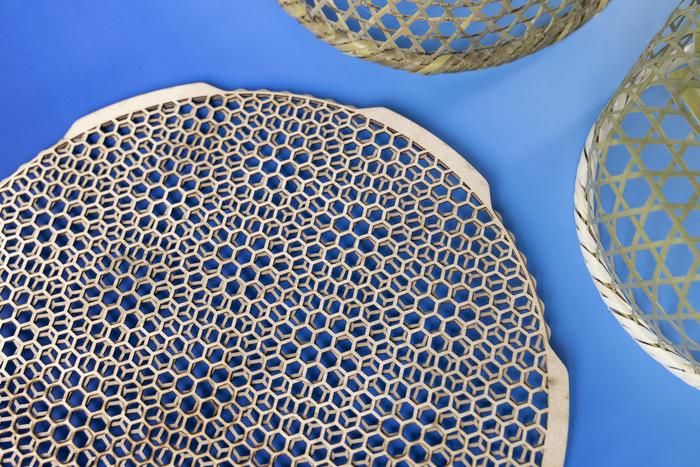
According to Törmä, SuperC’s combination of quantum geometry and machine learning gives them an excellent starting point. This latest discovery has its underpinning in traditional Japanese basket-making patterns; both of the newly discovered materials (YRu3B2 and LuRu3B2) gain their superconductivity from electrons forming flat bands in a traditional pattern known as a kagome lattice.
To identify the two new superconductors, the team used machine learning to narrow down promising elemental combinations. After pre-screening these with a unique algorithm, the team carried out detailed calculations to determine which materials could be superconductive.
After theoretical confirmation, SuperC collaborators at Rice University set about synthesising the samples. This complex process, which involves chemically combining raw elements into new compounds, was led by Professor Emilia Morosan. The team at Rice was then able to run tests on the materials to confirm their superconductivity.
The proof-of-concept paper was recently published in Physical Review Research.
Why does it matter?
The quantum mechanical theory of superconductivity is complex, which makes finding new superconductors an arduous task.
‘Over the decades researchers have recognised over 7,000 superconductors, but mostly serendipitously,’ explains Törmä. ‘The process of identifying possible materials is so computationally heavy that, in fact, researchers have only been able to theoretically predict the viability of about 20 of these.’
Even if you manage to find what might look like a viable combination, most are completely unusable. For example, they are difficult to synthesize or scale, says Törmä. It follows that finding viable superconductors requires vast computational power to screen materials. SuperC’s machine-learning approach upends that idea.
‘Our method uses machine-learning-based pre-screening followed by targeted calculations on the promising candidates. This approach will greatly speed up superconductor discovery in the future. With machine learning, we may be able to push the number of materials we can process into the billions,’ says Törmä. ‘This will take us a critical step closer to finding a room-temperature superconductor.’
IMAGE SOURCE: Esa Kapila.


Leave a Reply