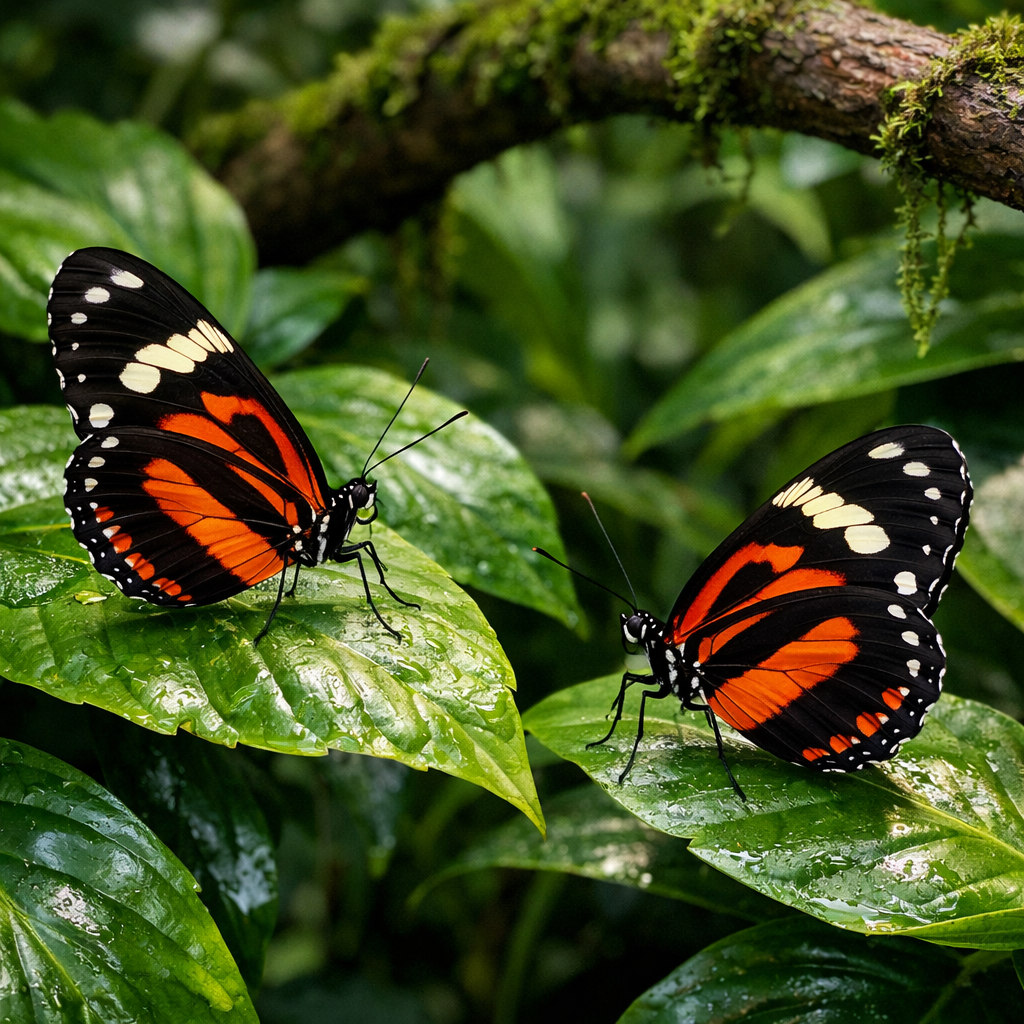
A sweeping new study of South American butterflies and moths finds that convergent mimicry coloration returns to the same two genes, again and again, across species that diverged in the age of dinosaurs.
When the nineteenth-century British naturalist Henry Walter Bates traveled the Amazon in the 1850s and encountered dozens of strikingly similar-looking butterfly and moth species that were not closely related to one another, he recognized something profound: nature was, in some sense, repeating itself. More than 160 years later, a team of international researchers has traced that repetition all the way down to the molecular level — and found that evolution has been running the same genetic play for at least 120 million years.
The study, published April 30 in PLoS Biology, examined the genetic basis of wing color pattern mimicry across seven butterfly species and one day-flying moth — all members of the neotropical ‘tiger’ mimicry ring, a species-rich assemblage of more than 100 toxic or distasteful insects that share warning coloration to deter predators. The lineages studied diverged from one another anywhere from roughly one million to 120 million years ago, spanning an evolutionary interval that stretches from the early Cretaceous to the present.
What the researchers found was striking in its consistency: despite divergence times vast enough to separate butterflies from moths entirely, the same two genes — ivory and optix — were recruited, over and over, to produce nearly identical color patterns. And the mechanism, in nearly every case, was not a change in the genes themselves but in the regulatory switches that control when and where those genes are expressed.
“Butterflies and moths have been using the exact same genetic tricks repeatedly to achieve similar color patterns since the age of the dinosaurs,” said Prof. Kanchon Dasmahapatra, from the University of York.
‘Convergent evolution, where many unrelated species independently evolve the same trait, is common across the tree of life,’ Dasmahapatra continued. ‘But we rarely have the opportunity to investigate the genetic basis of this phenomenon. Investigating seven butterfly lineages and a day-flying moth, we show that evolution can be surprisingly predictable, and that butterflies and moths have been using the exact same genetic tricks repeatedly to achieve similar colo patterns since the age of the dinosaurs.’
The team, led jointly by researchers at the University of York and the Wellcome Sanger Institute and including scientists from Ecuador, Colombia, Peru, France, and the United States, used whole-genome sequencing, genome-wide association (GWA) analyses, and quantitative trait locus (QTL) mapping to identify the genomic regions controlling three distinct color pattern elements: the presence or absence of a forewing yellow band, and variation in hindwing melanization between orange and black patterns. Across all species studied, the genetic signal pointed repeatedly to noncoding regulatory regions adjacent to ivory and optix.
The gene ivory — a long noncoding RNA previously known to control seasonal color patterns in buckeye butterflies and industrial melanism in peppered moths — was consistently associated with the forewing yellow band phenotype. In four ithomiine butterfly species spanning roughly 28 million years of divergence, the GWA peaks fell within strikingly similar locations inside ivory’s first intron, upstream of a conserved regulatory element called E230. A 2024 study demonstrated that a microRNA, mir-193, derived from ivory is likely the primary effector, repressing multiple pigmentation genes — providing a molecular mechanism for the patterns observed.
The gene optix, well known from prior work in Heliconius butterflies as a master regulator of red and orange pigmentation, showed the same pattern of repeated recruitment for hindwing melanization across multiple genera. In the moth Mechanitis messenoides, the team performed CRISPR-Cas9 knockouts of both genes, confirming their causal roles: disabling ivory turned orange and black scales yellow; disabling optix turned orange scales black.
Professor Joana Meier of the Wellcome Sanger Institute, the study’s other senior author, emphasized the ecological logic underlying these findings. She noted that the distantly related butterflies and the moth are all toxic and distasteful to birds, and that species benefit from mimicking warning colour patterns that predators have already learned to associate with toxicity. The highly conserved genetic basis over 120 million years makes it comparatively easy for diverse species to evolve these same patterns.
Professor Joana Meier of the Wellcome Sanger Institute, the study’s other senior author, emphasized the ecological logic underlying these findings. She noted that the distantly related butterflies and moth are all toxic and distasteful to predators, and that species benefit from mimicking warning colour patterns that birds have already learned to associate with toxicity. The highly conserved genetic basis over 120 million years makes these warning colour patterns comparatively easy to evolve.
Perhaps the most dramatic finding concerns the day-flying moth Chetone histrio, which is locally polymorphic in Peru — individual moths belonging to either the striped or orange-black sub-mimicry rings occur in the same location. Unlike the butterfly species, where small clusters of SNPs in tight regulatory windows drive color switching, C. histrio shows a roughly one-megabase block of DNA in perfect association with its color morph. That block turns out to be a chromosomal inversion — a large segment of DNA flipped in reverse orientation that locks together allele combinations controlling multiple color pattern elements simultaneously.
What makes that finding particularly remarkable is that the inversion breakpoints in C. histrio closely match those of the P1 inversion in Heliconius numata, a butterfly that employs an almost identical supergene architecture to maintain its own locally polymorphic color forms — despite the moth and butterfly lineages having diverged approximately 120 million years ago. The parallel extends to dominance: in both species, the derived inversion haplotype is dominant and controls the shift from striped to orange-black patterning.
The study also weighed in on a longstanding debate in evolutionary biology stretching back to Bates himself. While Bateson and Punnett argued for large-effect mutations controlling mimicry, and R.A. Fisher countered that such loci must be backed by polygenic modifiers scattered across the genome, the new data support a middle path: two primary switch loci — ivory and optix — with modifiers clustered near those same switches rather than diffused genome-wide. ‘Our study clarifies this longstanding dispute,’ the authors write.
The research also diverges in one important respect from prior work on Heliconius butterflies, where convergent coloration among closely related species often traces to allele sharing through hybridization. In the ithomiine butterflies examined here — Mechanitis, Melinaea, and Hypothyris — the team found little evidence that mimetic convergence results from introgressed alleles passed between species. The researchers suggest that frequent chromosomal rearrangements in ithomiines may generate reproductive barriers that limit gene flow at critical color loci, forcing each lineage to independently rediscover the same regulatory solutions.
The broader implication touches on one of evolutionary biology’s oldest questions, posed by the late Stephen Jay Gould: if you could rewind the tape of life and play it again, would the same forms emerge? The answer, at least for wing color patterning in Lepidoptera, appears to be largely yes — and for a specific mechanistic reason. The developmental pathways controlling these pigmentation patterns are deeply constrained, and the regulatory architecture around ivory and optix appears to be an evolutionary sweet spot: accessible to mutation, capable of generating discrete phenotypic switches with minimal pleiotropic side effects, and reachable by lineages diverged by geological epochs.
That predictability may have a practical dimension beyond evolutionary theory. Understanding the constrained genetic pathways underlying adaptation could help scientists anticipate how other species respond to environmental pressures — including climate-driven shifts in habitat and predator communities that would favor new warning coloration strategies.
The research was funded by the Natural Environment Research Council (NERC), the Wellcome Trust, a Branco Weiss Fellowship, a Royal Society University Research Fellowship, and the Agence Nationale de la Recherche (ANR), among other sources.
Endnotes
Stern DL, Orgogozo V. Is genetic evolution predictable? Science 323(5915): 746–751 (2009). https://doi.org/10.1126/science.1158997
Ben Chehida Y, van der Heijden ESM, Page E, et al. Genetic parallelism underpins convergent mimicry coloration in Lepidoptera across 120 million years of evolution. PLoS Biology 24(4): e3003742 (2026). https://doi.org/10.1371/journal.pbio.3003742
University of York press release: ‘Evolution has reused the same genes for 120 million years, study shows.’ 30 April 2026. https://www.york.ac.uk/news-and-events/news/2026/research/evolution-same-genes-120-million-years/
Bates HW. Contributions to an insect fauna of the Amazon valley. Lepidoptera: Heliconidae. Transactions of the Linnean Society of London 23: 495–566 (1862).
Tian S, Asano Y, Das Banerjee T, et al. A microRNA is the effector gene of a classic evolutionary hotspot locus. Science 386(6726): 1135–1141 (2024). https://doi.org/10.1126/science.adp7899
Fandino RA, Brady NK, Chatterjee M, et al. The ivory lncRNA regulates seasonal color patterns in buckeye butterflies. Proceedings of the National Academy of Sciences 121(41): e2403426121 (2024). https://doi.org/10.1073/pnas.2403426121
Livraghi L, Hanly JJ, Evans E, et al. A long noncoding RNA at the cortex locus controls adaptive coloration in butterflies. Proceedings of the National Academy of Sciences 121(36): e2403326121 (2024). https://doi.org/10.1073/pnas.2403326121
Joron M, Frezal L, Jones RT, et al. Chromosomal rearrangements maintain a polymorphic supergene controlling butterfly mimicry. Nature 477: 203–206 (2011). https://doi.org/10.1038/nature10341
Bohutínská M, Peichel CL. Divergence time shapes gene reuse during repeated adaptation. Trends in Ecology & Evolution 39(4): 396–407 (2024). https://doi.org/10.1016/j.tree.2023.11.007
Blount ZD, Lenski RE, Losos JB. Contingency and determinism in evolution: replaying life’s tape. Science 362(6415): eaam5979 (2018). https://doi.org/10.1126/science.aam5979

COPY II (2-3 PARAGRAPHS)
IMAGE CREDIT: NASA.




Leave a Reply