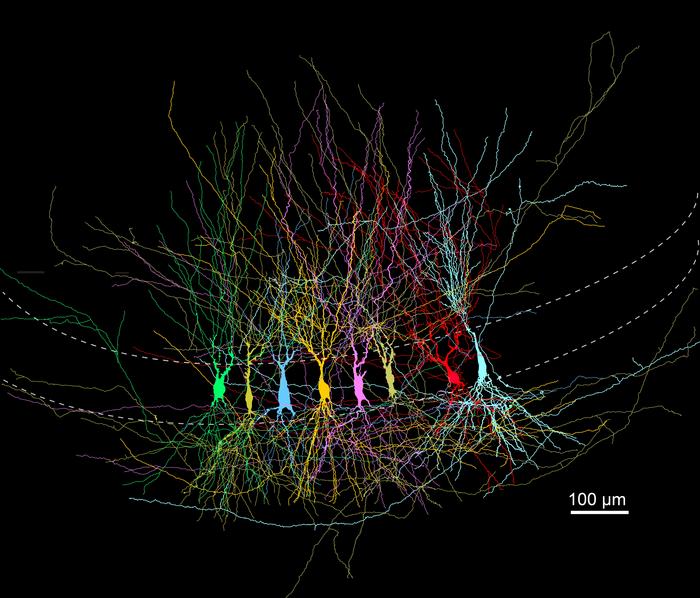
The hippocampus is a key brain region involved in memory formation and spatial orientation. It transforms short-term memories into long-term ones, helping us retain and build upon our experiences. Researchers led by Magdalena Walz Professor for Life Sciences Peter Jonas at the Institute of Science and Technology Austria (ISTA) focus precisely on this area of the brain. Their latest study, published in Nature Communications, reveals how the central neural network in the hippocampus develops after birth.
Imagine a blank sheet of paper in front of you. There’s nothing on it so you start writing, adding more and more information. This is the principle of tabula rasa—the “blank slate.”
It’s a different story when the sheet already contains marks: new information must be added to, or overwrite, what is already there. That describes tabula plena—the “full slate.”

At the heart of this philosophical concept lies a fundamental question: Is everything pre-set from the very beginning or do experiences shape who we become?
Biology reflects this controversy as well—between genes that provide the basic blueprint and environmental factors that sculpt the final organism.
Neuroscientists in the Jonas group at the Institute of Science and Technology Austria (ISTA) addressed precisely this question in the context of the hippocampus—the brain region that forms memories and guides spatial navigation. Specifically, they asked: How does the hippocampal network evolve after birth? Is it linked to tabula rasa or tabula plena?
First more, then less
The study focused on a central hippocampal network made up of interconnected CA3 pyramidal neurons. These cells store and recall memories through a process known as plasticity—the ability of neurons to constantly change, for example, by strengthening or weakening their connections or by reshaping their structure.
For his project, ISTA alum Victor Vargas-Barroso examined mouse brains at three developmental stages: early after birth (day 7–8), adolescence (day 18–25), and adulthood (day 45–50).
To analyze the networks, he applied the patch-clamp technique. This allows researchers to measure tiny electrical signals in specific parts of neurons—such as at their signal-sending ends (presynaptic terminals) or at the branching sites that receive signals (dendrites). In addition, advanced microscopy and laser-based techniques were used to observe processes inside the cells and to activate individual connections with high precision.
The results: Early on, the CA3 network is very dense, and the connections appear random. As the animals mature, however, the configuration shifts—the network becomes sparser but more structured and refined.
“This discovery was quite surprising,” says Jonas. “Intuitively, one might expect that a network grows and becomes denser over time. Here, we see the opposite. It follows what we call a pruning model: it starts out full, and then it becomes streamlined and optimized.”
An efficient network thanks to tabula plena?
Why this happens remains a matter of speculation. Jonas suspects that an initially widespread network allows neurons to connect quickly and efficiently—a crucial advantage in the hippocampus. This region does not just store visual, smell, or sound information—it links all these together.
“That’s a complex task for neurons,” Jonas explains. “An initially exuberant connectivity, followed by selective pruning, might be exactly what enables this integration.”
If, on the other hand, the network started as a true tabula rasa—with no preexisting connections—neurons would be too far apart and would need to ‘find’ one another first, making efficient communication nearly impossible.
IMAGE CREDIT: Jose Guzman / Jonas group at ISTA.



Leave a Reply