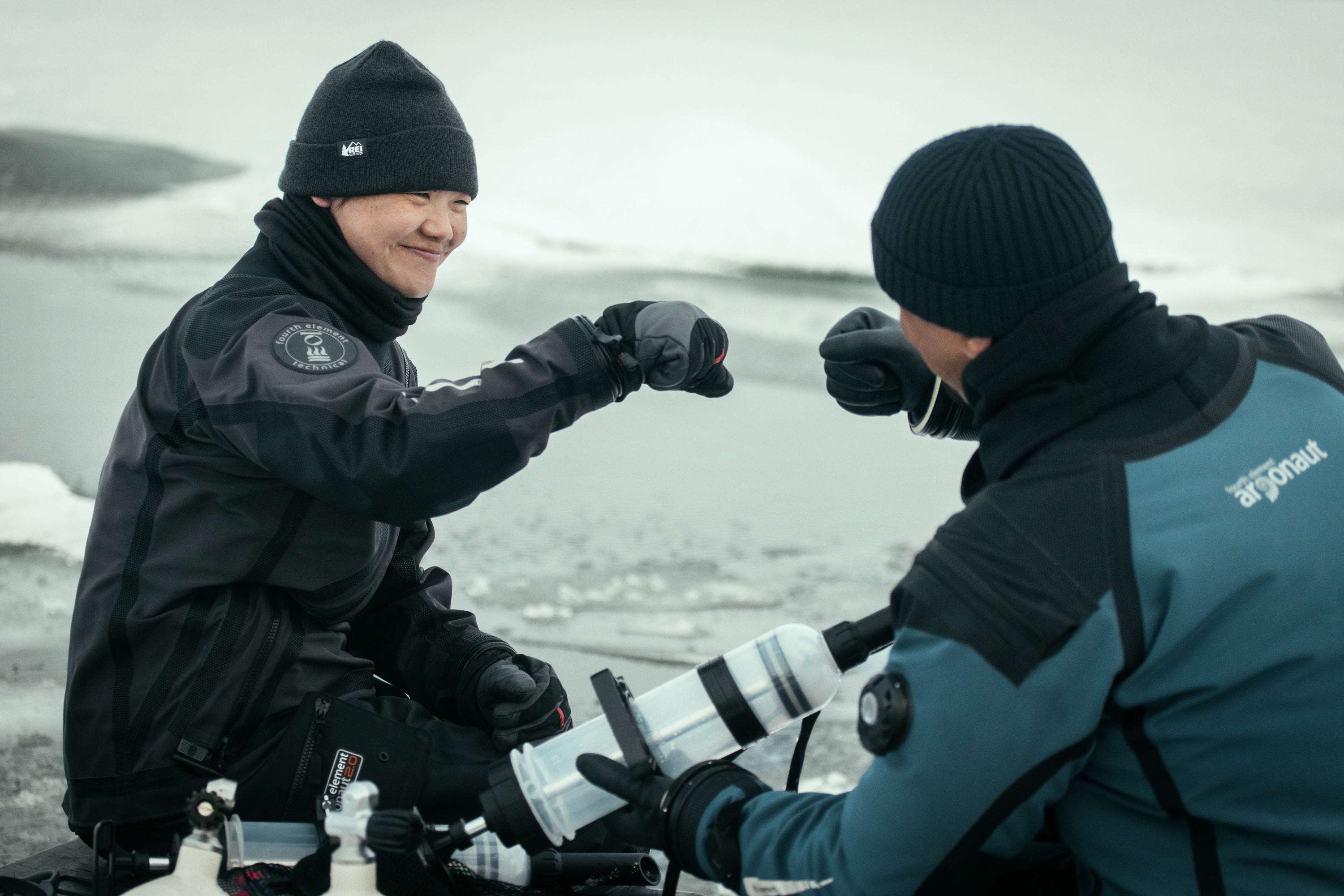
When Allison Fong received an email from a production company in early 2023, she almost deleted it as spam. Weeks later, she learned it was an invitation to join Will Smith at the North Pole for Pole to Pole, a National Geographic docuseries traversing the globe from one pole to the other. What the production team wanted to film: her research on the invisible organisms that sustain life on Earth. Fong, a microbial oceanographer and National Geographic Explorer who spent nine months drifting through the central Arctic during the landmark MOSAiC expedition, has logged more than 500 days at sea studying microbes from Rapa Nui to the frozen reaches of the Arctic Ocean. She’s made a career of asking questions that can only be answered in extreme places—and translating what she finds for audiences far from the ice.
In the North Pole episode of Pole to Pole, Fong and her team made a significant discovery: sea ice ridges function as ecological hotspots, with communities living on the underside of ridge ice proving more productive than those in surrounding waters. The finding offers crucial insight into what’s being lost as Arctic sea ice diminishes with warming. In this conversation, Fong discusses how a cold kept her from responding to a once-in-a-lifetime opportunity, why she calls microbes “the unsung heroes of the planet,” and what it’s like to do science when Plan A, Plan B, and the weather all have other ideas.
Starting at the beginning: how did this collaboration with Will Smith and Pole to Pole come together? And what was your initial reaction to having your research featured?
It’s a funny story. I received an email from the production company, Newtopia, in early 2023—when I had a terrible cold. I glanced at it and assumed it was spam. You get those messages sometimes: “Amazing opportunity,” “We’d love to work with you,” and it doesn’t feel real.
A couple of weeks later, once I was feeling better, I went back and actually read it carefully. I scrolled down, saw the letterhead, and thought, “Oh—this might be legitimate.” I wrote back, and they replied the same day asking to set up a call. They said they knew my work, which genuinely surprised me.
On the call, they proposed the premise: they wanted to go to the High Arctic—the Arctic Ocean, potentially even to the North Pole—and asked whether there was science I could propose to do there, and whether I’d be willing to have it featured in the series. I was stunned. They told me they’d like to center an episode around my work.
I remember thinking, “Do you realize I work on invisible things—microbes?” But they were enthusiastic. And for me, it was an extraordinary opportunity: to do fieldwork I otherwise might not be able to do, and to communicate climate science to a much wider audience. I was also grateful I didn’t keep treating it like spam.
Field work is challenging enough—doing it while cameras are rolling adds another layer. Did the presence of the film crew, and Will Smith, affect the dynamics of working on the ice and searching for microbes?
It was the biggest production I’ve ever been part of. I’d done smaller docuseries with teams of three or four people, so I wasn’t prepared for the scale. The production team handled it thoughtfully—they introduced what to expect, and they made a real effort to stay out of the way.
When I’m in the field, I go into what I call “expedition mode.” You’re managing safety, logistics, and scientific priorities all at once. In that context, I treated the production team—and the safety and logistics crew—as an extension of the expedition. They were additional players we needed to accomplish the work.
The main difference was coordination. Normally, I have full visibility into how the science unfolds. Here, we were balancing production needs with what the ship could support, and what the captain would allow. It didn’t hinder the work, but it demanded more communication and more planning.
We also prepared extensively beforehand—thinking through scenarios, contingency plans, what mattered most, and what could be adapted if Plan A or Plan B didn’t work. That kind of preparation is essential, especially in the Arctic. Weather changes quickly. Equipment fails. You need redundancy, time buffers, and alternatives.
And yes—when you bring a larger team, including people who aren’t as experienced in extreme conditions, the risk profile changes. But setbacks are part of expedition science; gear issues and delays can happen to anyone.
You’ve described phytoplankton as indicators of planetary health. In the series, you call microbes “the unsung heroes of the planet.” Can you explain that for readers who may not have a strong science background?
Microbes were the earliest organized life on Earth, and they’ve been shaping the planet ever since. What’s remarkable is that they’re essentially microscopic engineers in every environment they inhabit—oceans, soils, even our own bodies. They’ve evolved specialized capabilities over billions of years, and those capabilities underpin the systems we rely on.
A classic example is oxygen. Early Earth wasn’t oxygenated. Tiny microbes—cyanobacteria—began photosynthesizing, and over long periods of time, that process helped oxygenate the planet. That shift made complex life as we know it possible.
In the ocean today, phytoplankton remain foundational. They generate oxygen and form the base of marine food webs. Much of the energy that supports ocean ecosystems begins with these single-celled organisms. They’re doing essential work constantly, mostly out of sight—so “unsung heroes” feels accurate.
What was your discovery, and what’s its significance for understanding climate change?
We’ve been studying sea ice ridges in the Arctic, which serve as important habitat. At the same time, Arctic sea ice is diminishing with warming, and we’re in a race to understand what’s being lost as that habitat changes.
The key finding is that sea ice ridges—especially the underside of ridges—function as ecological hotspots. The environment is surprisingly complex: light filters through uneven ice, and organisms are highly tuned to that specific mix of light and nutrients.
We found that the communities associated with the bottom of the ridge ice can be more productive and grow faster than nearby communities in the surrounding water or other parts of the ice. They also serve as an important food source. In other words, even in places where low light might seem limiting, these organisms are well adapted—and the ridges support a distinct, productive ecosystem.
There’s also a moment in the show where it seems like you might not get the samples—and the idea of failure comes up. We don’t talk much about failure in academic science. How do you think about it?
In the moment, it can feel devastating when you don’t get what you came for. But failure—or more accurately, setbacks—are routine in science. We tend to highlight the successes, but those successes are built on many attempts that didn’t work.
In field science especially, so much is outside your control. You can plan for a year, and then a storm forces a change. Equipment breaks. Ship constraints shift. Sometimes an entire attempt ends early. The important thing is to treat those outcomes as information: what did we learn, and how does that shape the next question or the next approach?
I also think it’s valuable to show that reality publicly. It’s closer to how science actually happens, and it helps people understand that persistence and adaptation are part of the work—not signs of incompetence.
Last question. You’ve logged over 500 days at sea and studied microbes from Rapa Nui to the Arctic Ocean. What draws you to extreme environments?
The questions do. Some questions can only be answered in places with specific conditions, so the research pulls you into remote environments.
And those environments also change your perspective. Whether it’s the vastness of the South Pacific or the immensity of the Arctic, it reminds you how complex—and how interconnected—our planet is. I’m interested in connecting what happens in those faraway systems to what matters in everyday life and communities.
Microbes are a useful lens for that because they’re everywhere. Studying them lets you link the most remote places on Earth to the processes that support life globally.
Credit: National Geographic/Freddie Claire


Leave a Reply