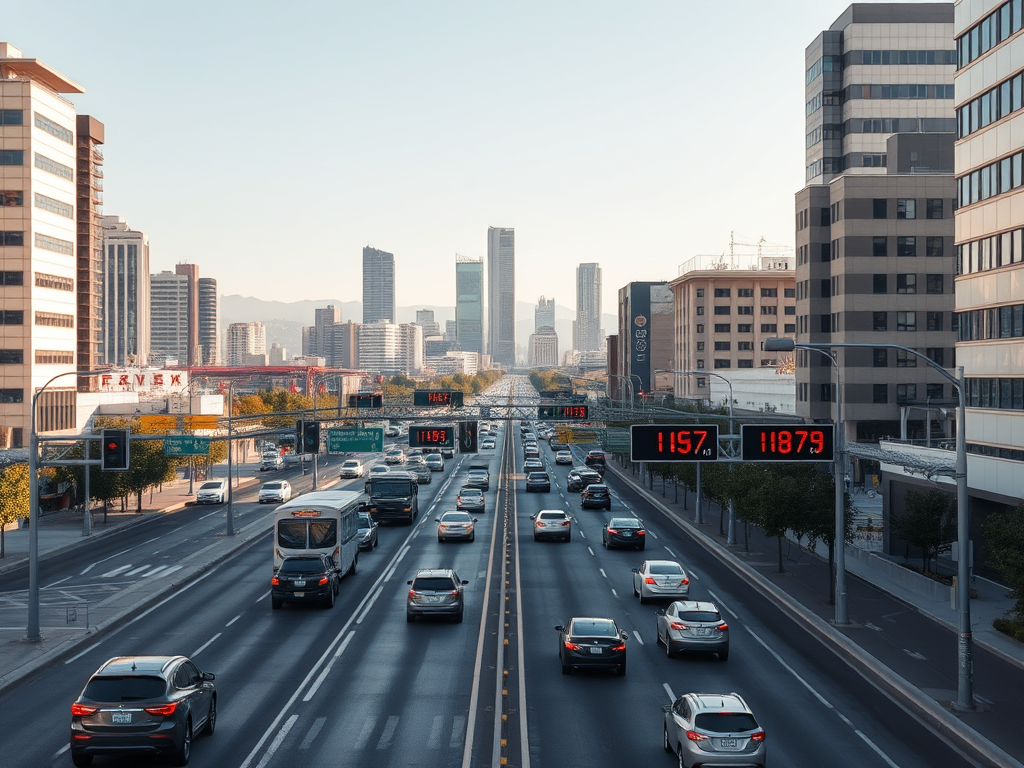
Researchers at National University of Singapore used multiple interpretable machine learning methods to predict traffic congestion in in Alameda County in the San Francisco Bay Area, USA, during the pre-lockdown, lockdown, and post-lockdown periods.
The team published their study in Communications in Transportation Research on November 24, 2025.
“We develop a suite of advanced machine learning models—including support vector regression (SVR), multiple linear regression (MLR), recurrent neural networks (RNN), and long short-term memory (LSTM) architectures—to predict traffic congestion across different COVID-19 periods. Additionally, we employ two complementary interpretability techniques: Integrated Gradients (IG) to explain the predictions of the best-performing Bi-LSTM model, and SHAP values to interpret the feature contributions in the SVR model, thereby providing transparent and data-driven insights into the factors driving congestion changes during the pandemic”, says Dan Zhu, a research fellow at the Department of Civil and Environmental Engineering at National University of Singapore.

Prediction Performance of Machine Learning Models
In this study, the research team examined how different factors—including weather conditions, seasonal patterns, and key COVID-19 indicators—shaped traffic congestion across the pre-lockdown, lockdown, and post-lockdown periods. Using these data, the team evaluated the performance of several machine learning models with the Normalized Root Mean Square Error (NRMSE), a widely used metric that allows fair comparison across different time periods.
The results reveal striking contrasts between the three phases. During the strict lockdown, traffic became highly predictable, with flattened peaks and fewer fluctuations. But before the lockdown, congestion varied significantly due to weather, seasonal effects, and economic activity, making this period the hardest to forecast. Post-lockdown traffic sat between these two extremes as the gradual reopening and evolving public behavior reintroduced irregular travel patterns.
When comparing models, the bidirectional LSTM (Bi-LSTM) stood out—achieving the lowest error in almost every period—while traditional forecasting tools like SARIMA only performed well before the pandemic. Once travel patterns were disrupted, SARIMA struggled to adapt, whereas Bi-LSTM remained robust.
These findings show just how deeply the pandemic reshaped people’s travel habits,” says Yang Liu, Associate Professor at the National University of Singapore. Our study demonstrates that modern machine learning models, especially Bi-LSTM, are far better equipped to handle sudden changes in travel behavior. As cities continue to face disruptions, building predictive systems that stay accurate under uncertainty will be crucial for effective traffic management.
Model Interpretability
In addition to predicting traffic patterns, the research team also sought to understand why the models made certain predictions—a key requirement for city planners who rely on transparent and trustworthy tools. To achieve this, the team examined the inner workings of the Bi-LSTM model using a technique called Integrated Gradients (IG). IG reveals which factors—such as weather conditions, seasonal patterns, or COVID-19 indicators—played the largest role in shaping the model’s forecast, and how their influence changed over time.
By testing multiple reference points, including zero inputs, average conditions, and values from the previous week, the researchers found that the model consistently highlighted the same dominant factors across all scenarios. This stability gave the team confidence that the insights reflected genuine trends rather than artifacts of the method.
For models that cannot be analyzed with IG, such as Support Vector Regression, the team used another explanation tool known as SHAP. SHAP values allowed the researchers to quantify how much each feature contributed to traffic levels—for example, showing that weekends consistently reduced congestion, while high hospitalization numbers were linked to lower mobility during COVID-19.
“These interpretability tools help us move beyond accuracy and understand the real-world drivers behind congestion,” says Litian Xie, Associate Professor at the National University of Singapore. For cities, this kind of transparency is essential. It tells us not only what will happen, but why it’s happening—and that’s the insight planners need to design more resilient traffic system.
The above research is published in Communications in Transportation Research (COMMTR), which is a fully open access journal co-published by Tsinghua University Press and Elsevier. COMMTR publishes peer-reviewed high-quality research representing important advances of significance to emerging transport systems. COMMTR is also among the first transportation journals to make the Replication Package mandatory to facilitate researchers, practitioners, and the general public in understanding and advancing existing knowledge. At its discretion, Tsinghua University Press will pay the open access fee for all published papers in 2025.



Leave a Reply