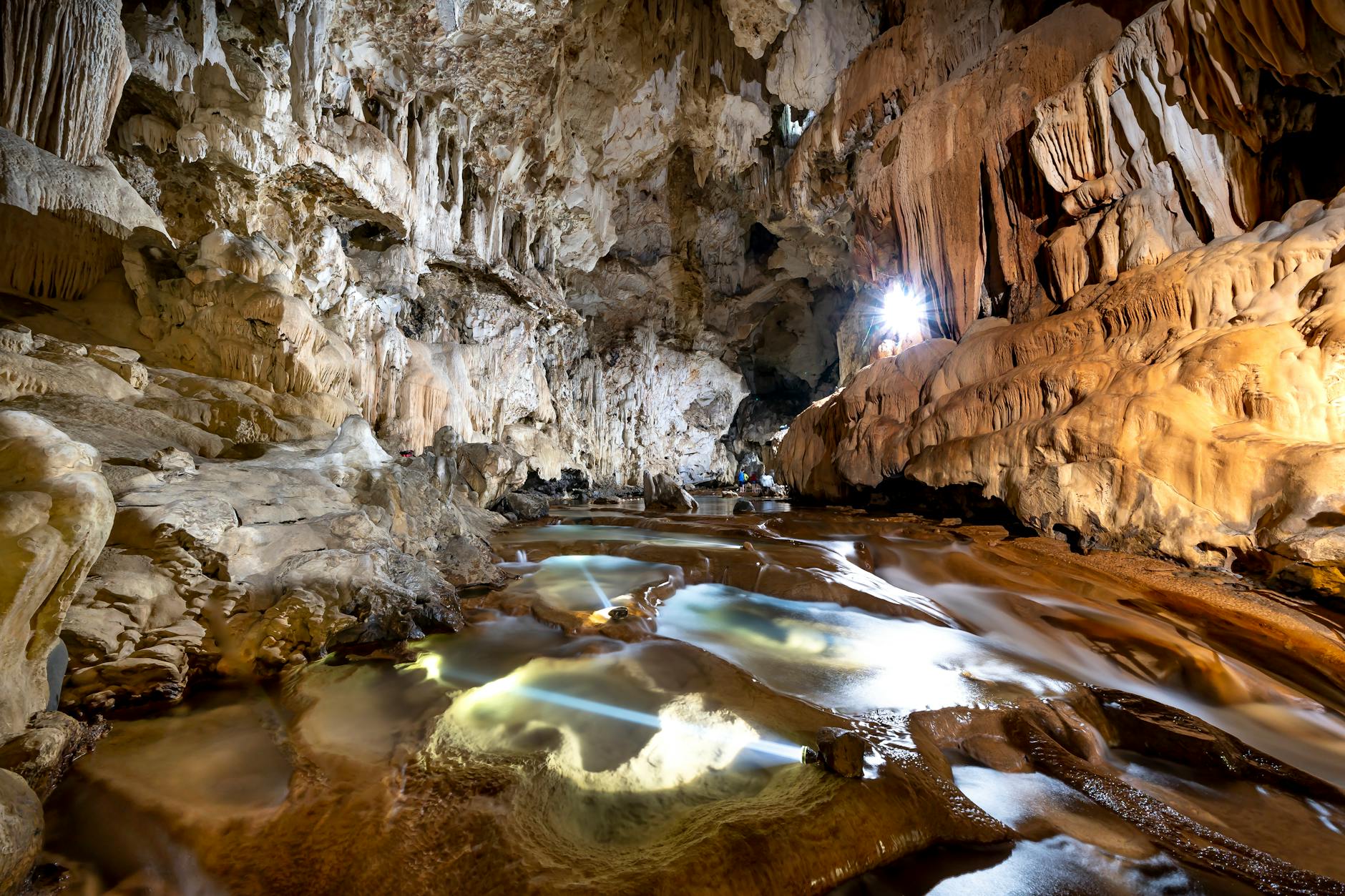
Deep inside caves, water dripping from the ceiling creates one of nature’s most iconic formations: stalagmites. These pillars of calcite, ranging from centimeters to many meters in height, rise from the cave floor as drip after drip of mineral-rich water deposits a tiny layer of stone. Beyond their beauty—echoed in fanciful nicknames like the “Minaret” or the “Wedding Cake”—stalagmites are also natural archives, recording ancient climatic changes in their layered growth, much like tree rings.
But what determines the shape of a stalagmite? Why do some grow into slender cones, others into massive columns, and still others into curious flat-topped forms? A new study by researchers from the University of Warsaw, the University of Florida, the Research Center of the Slovenian Academy of Sciences and Arts and University Medical Center Ljubljana, published in the Proceedings of the National Academy of Sciences, provides the first complete mathematical description of stalagmite shapes.
The team succeeded in analytically solving a 60-year-old mathematical model of stalagmite growth, which predicts how an “ideal” stalagmite grows when conditions in the cave remain steady. The mathematics reveals one of nature’s hidden blueprints: stalagmites grow into flat-topped pedestals, classical columns, or pointed cones not by chance, but according to a single controlling factor – the Damköhler number – which represents a balance between the rates of calcite precipitation and the flow of water. When dripping is concentrated and steady, a columnar form emerges, while spread-out dripping produces flat tops. When the flow rate is high or when water drips directly onto the stalagmite from the cave roof, conical shapes with sharp pointed tops can emerge.
“It turns out that the rich diversity of stalagmite shapes can be explained by one simple parameter,” says the lead author Piotr Szymczak of the University of Warsaw. “This is a rare case where the beauty we see in nature corresponds directly to a clean mathematical law.”
To test their theory, the scientists used X-ray tomography on stalagmites from Slovenia’s famous Postojna Cave. The scans, performed in Ljubljana University Medical Centre, matched the predicted shapes with striking accuracy. Even delicate details, such as the transition from a flat top to a columnar body, were captured by the equations.
“When we compared our analytic solutions with real cave samples, the match was remarkable,” adds Matej Lipar of the Research Centre of the Slovenian Academy of Sciences and Arts. “It shows that even under natural, messy conditions, the underlying geometry is there.”

The study also shows that shape matters for climate science. Stalagmites are widely used to reconstruct rainfall and temperature records through subtle shifts in the chemical signatures of carbon isotopes trapped inside the stone layers, rather like reading a diary written by ancient rainwater. The new model reveals that flat-topped stalagmites record these isotope signals differently from columnar or conical ones—a finding that could refine how paleoclimate records are interpreted.
“Stalagmites are natural climate archives, but we now see that their geometry leaves its own imprint on the isotopic record,” explains Anthony Ladd of the University of Florida. “Recognizing this effect will allow us to extract more reliable information about past climates.”
So the next time you stand in front of a stalagmite – whether in Poland’s Raj Cave, Kentucky’s Mammoth Cave, or Slovenia’s Postojna Cave, you may see more than a curious rock formation. Stalagmites are not just stone curiosities; they are natural laboratories where physics, chemistry, and geology meet—and now, with mathematics, their forms can be read like a code written over millennia by dripping water.
IMAGE CREDIT: Quang Nguyen Vinh.


Leave a Reply