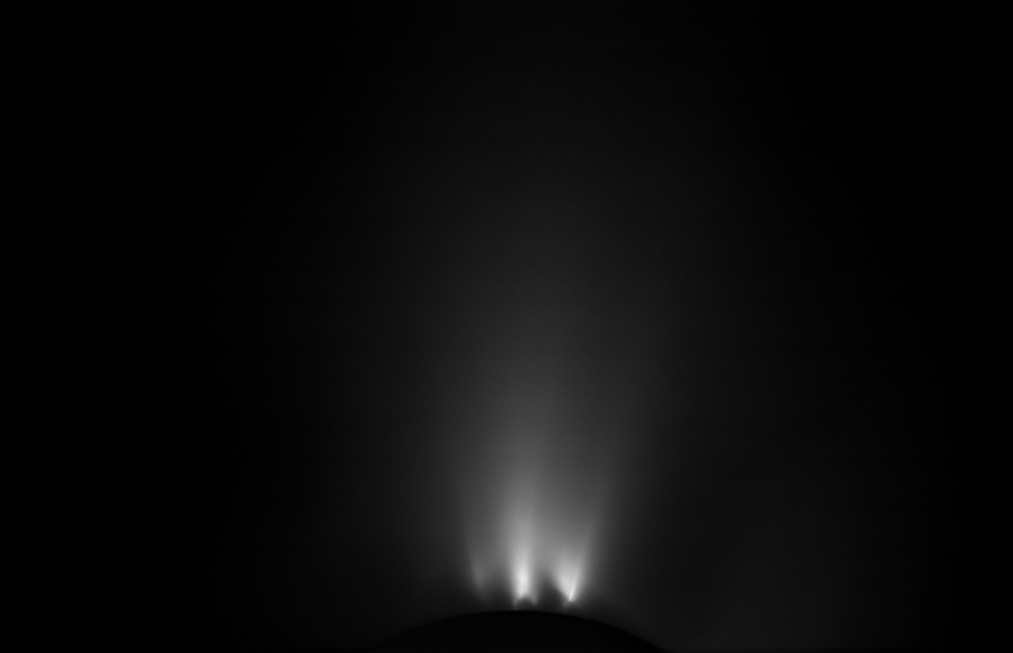
For nearly two decades, Saturn’s small, icy moon Enceladus has loomed large in the search for life beyond Earth. Since NASA’s Cassini spacecraft first flew through its geyser-like plumes in 2005, scientists have been piecing together a portrait of a world with a global ocean, seafloor hydrothermal activity, and a remarkable chemical pantry. Now, new findings add another piece to that puzzle: freshly erupted ice grains from Enceladus contain a variety of organic compounds, some of which are precursors to the molecules of life.
Published this week in Nature Astronomy, the study presents the most detailed analysis yet of organics detected during Cassini’s high-speed “E5” flyby in 2008. By slamming through Enceladus’s jets at nearly 18 kilometers per second, the spacecraft’s Cosmic Dust Analyzer captured mass spectra from ice grains expelled only minutes earlier. That speed, far higher than in previous encounters, fragmented molecules in ways that revealed chemical signatures scientists had not seen before.
“We again detect aryl and oxygen moieties in these fresh ice grains, as previously identified in older E-ring grains,” the team reported. “Furthermore, the unprecedented high encounter speed revealed previously unobserved molecular fragments… allowing the identification of aliphatic, (hetero)cyclic ester/alkenes, ethers/ethyl and, tentatively, N- and O-bearing compounds”.
In simpler terms: Cassini found aromatic molecules, aldehydes, esters, ethers, and nitrogen-oxygen–bearing fragments—all categories of compounds that can play roles in prebiotic chemistry. Their presence bolsters the idea that Enceladus’s dark ocean floor hosts hydrothermal activity akin to Earth’s deep-sea vents, places where organic molecules can form and evolve.
A Richer Chemical Landscape
Earlier Cassini studies had already revealed salts, methane, hydrogen, and even phosphates in Enceladus’s plumes, establishing that five of the six elements considered essential for life (CHNOPS: carbon, hydrogen, nitrogen, oxygen, phosphorus, sulfur) are present. The new analysis broadens that picture by showing a greater diversity of organics in freshly erupted grains compared with those that linger in Saturn’s diffuse E ring.
The distinction matters. Ice grains that drift in orbit for years are bombarded by radiation and micrometeoroids, altering their chemistry. By contrast, the grains sampled during E5 were ejected minutes before Cassini intercepted them. They offer a cleaner, less contaminated glimpse of Enceladus’s interior chemistry.
“These freshly ejected species are derived from the Enceladus subsurface, hinting at a hydrothermal origin and involvement in geochemical pathways towards the synthesis and evolution of organics,” the authors wrote.
Why It Matters for Astrobiology
On Earth, aldehydes, esters, and aromatic compounds participate in chemical networks that produce amino acids, lipids, and other biologically relevant molecules. The fact that such compounds exist on Enceladus strengthens its candidacy as one of the solar system’s most promising places to search for extraterrestrial life.
As the press release emphasized, “The chemical soup of Enceladus is getting richer.” Each new detection, it noted, “offers potential pathways toward important biomolecules.” That includes lipids and amino acids, the building blocks of cell membranes and proteins.
The findings also highlight the resilience of these compounds. Despite being blasted through kilometers of ocean, vented into space, and shattered at hypervelocity by Cassini’s instrument, organic fragments retained their identifiable chemical fingerprints.
“This work demonstrates that such moieties in these freshly ejected ice grains are probably derived from within Enceladus rather than from space weathering,” the study concluded.
Looking Ahead
Cassini ended its mission in 2017, diving into Saturn’s atmosphere, but its data continues to yield surprises. The detection of new organic compounds underscores the need for follow-up missions. NASA’s Dragonfly rotorcraft will explore Titan later this decade, and Europa Clipper will soon investigate another ocean moon. Yet Enceladus—only 500 kilometers wide but teeming with chemistry—remains a prime target.
Astrobiologists argue that a dedicated probe, equipped with next-generation dust analyzers capable of distinguishing isotopic ratios, could determine whether Enceladus’s organics are abiotic or hint at biological activity. As one researcher put it in the release: “With every discovery, Enceladus becomes an even more compelling destination in the search for life.”
For now, the little moon continues to whisper secrets through its icy jets—secrets Cassini captured in fleeting moments, but which may redefine humanity’s understanding of habitability in the outer solar system.
IMAGE CREDIT: NASA/JPL-Caltech/SSI/CICLOPS/Kevin M. Gill




Leave a Reply