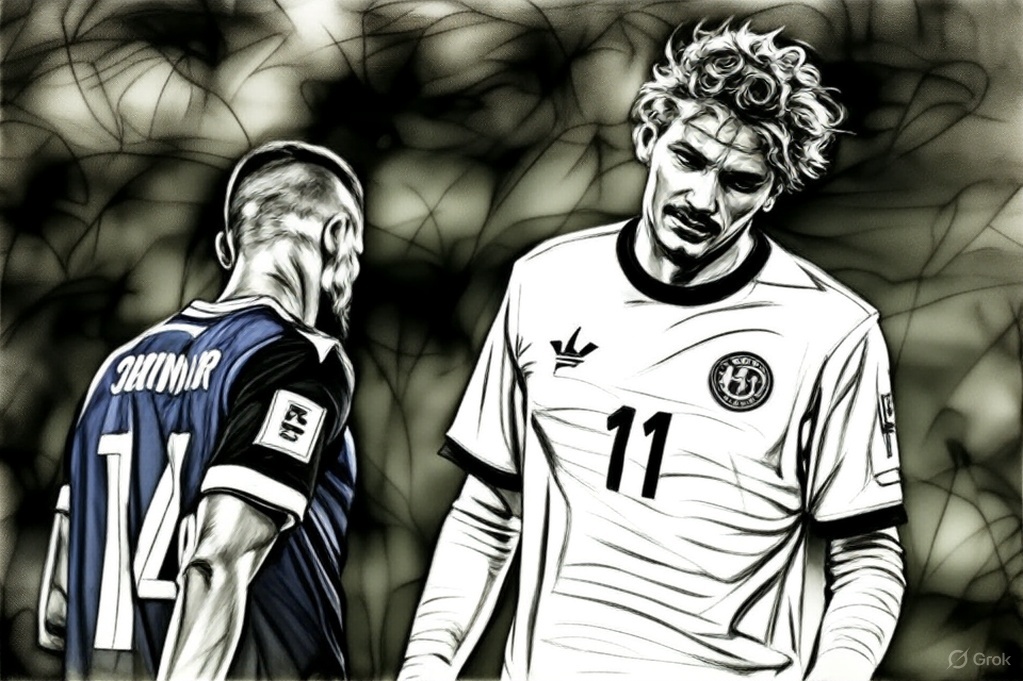
The spreadsheet says Germany should have won. The scoreboard says Slovakia already did. In Bratislava’s Tehelné pole on September 4th, 2025, mathematics collided with reality in the most brutal way possible: Germany’s 52-game unbeaten streak in away World Cup qualifiers didn’t just end—it shattered against the rocks of Slovakian precision. This wasn’t robbery; it was a masterclass in maximizing moments while your opponent drowns in their own possession.

The Model’s Whisper vs. Reality’s Roar
Strip away the noise and you find Germany nudging ahead on raw xG (1.42–1.30), their predicted scoreline tilting 1.68–1.14 in their favor. The xPTS model handed them 1.46 points to Slovakia’s 1.27—essentially calling it a coin flip with Germanic edges. But here’s where the beautiful game laughs at probability: football isn’t played on spreadsheets, and Slovakia turned statistical marginalia into match-defining chasms.

The first rupture came through shot placement—an art form Slovakia mastered while Germany forgot the manual. Watch how Slovakia’s xGOT rocketed from 1.30 to 2.24, a staggering 72% uplift that screams elite execution. Every strike found corners, exploited heights, challenged keepers at velocities that turn average saves into highlight-reel attempts. Meanwhile, Germany’s finishing withered under pressure, their xGOT plummeting from 1.42 to 1.04—a 27% decrease that tells you everything about their risk-averse, safety-first shooting that played directly into Martin Dúbravka’s gloves.
That +0.94 xGOT delta favoring Slovakia? That’s not variance—that’s the difference between killers and technicians.

The Goalkeeping Swing That Changed Everything
Layer in the men between the sticks and the picture sharpens further. Dúbravka became a wall, conceding zero from 1.04 xGOT—essentially saving +1.0 goals above expectation. Oliver Baumann, despite facing hellfire in the form of 2.24 xGOT, could only manage +0.24 in saves. Combine those swings and you’re staring at ~1.3 goals of pure goalkeeping advantage to Slovakia. In a sport where single moments define legacies, that’s the entire margin wrapped in latex gloves.
Territory Without Teeth
Germany’s 70% possession reads like domination until you realize it was football’s equivalent of shadowboxing. Those 614 passes at 89% accuracy? Window dressing. The 14 shots? Thirteen got blocked or sailed harmlessly wide. Slovakia’s compact 4-3-3 didn’t just absorb pressure—it weaponized German sterility, forcing them into low-leverage positions where possession becomes prison.
The shot quality tells the real story: Germany averaged a paltry 0.10 xG per attempt while Slovakia generated 0.16 xG per shot. When you need fewer attempts to create better chances, you’re not lucky—you’re clinical. Slovakia hit the target five times from eight attempts; Germany managed four from fourteen. That’s not variance; that’s the difference between a scalpel and a sledgehammer.


The Temporal Battlefield
Slovakia owned the first half with surgical precision, generating 1.11 xG to Germany’s sleepy 0.53. Dávid Hancko’s 42nd-minute opener—born from a German turnover that Antonio Rüdiger will see in nightmares—exemplified their approach: wait, strike, devastate. When David Strelec curled home Slovakia’s second ten minutes after the restart, following his earlier assist to Hancko, the match transformed from contest to containment.
Germany’s second-half surge (0.89 xG to Slovakia’s 0.19) came too late, pressing against a locked door with no key. The game state had shifted irrevocably—Slovakia could afford to absorb, to bend without breaking, knowing Germany’s finishing couldn’t cash the checks their possession was writing.
Creation Channels: The Open-Play Paradox
Here’s where the tactical anatomy gets fascinating. Slovakia generated 100% of their xG from open play—pure, unfiltered football at its most ruthless. Both goals emerged from transition moments where German structure evaporated: Hancko exploiting defensive confusion, Strelec dancing past Rüdiger like the defender was standing still.
Germany’s creation profile? A concerning 26% came from set pieces (0.37 of their 1.42 total xG), revealing their live-ball impotence. When you’re leaning on dead balls for over a quarter of your threat despite monopolizing possession, you’re not controlling—you’re flailing. Their open-play xG of 1.05 from 70% possession is damning evidence of sterile circulation rather than incisive penetration.

The Human Element: When Debuts Become Disasters
Julian Nagelsmann’s experimental lineup—Newcastle’s Nick Woltemade leading the line in just his third cap, 21-year-old Nnamdi Collins making his debut at right-back—became a case study in why qualifiers aren’t laboratories. Collins was hooked at halftime after being repeatedly burned by Slovakia’s direct running. The defensive axis of Rüdiger and Jonathan Tah, typically Germany’s foundation, crumbled under minimal pressure, committing the errors that birthed both goals.
Germany’s 18 fouls to Slovakia’s 12 reveals the frustration—a team chasing shadows, breaking up play through desperation rather than design. Their 13 clearances (compared to Slovakia’s 40) tells you who was under siege, but also who was comfortable being besieged.
Historical Tremors and Future Earthquakes
This wasn’t just a loss—it was Germany’s first away defeat in World Cup qualifying from 53 attempts, their third consecutive competitive defeat following June’s Nations League failures against Portugal and France. For a nation that hasn’t missed a World Cup since 1930 (excluding bans), that aims to win the 2026 tournament according to Nagelsmann’s pre-match declarations, this was seismic.
The absence of stars magnified the problems—no Jamal Musiala, no Kai Havertz, no Marc-André ter Stegen—but elite teams find ways. Slovakia, missing their own pieces like winger Luka Haraslin, didn’t just find a way; they carved one through German assumptions with a £6.5 million striker (Strelec’s recent move to Middlesbrough looking like highway robbery now) and a defense marshaled by Milan Škriniar that simply refused to break.
The Emotional Void
Nagelsmann’s post-match autopsy cut deepest not through tactical analysis but emotional indictment: “We did not show any emotionality in our game today. In terms of emotions, the opponents were miles ahead of us.” When Bastian Schweinsteiger calls your performance “lifeless” and sporting director Rudi Völler uses the same word, you’re not just losing football matches—you’re losing identity.
The xG fairness metric reading 54% confirms what the eye saw—this wasn’t theft but earned reward. Slovakia maximized their moments while Germany maximized their possession, and in football’s cruel arithmetic, only one of those currencies spends.
The Path Forward: From Probability to Reality
Germany’s prescription is clear even if the medicine is bitter. First, they must elevate pre-shot quality—more penalty box penetration, fewer speculative efforts from the channels. That 27% xG-to-xGOT dropoff is catastrophic at this level; finishing drills need to close that leak before it becomes a flood.
Second, transition defense requires immediate surgery. Both Slovakian goals followed German turnovers or positional errors that created the space elite players punish. When your center-backs are “playing on their heels” as observers noted, you’re inviting disaster.
Third, the set-piece crutch must become a weapon, not a lifeline. Use dead balls to tilt match states early, not to rescue them late. Germany’s second-half surge came after the game was functionally over—that sequencing must reverse.
Finally, and perhaps most critically, Germany must rediscover their emotional core. Talent without hunger is just potential energy; Slovakia showed what kinetic fury looks like when channeled through tactical discipline. The hosts didn’t just want it more—they executed their want with precision that turned probability into irrelevance.
The Bottom Line
Germany’s process wasn’t catastrophic—the underlying numbers suggest a draw or narrow win on most nights. But Slovakia’s execution in the moments that mattered was sublime. This is football’s beautiful cruelty: you can dominate territory, complete passes at will, generate decent chances, and still lose 2-0 because your opponent turns their fewer opportunities into gold while you turn yours into dust.
The model says Germany won. The table, the only metric that ultimately matters, says Slovakia won better. In qualification campaigns where every point carries weight, Germany just learned that possession without penetration, control without conviction, and statistics without soul amount to nothing when the whistle blows.
For Slovakia—seeking their first World Cup since 2010—this wasn’t just a victory but a statement. For Germany, it’s a wake-up call arriving at dawn of a campaign they cannot afford to sleepwalk through. The spreadsheet will regress to the mean over time. But time, in the compressed reality of World Cup qualification, is a luxury Germany just spent in Bratislava.
The beautiful game’s cruelest lesson? Sometimes the math is right, and you still lose. Sometimes you deserve to.
Key Football Statistics Glossary
| Statistic | Explanation |
|---|---|
| xG (Expected Goals) | The probability that a shot will result in a goal based on factors like distance, angle, and type of assist (0.0 = no chance, 1.0 = certain goal). |
| xGOT (Expected Goals on Target) | The probability a shot on target will score based on its placement, power, and trajectory after it’s been struck. |
| xPTS (Expected Points) | The probable points a team should earn from a match based on the quality of chances created and conceded. |
| xAG (Expected Assists) | The likelihood that a pass will become an assist based on the position and situation where the receiving player takes their shot. |
| xG/shot | The average quality of each shot attempt, revealing whether a team creates high-quality or low-quality chances. |
| xG Fairness | A percentage indicating whether the actual result aligned with the expected outcome based on chance quality (50% = perfectly fair). |
| Post-shot uplift/decrease | The percentage change between xG and xGOT, showing whether a player’s finishing improved or worsened their scoring probability. |
| Goals saved above expectation | The difference between goals a keeper actually conceded versus what they should have conceded based on shot quality faced. |
| Open-play vs Set-piece xG | The breakdown of expected goals from live play versus dead-ball situations like corners and free kicks. |
| Possession % | The percentage of time a team controls the ball during the match. |
| Pass completion % | The percentage of attempted passes that successfully reach a teammate. |


Leave a Reply