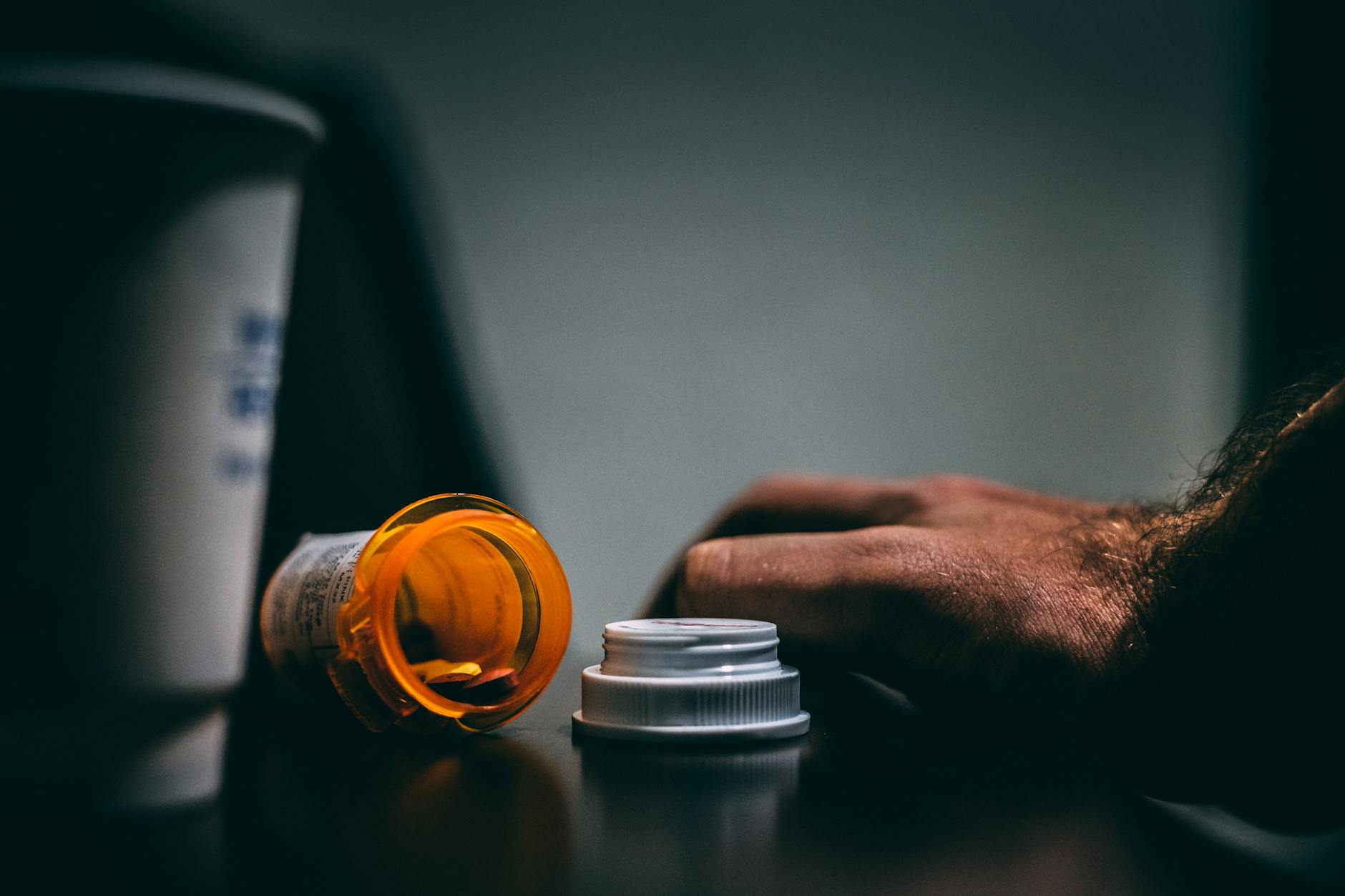
In the dim basement of a Salt Lake City pharmacy, hundreds of amber-colored plastic pill bottles sit stacked in rows, one man’s defensive wall in a tariff war.
Independent pharmacist Benjamin Jolley and his colleagues worry that the tariffs, aimed at bringing drug production to the United States, could instead drive companies out of business while raising prices and creating more of the drug shortages that have plagued American patients for several years.
Jolley bought six months’ worth of the most expensive large bottles, hoping to shield his business from the 10% across-the-board tariffs on imported goods that President Donald Trump announced April 2. Now with threats of additional tariffs targeting pharmaceuticals, Jolley worries that costs will soar for the medications that will fill those bottles.
In principle, Jolley said, using tariffs to push manufacturing from China and India to the U.S. makes sense. In the event of war, China could quickly stop all exports to the United States.
“I understand the rationale for tariffs. I’m not sure that we’re gonna do it the right way,” Jolley said. “And I am definitely sure that it’s going to raise the price that I pay my suppliers.”
Squeezed by insurers and middlemen, independent pharmacists such as Jolley find themselves on the front lines of a tariff storm. Nearly everyone down the line — drugmakers, pharmacies, wholesalers, and middlemen — opposes most tariffs.
Slashing drug imports could trigger widespread shortages, experts said, because of America’s dependence on Chinese- and Indian-made chemical ingredients, which form the critical building blocks of many medicines. Industry officials caution that steep tariffs on raw materials and finished pharmaceuticals could make drugs more expensive.
“Big ships don’t change course overnight,” said Robin Feldman, a UC Law San Francisco professor who writes about prescription drug issues. “Even if companies pledge to bring manufacturing home, it will take time to get them up and running. The key will be to avoid damage to industry and pain to consumers in the process.”
Trump on April 8 said he would soon announce “a major tariff on pharmaceuticals,” which have been largely tariff-free in the U.S. for 30 years.
“When they hear that, they will leave China,” he said. The U.S. imported $213 billion worth of medicines in 2024 — from China but also India, Europe, and other areas.
Trump’s statement sent drugmakers scrambling to figure out whether he was serious, and whether some tariffs would be levied more narrowly, since many parts of the U.S. drug supply chain are fragile, drug shortages are common, and upheaval at the FDA leaves questions about whether its staffing is adequate to inspect factories, where quality problems can lead to supply chain crises.
On May 12, Trump signed an executive order asking drugmakers to bring down the prices Americans pay for prescriptions, to put them in line with prices in other countries.
Meanwhile, pharmacists predict even the 10% tariffs Trump has demanded will hurt: Jolley said a potential increase of up to 30 cents a vial is not a king’s ransom, but it adds up when you’re a small pharmacy that fills 50,000 prescriptions a year.
“The one word that I would say right now to describe tariffs is ‘uncertainty,’” said Scott Pace, a pharmacist and owner of Kavanaugh Pharmacy in Little Rock, Arkansas.
To weather price fluctuations, Pace stocked up on the drugs his pharmacy dispenses most.
Sign up for the Daily Dose Newsletter and get every morning’s best science news from around the web delivered straight to your inbox? It’s easy like Sunday morning.
“I’ve identified the top 200 generics in my store, and I have basically put 90 days’ worth of those on the shelf just as a starting point,” he said. “Those are the diabetes drugs, the blood pressure medicines, the antibiotics — those things that I know folks will be sicker without.”
Pace said tariffs could be the death knell for the many independent pharmacies that exist on “razor-thin margins” — unless reimbursements rise to keep up with higher costs.
Unlike other retailers, pharmacies can’t pass along such costs to patients. Their payments are set by health insurers and pharmacy benefit managers largely owned by insurance conglomerates, who act as middlemen between drug manufacturers and purchasers.
Neal Smoller, who employs 15 people at his Village Apothecary in Woodstock, New York, is not optimistic.
“It’s not like they’re gonna go back and say, well, here’s your 10% bump because of the 10% tariff,” he said. “Costs are gonna go up and then the sluggish responses from the PBMs — they’re going to lead us to lose more money at a faster rate than we already are.”
Smoller, who said he has built a niche selling vitamins and supplements, fears that FDA firings will mean fewer federal inspections and safety checks.
“I worry that our pharmaceutical industry becomes like our supplement industry, where it’s the wild West,” he said.

Narrowly focused tariffs might work in some cases, said Marta Wosińska, a senior fellow at the Brookings Institution’s Center on Health Policy. For example, while drug manufacturing plants can cost $1 billion and take three to five years to set up, it would be relatively cheap to build a syringe factory — a business American manufacturers abandoned during the covid-19 pandemic because China was dumping its products here, Wosińska said.
It’s not surprising that giants such as Novartis and Eli Lilly have promised Trump they’ll invest billions in U.S. plants, she said, since much of their final drug product is made here or in Europe, where governments negotiate drug prices. The industry is using Trump’s tariff saber-rattling as leverage; in an April 11 letter, 32 drug companies demanded European governments pay them more or face an exodus to the United States.
Brandon Daniels, CEO of supply chain company Exiger, is bullish on tariffs. He thinks they could help bring some chemical manufacturing back to the U.S., which, when coupled with increased use of automation, would reduce the labor advantages of China and India.
“You’ve got real estate in North Texas that’s cheaper than real estate in Shenzhen,” he said at an economic conference April 25 in Washington, referring to a major Chinese chemical manufacturing center.
But Wosińska said no amount of tariffs will compel makers of generic drugs, responsible for 90% of U.S. prescriptions, to build new factories in the U.S. Payment structures and competition would make it economic suicide, she said.

Several U.S. generics firms have declared bankruptcy or closed U.S. factories over the past decade, said John Murphy, CEO of the Association for Accessible Medicines, the generics trade group. Reversing that trend won’t be easy and tariffs won’t do it, he said.
“There’s not a magic level of tariffs that magically incentivizes them to come into the U.S.,” he said. “There is no room to make a billion-dollar investment in a domestic facility if you’re going to lose money on every dose you sell in the U.S. market.”
His group has tried to explain these complexities to Trump officials, and hopes word is getting through. “We’re not PhRMA,” Murphy said, referring to the powerful trade group primarily representing makers of brand-name drugs. “I don’t have the resources to go to Mar-a-Lago to talk to the president myself.”
Many of the active ingredients in American drugs are imported. Fresenius Kabi, a German company with facilities in eight U.S. states to produce or distribute sterile injectables — vital hospital drugs for cancer and other conditions — complained in a letter to U.S. Trade Representative Jamieson Greer that tariffs on these raw materials could paradoxically lead some companies to move finished product manufacturing overseas.
Fresenius Kabi also makes biosimilars, the generic forms of expensive biologic drugs such as Humira and Stelara. The United States is typically the last developed country where biosimilars appear on the market because of patent laws.
Tariffs on biosimilars coming from overseas — where Fresenius makes such drugs — would further incentivize U.S. use of more expensive brand-name biologics, the March 11 letter said. Biosimilars, which can cost a tenth of the original drug’s price, launch on average 3-4 years later in the U.S. than in Canada or Europe.
In addition to getting cheaper knockoff drugs faster, European countries also pay far less than the United States for brand-name products. Paradoxically, Murphy said, those same countries pay more for generics.
European governments tend to establish more stable contracts with makers of generics, while in the United States, “rabid competition” drives down prices to the point at which a manufacturer “maybe scrimps on product quality,” said John Barkett, a White House Domestic Policy Council member in the Biden administration.
As a result, Wosińska said, “without exemptions or other measures put in place, I really worry about tariffs causing drug shortages.”
Smoller, the New York pharmacist, doesn’t see any upside to tariffs.
“How do I solve the problem of caring for my community,” he said, “but not being subject to the emotional roller coaster that is dispensing hundreds of prescriptions a day and watching every single one of them be a loss or 12 cents profit?”
This article was originally published in KFF Health News and NPR.
WORDS: Jackie Fortiér: jfortier@kff.org, @JackieFortier; Arthur Allen: aallen@kff.org, @ArthurAllen202
If you enjoy the content we create and would like to support us, please consider becoming a patron on Patreon! By joining our community, you’ll gain access to exclusive perks such as early access to our latest content, behind-the-scenes updates, and the ability to submit questions and suggest topics for us to cover. Your support will enable us to continue creating high-quality content and reach a wider audience.
Join us on Patreon today and let’s work together to create more amazing content! https://www.patreon.com/ScientificInquirer




Leave a Reply