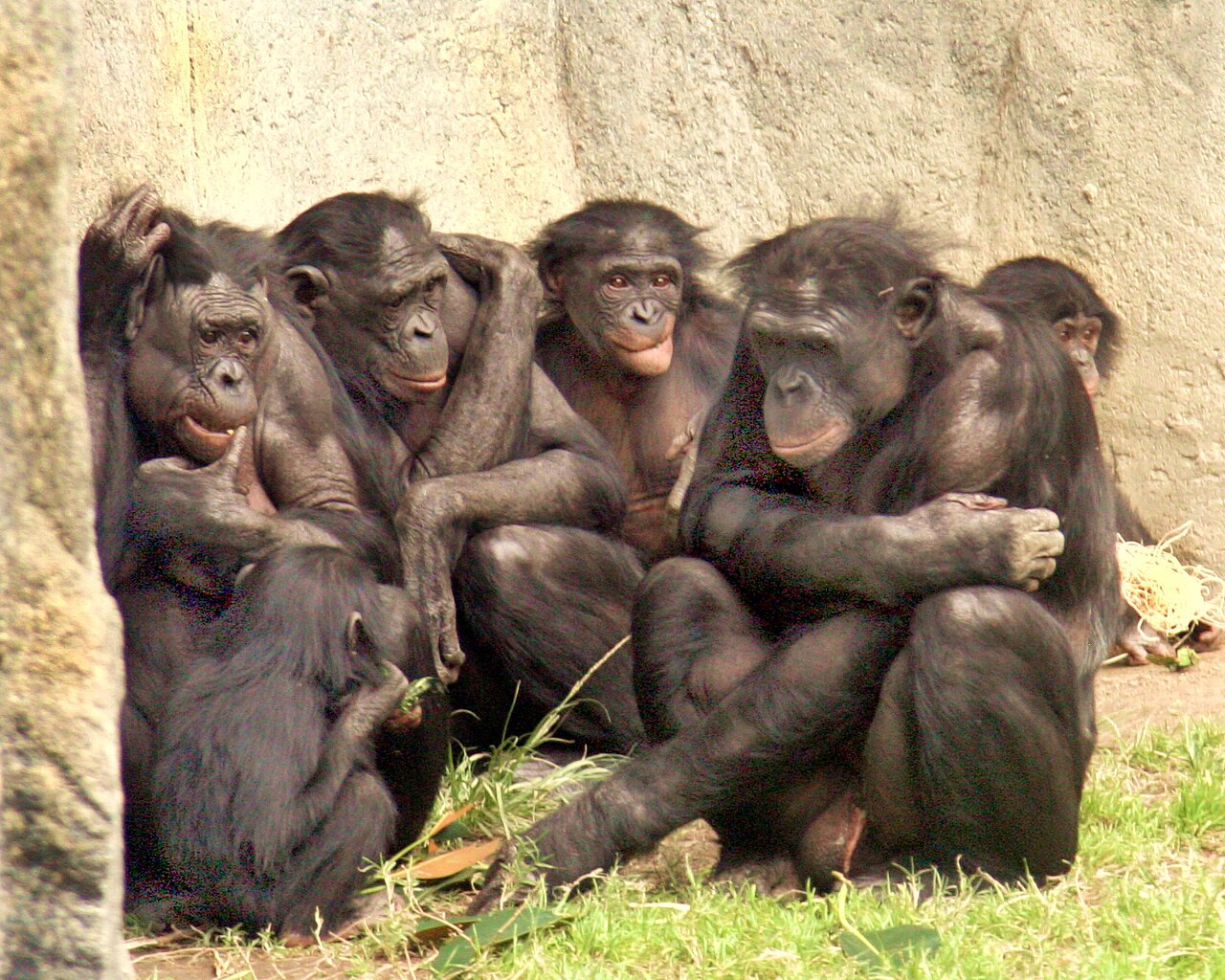
Researchers from the University of Zurich and Harvard University have made a groundbreaking discovery, demonstrating that bonobos—our closest living relatives—combine their vocalizations into complex, meaningful structures similar to human language. This research challenges long-standing assumptions about human uniqueness in language, indicating that key aspects of linguistic communication may be far more ancient and widespread than previously thought.
In their study, published in the journal Science, the researchers meticulously documented bonobo calls in the Kokolopori Community Reserve in the Democratic Republic of Congo. They applied novel linguistic techniques to analyze bonobo vocal behavior, revealing both trivial and nontrivial compositional structures. According to lead researcher Mélissa Berthet, this allowed them to construct “a bonobo dictionary of sorts – a complete list of bonobo calls and their meaning.”
“This represents an important step towards understanding the communication of other species, as it is the first time that we have determined the meaning of calls across the whole vocal repertoire of an animal,” Berthet explained.
Compositionality, the ability to combine individual meaningful elements into larger meaningful phrases, is central to human language and has several distinct forms. In trivial compositionality, the meaning of a phrase is simply the direct sum of its constituent parts without any modification or alteration. For instance, the phrase “blond dancer” straightforwardly describes someone who is both blond and a dancer.
Conversely, nontrivial compositionality involves a more complex relationship, where one element modifies or significantly changes the meaning of another. For example, the phrase “bad dancer” does not imply a dancer who is morally bad, but rather someone whose dancing is poor in quality. The bonobos studied exhibited both forms of compositionality, including three call combinations specifically identified as nontrivial. These findings underscore a complexity in animal communication systems previously assumed unique to human speech, revealing that bonobos use calls in sophisticated ways that modify and refine the meaning conveyed by individual vocalizations.
Simon Townsend, senior author of the study, noted, “With our approach, we were able to quantify how the meaning of bonobo single calls and call combinations relate to each other.” Importantly, Townsend emphasized that their findings indicate “the capacity to combine call types in complex ways is not as unique to humans as we once thought.”
The implications of these findings stretch far into our evolutionary past. Given that humans and bonobos shared a common ancestor around 7 to 13 million years ago, this study suggests compositional communication might date back at least this far. Harvard Professor and co-author Martin Surbeck pointed out, “Since humans and bonobos had a common ancestor approximately 7 to 13 million years ago, they share many traits by descent, and it appears that compositionality is likely one of them.”
This bonobo research adds significantly to a growing body of evidence showing that sophisticated communication is more widespread among animals than traditionally recognized. Recent studies have unveiled similarly complex communication among birds and dolphins, yet the detailed compositional structure of bonobo calls stands out distinctly. Unlike simpler call systems, the bonobos’ repertoire involves nuanced structures capable of conveying sophisticated social cues and emotional states.
The discovery underscores how much remains unknown about animal communication systems and suggests that many animals likely communicate in ways more akin to human language than previously imagined. Townsend concludes, “Our study therefore suggests that our ancestors already extensively used compositionality at least 7 million years ago, if not more,” fundamentally reshaping our understanding of the evolutionary origins of language.
IMAGE CREDIT: Wcalvin



Leave a Reply