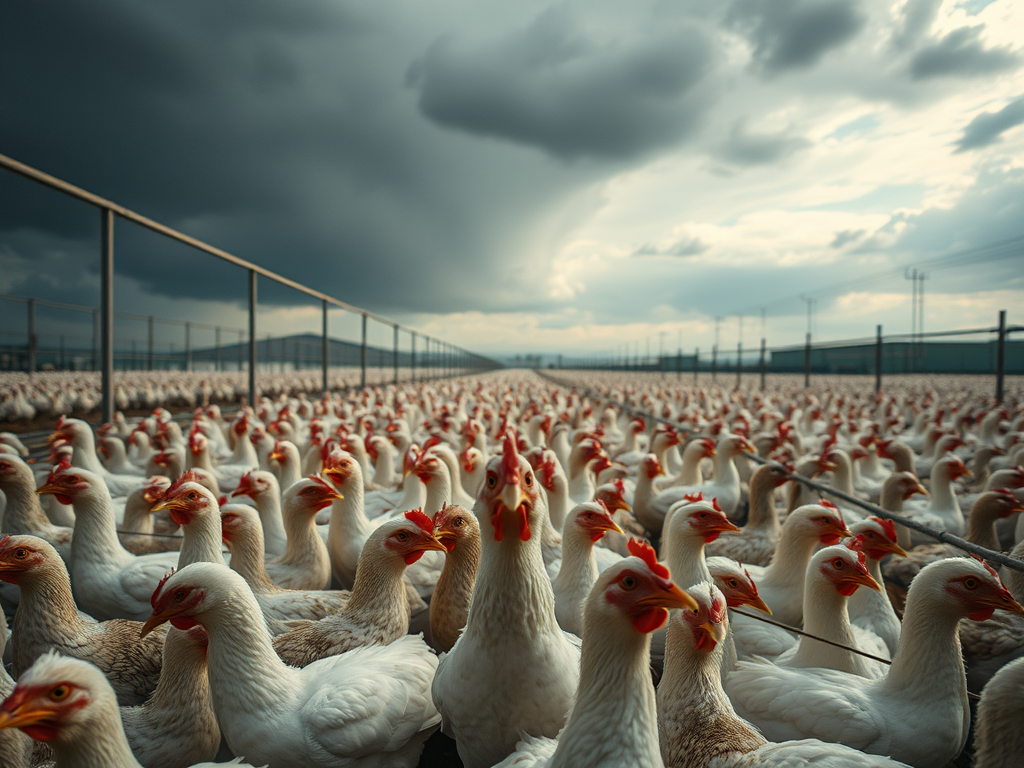
H5N1 AVIAN FLU OUTBREAKS IMPACT POULTRY FARMS NATIONWIDE
The USDA Animal and Plant Health Inspection Service (APHIS) reported new H5N1 avian flu outbreaks affecting multiple poultry farms across four states, including Ohio, the second-largest poultry producer in the US. Ohio saw significant outbreaks, including a commercial farm in Darke County with over 3 million birds and another in Mercer County with 85,000 birds. Indiana also reported two commercial farm outbreaks, including a turkey farm in Washington County and a duck-breeding facility in Elkhart County. Additionally, backyard bird cases were confirmed in Florida and New York. Over the last 30 days, nearly 19 million birds have been lost to the virus. In dairy cattle, Nevada has reported its eighth affected herd, bringing the total to 973 herds across 17 states since the virus was first detected in dairy cattle. The CDC confirmed two recent human cases, one in Ohio and one in Wyoming, with a total of 70 confirmed cases and one fatality in 2024. (CIDRAP)
BROOKE ROLLINS OUTLINES STRATEGIES TO COMBAT BIRD FLU
On her first day as USDA Secretary, Brooke Rollins discussed strategies to combat the bird flu outbreak and address soaring egg prices. In meetings with farmers, she promised relief, acknowledging the difficulty of resolving the issue quickly. Economists blame the bird flu for the sharp rise in egg prices, with the virus affecting over 162 million poultry, particularly egg-laying hens. While culling has been the main response, some suggest exploring vaccination, though trade restrictions on vaccinated poultry and logistical challenges pose significant hurdles. The National Chicken Council opposes vaccination due to concerns about export markets. Meanwhile, the virus has spread to other animals, including dairy cows, complicating containment efforts. Scientists worry the virus, now endemic in the U.S., could adapt to humans. While the flu remains a low human threat, 70 people have been infected, mostly farm workers and those with backyard flocks. (CNN)
MEASLES OUTBREAK IN WEST TEXAS SPREADS TO MULTIPLE COUNTIES
A measles outbreak in west Texas has led to 99 confirmed cases, with additional suspected cases, as health officials investigate exposures across the state. The outbreak, primarily centered in the Mennonite community in Gaines County, has spread to several neighboring counties, including Ector and Yoakum. On February 21, the Texas Department of State Health Services (TDSHS) reported 32 new cases, pushing the total to 90, with 16 patients hospitalized. Five were vaccinated, and the rest were unvaccinated or had unknown vaccination status. In New Mexico, six more cases were confirmed in Lea County, bordering Gaines County. The TDSHS also reported measles exposures at Texas State University and the University of Texas at San Antonio between February 14 and 16. The CDC has reported 93 cases this year across eight jurisdictions, with 95% of patients unvaccinated or with unknown vaccination status. Most affected individuals are children and teens. (CIDRAP)
NORTH KOREA LINKED TO MASSIVE $1.5 BILLION CRYPTO HEIST
A massive cryptocurrency heist, likely orchestrated by North Korea, drained $1.5 billion from Dubai-based exchange Bybit, marking the largest theft in digital asset history. The theft involved over 400,000 ethereum and staked ethereum coins that were transferred from Bybit’s “Multisig Cold Wallet” to hot wallets, and then into attackers’ wallets. Despite cold wallets being considered secure due to their offline nature, the attackers managed to exploit a vulnerability in Bybit’s smart contract logic, manipulating the user interface (UI) of employees who approved the transfer. This breach demonstrated that even multisig protections can be bypassed through sophisticated UI manipulation and social engineering, highlighting the human element as the weakest link in crypto security. North Korea has a history of using cryptocurrency theft to fund its weapons programs. The attack underscores the need for improved security practices, including better network segmentation and defense-in-depth strategies.(Ars Technica)

US MISSING KEY INTERNATIONAL CLIMATE MEETINGS UNDER TRUMP
US officials have missed several key international climate meetings since Donald Trump’s second term began, raising concerns about the country’s future role in global climate efforts. Despite Trump’s exit from the Paris Agreement, his first term saw US participation in UNFCCC meetings. However, in recent weeks, US representatives have been absent from at least four international climate forums, including a UNFCCC climate finance committee and an IPCC meeting. Trump has also reportedly blocked US scientists from attending an IPCC session as it prepares its seventh report. Critics fear the US may disengage entirely from climate change negotiations, undermining global efforts to address the crisis. Experts warn that a diminished US presence could create a “power gap” in international discussions, potentially allowing countries with lower climate ambitions, like petrostates, to dominate. Trump’s decision to rescind $4 billion from the Green Climate Fund further signals a shift in the US’s climate stance. (The Guardian)
MUKESH AMBANI TARGETS SMALL BUSINESS AND NEUROSCIENCE FOR IPL STREAMING BOOST
After a $8.5 billion merger with Walt Disney, Indian billionaire Mukesh Ambani is focusing on small businesses and neuroscience to boost streaming revenues from the Indian Premier League (IPL). Reliance aims to attract small advertisers with ad packages starting at $17,000, emphasizing the IPL’s high engagement rates. The company is using “brain mapping” research to show its streaming ads outperform Google and Meta’s platforms. To combat rising competition in the $28-billion Indian digital ad market, Reliance plans to use user data to target ads by factors such as age, income, and location. Despite facing pressure from hefty investments in IPL rights and battling tech giants like Google and Meta, Reliance is banking on the IPL’s vast popularity to attract advertisers. However, challenges remain, as Reliance’s ads face tough competition, and its efforts to offer more affordable options for small businesses have met with mixed responses. (Reuters)
NASA SAYS ASTEROID 2024 YR4 NO LONGER THREATENS EARTH
NASA announced that the asteroid 2024 YR4, which had a heightened chance of hitting Earth in 2032, now poses no significant threat. Initially, the asteroid had a 1% chance of impact, with probabilities rising to 3.1% in January and February. This raised concerns, especially as the asteroid, between 130 and 300 feet wide, could potentially destroy a city. However, as more data was collected, the odds of impact steadily decreased, reaching 0.004% on February 19, and further diminishing to 0.0017% shortly after. NASA confirmed the asteroid’s trajectory has become much clearer, and there is now virtually no chance it will hit Earth. While a slight chance remains that it could strike the Moon (1.7%), the asteroid will be out of view until 2028. NASA continues to monitor the object, emphasizing that early detection is key to managing asteroid risks. (New York Times)
OXFORD SCIENTISTS TELEPORT DATA BETWEEN QUANTUM COMPUTERS
Scientists at the University of Oxford have achieved a groundbreaking milestone in quantum technology: teleporting data between two quantum computers. While the transmission distance was just under two meters, this experiment demonstrates the potential of sending information without traditional connections, such as cables or Wi-Fi. Quantum teleportation works through “entanglement,” where subatomic particles called qubits form a bond that allows them to mirror each other’s state instantly, regardless of distance. Unlike classical bits, which can only be 0 or 1, qubits can represent both at once, enabling quantum computers to process information much faster. The Oxford experiment successfully transmitted qubit information with 86% accuracy, showing potential for a future “quantum internet” that is faster and more secure. This achievement, using Grover’s Algorithm to search quantum data, marks a significant step toward revolutionizing data transmission. Though small now, this breakthrough signals the arrival of quantum communication in the near future. (Union Rayo)
CHINESE ROVER FINDS EVIDENCE OF ANCIENT BEACHES ON MARS
Ground-penetrating radar from China’s Zhurong rover has uncovered evidence of ancient “beaches” on Mars, suggesting the presence of a large ocean, called Deuteronilus, about 3.5 to 4 billion years ago. This ocean could have supported life, similar to Earth’s primordial seas. The rover, which operated from May 2021 to May 2022, detected thick layers of sand-like material buried up to 35 meters beneath the surface, aligned like Earth’s beaches where waves meet the shore. These findings are located in the southern part of Utopia Planitia and span 1.2 km. Scientists ruled out other explanations like wind-blown dunes or ancient rivers, concluding that the structures are most likely coastal deposits formed by wave action. This discovery provides valuable insights into Mars’ ancient climate and its potential for life, with some water possibly still trapped underground, as suggested by recent seismic data. (Channel News Asia)
DNA EVIDENCE LINKS HUNS TO ANCIENT XIONGNU NOMADS
New DNA evidence sheds light on the origins of the Huns, the nomadic warriors who helped bring about the decline of the Roman Empire. Historians have long speculated that the Huns might be descendants of the Xiongnu, a group of steppe nomads who threatened China’s borders from 200 BCE. While archaeological evidence was inconclusive, a recent DNA analysis has confirmed that some Huns were indeed descendants of the Xiongnu elite, though they formed part of a larger coalition of tribes, most of whom came from closer to Rome. The study, based on the remains of Huns buried in Hungary between 400 and 500 CE, revealed that while some had clear genetic ties to the Xiongnu, most Huns had little genetic connection to East Asia. The study suggests that after the fall of the Xiongnu Empire, their elites scattered, and some eventually moved west, blending with other tribes. These descendants later united under Attila the Hun. (Science)
STUDY FINDS URINATION IN CHIMPANZEES IS SOCIALLY CONTAGIOUS
A study in Japan found that urination in chimpanzee troops is contagious, with lower-status individuals more likely to mimic others. The research, conducted over 600 hours in Kumamoto Prefecture by Kyoto University, revealed that urination events occurred more synchronously than expected, particularly among individuals in close physical proximity. The study, a world first, indicates that social influence plays a role in this behavior, akin to other socially contagious actions like yawning or mass movements in herds. While the exact reasons for contagious urination remain unclear, possible explanations include strengthening social bonds, aiding group behavior, and reducing the risk of detection by predators. The findings highlight how seemingly trivial behaviors can provide insights into social evolution and group dynamics. The study was published in *Current Biology* on January 20, 2024. (Asahi Shinbun)
SVALBARD SEED VAULT TO RECEIVE 14,000 NEW SAMPLES
The Svalbard Global Seed Vault, a “doomsday” facility in Norway designed to protect food crop seeds from global disasters, will receive more than 14,000 new seed samples on Tuesday. The vault, established in 2008 inside a mountain, serves as a backup for the world’s gene banks, safeguarding the genetic diversity of thousands of plant species. It has played a crucial role in rebuilding seed collections damaged during the war in Syria. The new samples include 15 varieties of sorghum from Sudan, a vital crop for the country’s food security and cultural heritage, amid the ongoing conflict in Sudan that has caused widespread hunger. The total of 14,022 new samples, also including Nordic tree seeds from Sweden and rice from Thailand, underscores the global importance of preserving agricultural biodiversity. The vault stands as a symbol of resilience, offering hope for future generations amid global challenges. (Reuters)
Thanks for reading. Let’s be careful out there.
WORDS: The Biology Guy.




Leave a Reply