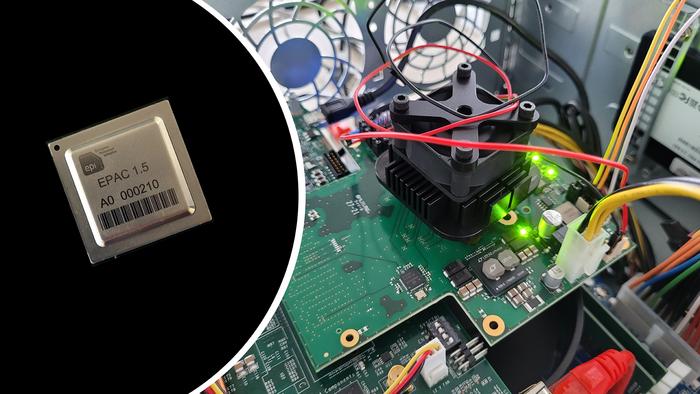
New technology from Chalmers University of Technology and the University of Gothenburg, Sweden, is helping the EU establish its own competitive computer manufacturing industry. Researchers have developed components critical for optimising on-chip memory, a key factor in enhancing the performance of next-generation computers.
The research leader, Professor Per Stenström, along with colleagues, has discovered new ways to make cache memory work smarter. A cache is a local memory that temporarily stores frequently accessed data, improving a computer’s speed and performance.
“Our solution enables computers to retrieve data significantly faster than before, as the cache can manage far more processing elements (PEs) than most existing systems. This makes it possible to meet the demands of tomorrow’s powerful computers,” says Per Stenström, Professor at the Department of Computer Science and Engineering at Chalmers University of Technology and the University of Gothenburg.
The solution improves the cache memory’s access to information about how and where data is processed in the system. As a result, the cache becomes better at managing data, which enhances its speed.
A step towards manufacturing competitive computers in Europe
This innovation is part of the European project, The European Processor Initiative (EPI), aimed at establishing a European processor industry and making Europe independent in high-performance computing chips. To secure European access to computers, Per Stenström argues, EU member states must control the entire chain, from intellectual property rights to manufacturing.
Sign up for the Daily Dose Newsletter and get every morning’s best science news from around the web delivered straight to your inbox? It’s easy like Sunday morning.
“The uncertain global landscape makes it even more important to secure European independence in advanced computing technology. Following the acute shortage of semiconductors, or computer chips, during the COVID-19 pandemic, the EU decided to invest 43 billion euros to ensure the supply of semiconductors within the EU through The European Chips Act, which came into effect in 2023. Semiconductors are a vital part of physical computer manufacturing, but expertise throughout the development chain also need to be secured,” says Stenström.
Currently, Europe relies heavily on American technology, with most expertise concentrated in the USA, while nearly all computer manufacturing takes place in Asia.
“This project aims to ensure that Europe can develop competitive computer technology capable of matching the world’s best manufacturers. It is part of a long-term strategy to become self-sufficient with globally competitive products by around 2030,” says Per Stenström, who is also the principal investigator for EPI at Chalmers.
“Supercomputers” to become reality in a few years
The first use of the research group’s components will be in a European high-performance computing system, planned for 2030.
“It will be one of the fastest classical computers in the world, capable of modeling climate change, weather, and similar computations requiring high processing power,” says Stenström.
However, this technology is not limited to supercomputers; Stenström anticipates that it will be integrated into standard computers within just a few years, enabling faster, more efficient devices for everyday use.
The research has been promoted by the Royal Swedish Academy of Engineering Sciences (IVA), on IVA’s annual 100 List. The list highlights current research with the potential to create value through commercialisation, business and method development or societal impact. The commercial part of the component development is carried out through the deeptech company Infininode, with funding and venture building support through Chalmers Ventures.
IMAGE CREDIT: Filippo Mantovani




Leave a Reply