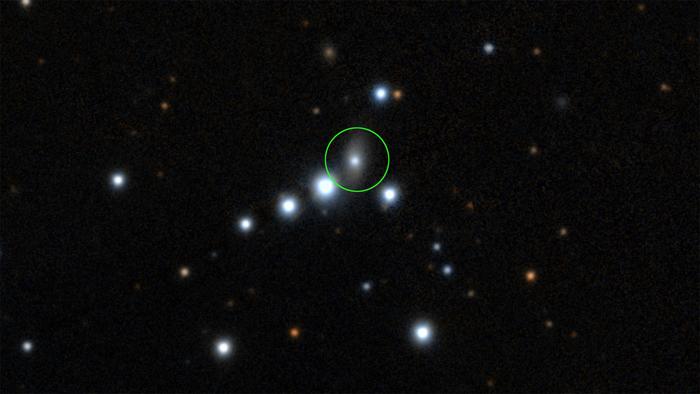
A large international team of scientists has observed a phenomenon that astronomers didn’t ever expect to see happen in real time. The findings are described in a new paper published in Astrophysical Journal Letters led by Eileen Meyer, associate professor of physics at UMBC.
A galaxy about 270 million light-years away from Earth in the constellation Draco called 1ES 1927+654 is the focus of the excitement. For many years, scientists had classified 1ES 1927+654 as an “active galactic nucleus,” or AGN, meaning it has an active black hole at its center. This particular black hole was adding material at a slow rate—until it wasn’t.
Back in 2018, the black hole first made news when it suddenly increased its activity exponentially. It dramatically increased the rate at which it was consuming material and became over 100 times brighter in the visible light spectrum over the course of a few months. A shift like that was once thought to take far longer than a human lifetime, on the order of thousands to millions of years. Since then, scientists have been observing it closely for any additional interesting phenomena, and 1ES 1927+654 has delivered.
After the major increase in activity began in 2018, which included nearly a year of extremely high levels of X-ray emission, the black hole quieted down again by 2020—only to dramatically increase its output again in 2023. At that time, it began emitting radio waves at 60 times the previous intensity over just a few months, behavior which has never been monitored in real time for a supermassive black hole.
Some of the highest-resolution imaging of radio frequency emissions was collected using a technique called Very Long Baseline Interferometry (VLBI). It clearly shows a pair of oppositely directed plasma jets forming near the black hole and expanding outward over the course of 2023 – 2024. Among the other unusual behavior of the black hole, this is the first-ever observation of jet formation in real time.
In recent years, scientists have discovered a handful of supermassive black holes that appear to emit far more intensely at radio frequencies compared to when they were first observed, which they call “changing-look AGN.” However, until now all of them had been observed at two timepoints years or decades apart, and the assumption was that “something happened” in between. This new paper gives the very first look at how this kind of change occurs in detail.
Sign up for the Daily Dose Newsletter and get every morning’s best science news from around the web delivered straight to your inbox? It’s easy like Sunday morning.
In some cases, black hole jets “can reach huge scales well outside the host galaxy. They can affect how many stars are forming,” Meyer says. Figuring out how the jets work “is a very important thing, in order to understand the big picture of how the universe is evolving and galaxies evolved.”
In the case described in the new paper, “We have very detailed observations of a radio jet ‘turning on’ in real time, and even more exciting are the VLBI observations, which clearly show these plasma blobs moving out from the black hole,” Meyer says. “That shows us that this really is an outflow jet of plasma that’s causing the radio flare. It’s not some other process causing increased radio emission. This is a jet moving at likely 20 to 30 percent of the speed of light originating very near a black hole. That’s the exciting thing.”
Sibasish Laha, an assistant research scientist for UMBC with the Center for Space Sciences Technology and second author on the new paper, has long studied changing-look AGN at X-ray wavelengths. On a hunch that 1ES 1927+654’s radio frequency emission might show interesting behavior as well, he reached out to Meyer to form a collaboration to study 1ES 1927+654 and other similar galaxies back in 2020. He is lead author on a companion paper that is currently under review. It includes additional X-ray observations and interpretation of the jet formation event.
“We still do not understand how black holes and their host galaxies interact with each other and co-evolve in cosmic time,” Laha says, “and this study for the first time gives us the rare opportunity to understand how a supermassive black hole ‘talks’ to the host galaxy.”
Not for the faint of heart
In this kind of work, time is of the essence. “Time-domain astronomy,” as it’s called, “is not for the faint of heart,” Meyer says. “You know, there are rapid alerts—something happens and you have to go follow up. You gotta get on it, and it doesn’t matter if it’s midnight, you have to send that email because you know every hour counts. It’s a little stressful.”
The project became an “all hands on deck” moment for the UMBC collaboration. Once Meyer and Laha saw the huge jump in radio activity in 2023, Meyer says, “We were like, ‘whoa, ok, something is happening.’ This has never been seen before. We got very excited, so this is where we went all in on basically trying to grab every radio telescope and get it to look at this source.”
Because 1ES 1927+654 was changing so rapidly before their eyes, the team was awarded new, unscheduled observations on telescopes around the world during the study period, when typically telescope time must be scheduled months or years in advance.
A postdoctoral fellow working with Meyer, Onic Shuvo, who is third author on the paper, took on the lion’s share of the late-night duties, rapidly analyzing incoming data and requesting new observations. He’s thrilled to be part of such an exciting discovery. “This remarkable finding challenges existing models of AGN activity and highlights the unique role that changing-look AGN play in unraveling the mysteries of the central engine of active galaxies in real-time,” Shuvo says.
A new jet is born
The newborn jets coming from 1ES 1927+654 are relatively small compared to the massive jet structures in some of the most powerful AGN, Meyer says. But that doesn’t make them less interesting—in fact, they are probably more common across the universe and therefore very important to understand, she says.
Some data suggested that the 2018 flare, in the visible spectrum, could be due to a “tidal disruption event,” where a large object like a star or cloud of gas gets too close to an inactive black hole and artificially brightens it for just a few years, Meyer says. But observations of tidal disruption events in already-active galaxies are rare and not well understood.
While the largest plasma jets extend well beyond their host galaxies and last millions of years, scientists are gaining understanding of a new class of smaller, shorter-lived jets called “compact symmetric objects,” or CSOs. Meyer believes the data in this case point most strongly to the birth of a new CSO. One recent hypothesis is that jets in CSOs are qualitatively different from the very large and long-lived jets seen elsewhere, Meyer says, perhaps representing “a single ingestion of a star or a gas cloud; basically a single tidal disruption event happens and powers this short-term jet for maybe 1,000 years.”
Perhaps the tidal disruption event occurred several years ago, “and it took a few years for the accreting black hole to organize and start producing the jet,” as the team saw in 2023 – 2024, Meyer says.
Open questions
Overall, “We still don’t really understand after all these decades of studying these sources why only a fraction of accreting black holes produce jets and then exactly how they launch them. Until recently we could not literally look into that innermost region to see what’s happening—how the accretion disk surrounding the black hole is interacting with and producing the jet. And so there are still a lot of open questions there,” Meyer says.
Questions remain, but today there are many promising models of how black holes produce jets, Meyer says. Next steps will include working with theorists to understand how the data from this study can help test and refine those models.
“There’s a lot of theoretical work to be done to understand what we’ve seen, but the good thing is that we have a massive amount of data,” Meyer says. “We’re going to keep following this source, and it’s going to continue to be exciting.”
IMAGE CREDIT: NASA.




Leave a Reply