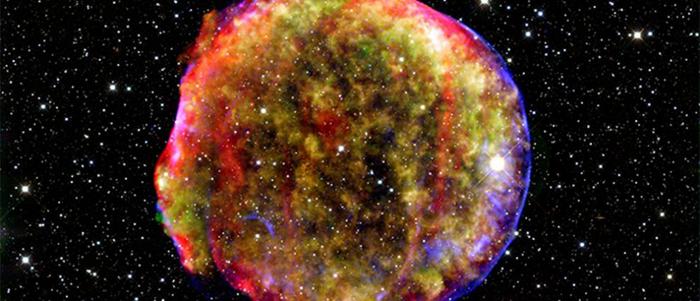
Scientists have come a step closer to understanding how collisionless shock waves – found throughout the universe – are able to accelerate particles to extreme speeds.
These shock waves are one of nature’s most powerful particle accelerators and have long intrigued scientists for the role they play in producing cosmic rays – high-energy particles that travel across vast distances in space.
The research, published today in Nature Communications, combines satellite observations from NASA’s MMS (Magnetospheric Multiscale) and THEMIS/ARTEMIS missions with recent theoretical advancements, offering a comprehensive new model to explain the acceleration of electrons in collisionless shock environments.
The paper, ‘Revealing an Unexpectedly Low Electron Injection Threshold via Reinforced Shock Acceleration’, was written by a team of international academics, led by Dr Savvas Raptis of The Johns Hopkins University Applied Physics Laboratory, in the USA, and in collaboration with Northumbria University’s Dr Ahmad Lalti.
This research addresses a long-standing puzzle in astrophysics – how electrons reach extremely high, or relativistic, energy levels.
For decades, scientists have been trying to answer a crucial question in space physics: What processes allow electrons to be accelerated to relativistic speeds?
Sign up for the Daily Dose Newsletter and get every morning’s best science news from around the web delivered straight to your inbox? It’s easy like Sunday morning.
The main mechanism to explain acceleration of electrons to relativistic energies is called Fermi acceleration or Diffusive Shock Acceleration (DSA). However, this mechanism requires electrons to be initially energized to a specific threshold energy before getting efficiently accelerated by DSA. Trying to address how electrons achieve this initial energy is known as ‘the injection problem’.
This new study provides key insights into the electron injection problem, showing that electrons can be accelerated to high energies through the interaction of various processes across multiple scales.
Using real-time data from the MMS mission, which measures the interaction of Earth’s magnetosphere with the solar wind, and the THEMIS/ARTEMIS mission, which studies the upstream plasma environment near the Moon, the research team observed a large scale, time dependent (i.e. transient) phenomenon, upstream of Earth’s bow shock, on December 17, 2017.
During this event, electrons in Earth’s foreshock region – an area where the solar wind is predisturbed by its interaction with the bow shock – reached unprecedented energy levels, surpassing 500 keV.
This is a striking result given that electrons observed in the foreshock region are typically found at energies ~1 keV.
This research suggests that these high-energy electrons were generated by the complex interplay of multiple acceleration mechanisms, including the interaction of electrons with various plasma waves, transient structures in the foreshock, and Earth’s bow shock.
All of those mechanisms act together to accelerate electrons from low energies ~ 1keV up to relativistic energies reaching the observed 500 keV, resulting in a particularly efficient electron acceleration process.
By refining the shock acceleration model, this study provides new insight into the workings of space plasmas and the fundamental processes that govern energy transfer in the universe.
As a result, the research opens new pathways for understanding cosmic ray generation and offers a glimpse into how phenomena within our solar system can guide us to understand astrophysical processes throughout the Universe.
Dr. Raptis believes that studying phenomena across different scales is crucial for understanding nature. “Most of our research focuses on either small-scale effects, like wave-particle interactions, or large-scale properties, like the influence of solar wind,” he says.
“However, as we demonstrated in this work, by combining phenomena across different scales, we were able to observe their interplay that ultimately energize particles in space.”
Dr Ahmad Lalti added: “One of the most effective ways to deepen our understanding of the universe we live in is by using our near-Earth plasma environment as a natural laboratory.
“In this work, we use in-situ observation from MMS and THEMIS/ARTEMIS to show how different fundamental plasma processes at different scales work in concert to energize electrons from low energies up to high relativistic energies.
“Those fundamental processes are not restricted to our solar system and are expected to occur across the universe.
“This makes our proposed framework relevant for better understanding electron acceleration up to cosmic-ray energies at astrophysical structures light-years away from our solar system, such as at other stellar systems, supernovae remnants, and active galactic nuclei.”
The paper ‘Revealing an Unexpectedly Low Electron Injection Threshold via Reinforced Shock Acceleration’ has been published today (Monday 13 January 2025) in Nature Communications (DOI 10.1038/s41467-024-55641-9).
IMAGE CREDIT: MPIA/NASA/Calar Alto Observatory.




Leave a Reply