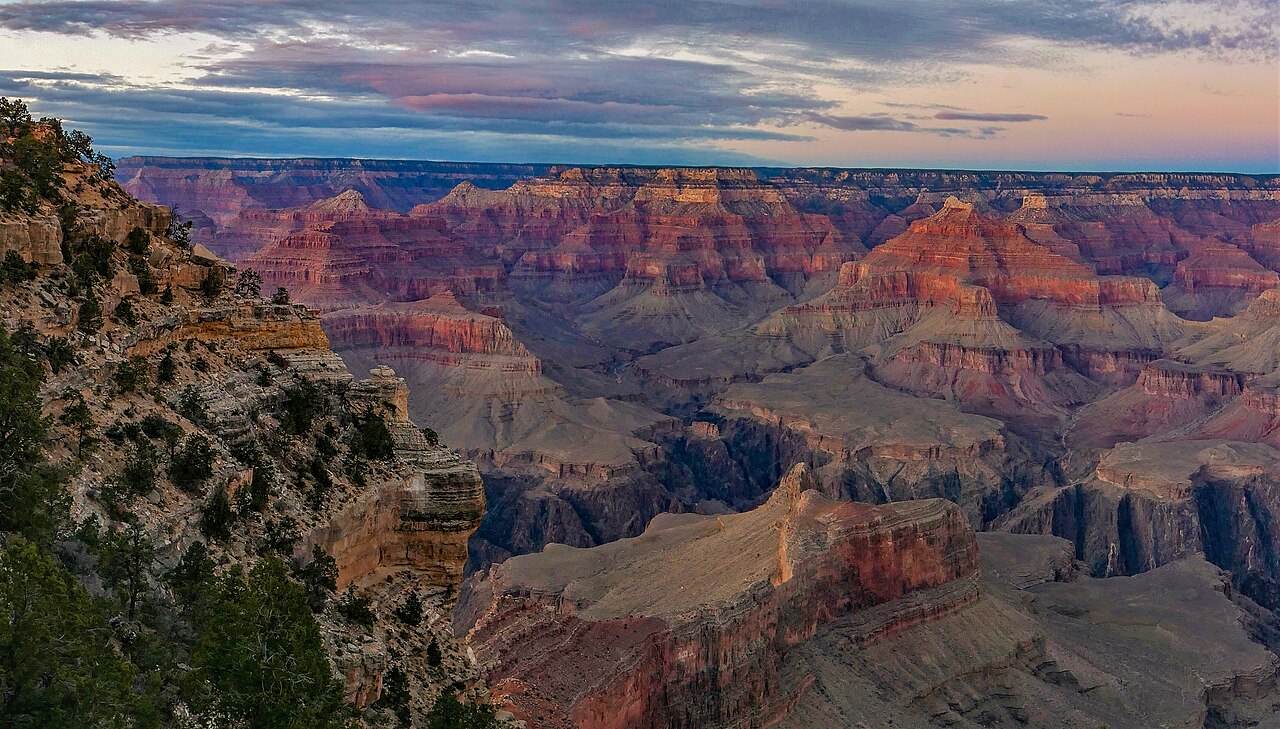

The Grand Canyon’s stratified layers offer a remarkable record of geological history, spanning nearly two billion years. This natural wonder showcases sedimentary rock formations arranged in distinct layers, each telling a unique story about the Earth’s past environments.
The geological history of the Grand Canyon begins with the oldest rocks at the bottom, the Vishnu Schist, which dates back around 2 billion years. These metamorphic rocks were originally formed as sediments that were deeply buried and subjected to intense pressure and heat, transforming them into schist and gneiss. Overlying these ancient rocks are the Grand Canyon Supergroup and the younger sedimentary layers.
As we move upwards through the canyon, the layers become progressively younger. The sedimentary rock layers, including the Tapeats Sandstone, Bright Angel Shale, and Redwall Limestone, represent different geological periods and environments. For instance, the Tapeats Sandstone, formed around 525 million years ago, indicates a shallow marine environment where sand accumulated. Above it, the Bright Angel Shale signifies a transition to deeper water conditions.
The Redwall Limestone, formed approximately 340 million years ago, is a key indicator of a warm, shallow sea that covered much of North America. Each of these layers was deposited over millions of years in various environments, including seas, deserts, and river deltas.
The erosion of these layers by the Colorado River, along with other geological processes, has exposed this detailed stratigraphy, allowing scientists to study Earth’s geological past in extraordinary detail.


Leave a Reply