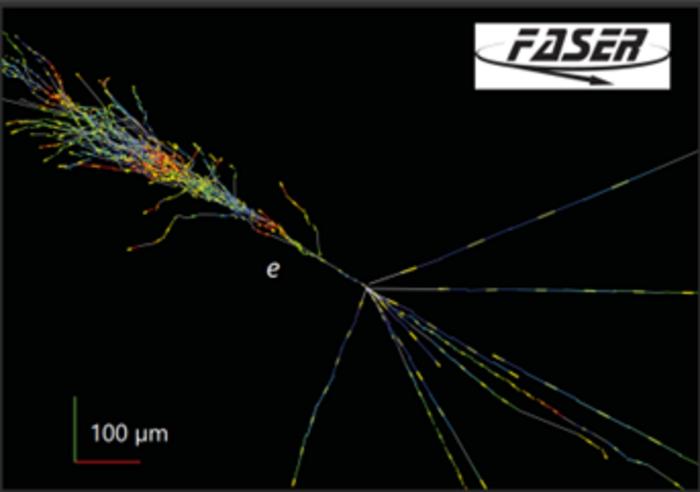
Neutrinos are fundamental particles in the Standard Model of particle physics, notable for their extremely small masses and weak interactions with matter. They are important for answering fundamental questions about the universe, including why particles have mass and why there is more matter than antimatter. Despite being abundant, their weak interactions make their detection difficult, and hence they are called “ghost particles.” At any given moment, numerous neutrinos freely pass through the Earth and our bodies, which originate from the Sun or cosmic rays. Understanding their rare interactions with matter is crucial for obtaining a more complete picture of particle physics and the universe.
There are three types, or flavors, of neutrinos: electron neutrinos (νe), muon neutrinos (νμ), and tau neutrinos (ντ). So far, most neutrinos studied by researchers have been low-energy neutrinos. To date, neutrino interaction cross sections, which is the probability of a neutrino interacting with a target particle, had not been measured at energies above 300 gigaelectronvolts (GeV) for electron neutrinos and between 400 GeV and six teraelectronvolts (6000 GeV) for muon neutrinos.
In a groundbreaking study, a team of researchers led by Associate Professor Akitaka Ariga from the Graduate School of Science, Chiba University, Japan, also affiliated with the Laboratory for High Energy Physics, University of Bern, Switzerland, and Associate Professor Tomoko Ariga from the Faculty of Arts and Science, Kyushu University, Japan, utilized the Forward Search Experiment (FASER) at CERN’s Large Hadron Collider (LHC), to achieve the first direct observation of high energy electron and muon neutrino interactions at a particle collider. The team included Dr. Ken Ohashi from the Laboratory for High Energy Physics at the University of Bern, Dr. Hiroaki Kawahara from the Faculty of Arts and Science at Kyushu University, and Project-specific Assistant Professor Daiki Hayakawa from the Graduate School of Science, Chiba University, along with other members of the FASER collaboration. Their findings were published in the journal Physical Review Letters on July 11, 2024.

One of the primary objectives of FASER is the study of high-energy neutrinos produced in the LHC’s proton-proton (pp) collisions using the dedicated FASERν detector. Dr. Akitaka Ariga explains, “With FASERν, charged particle tracks produced by neutrino interactions in the detector can be reconstructed with sub-micron precision. This allows us to identify electron and muon charged-current (CC) neutrino interactions and the measurement of neutrino interaction cross-sections in the currently unexplored TeV energy range.”
The FASERν emulsion detector is made of 730 layers of interleaved tungsten plates and emulsion films, with a total target mass of 1.1 tons. The researchers analyzed a subset of the exposed detector volume, corresponding to a mass of 128.6 kg, for high-energy neutrinos from the LHC pp collisions. After applying strict criteria, selecting events with electrons or muons with an energy above 200 GeV, four electron neutrino interaction candidate events and eight muon neutrino interaction candidate events were observed. These interactions had high statistical significance (5.2σ for electron neutrinos and 5.7σ for muon neutrinos), meaning they are highly unlikely to be random background fluctuations and therefore represent actual neutrinos.
Sign up for the Daily Dose Newsletter and get every morning’s best science news from around the web delivered straight to your inbox? It’s easy like Sunday morning.
The neutrinos detected in the study had energies in the teraelectronvolts range, the highest ever detected from an artificial source. This study marks the first measurement of neutrino interaction cross-sections in the unexplored energy range of 560–1740 GeV for electron neutrinos and 520–1760 GeV for muon neutrinos. Additionally, the measured interaction cross-sections were consistent with Standard Model predictions.
Highlighting the significance of the study, Dr. Akitaka Ariga says, “These results demonstrate the capability of studying flavor-tagged neutrino interactions at TeV energies with the FASERν emulsion-based detector at the LHC. This marks the first ever physics result on neutrinos from a particle collider, a breakthrough in particle physics that could revolutionize the strategy of large-scale experimental research in the field.”
IMAGE CREDIT: FASER Collaboration
If you enjoy the content we create and would like to support us, please consider becoming a patron on Patreon! By joining our community, you’ll gain access to exclusive perks such as early access to our latest content, behind-the-scenes updates, and the ability to submit questions and suggest topics for us to cover. Your support will enable us to continue creating high-quality content and reach a wider audience.
Join us on Patreon today and let’s work together to create more amazing content! https://www.patreon.com/ScientificInquirer



Leave a Reply