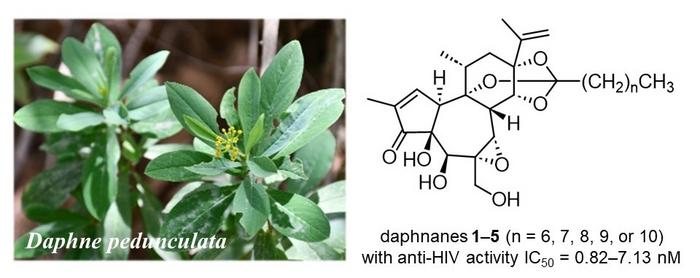
A research group led by Professor Wei Li of the Department of Pharmacognosy, Faculty of Pharmaceutical Sciences, Toho University, in collaboration with Shenyang Pharmaceutical University in China and Duke University Medical Center in the United States, discovered that Daphne pedunculata, (Thymelaeaceae) contains rare daphnane diterpenoids with odd-numbered aliphatic side chains.
Furthermore, these researchers revealed that these compounds inhibit the replication of the human immunodeficiency virus (HIV). This discovery is anticipated to lead to the development of novel HIV therapeutics with excellent anti-HIV activity.
The research of this research was published in the “Journal of Natural Medicines” of the Japanese Society of Pharmacognosy on May 23rd, 2024.

The plant family Thymelaeaceae comprises 53 genera and more than 800 species that are widely distributed worldwide, excluding the polar regions. These plants contain diterpenoids with notable biological activities, including anticancer and anti-HIV activities. Daphne pedunculata is an evergreen shrub endemic to Yunnan Province in China, that blooms yellow flowers from November to December.
The research group has previously isolated and structurally determined novel macrocyclic daphnane diterpenoids with anti-HIV activity from D. pedunculata. In this study, two novel daphnane diterpenoids with unusually odd-numbered aliphatic side chains were isolated from D. pedunculata and their anti-HIV activity was elucidated.
Sign up for the Daily Dose Newsletter and get every morning’s best science news from around the web delivered straight to your inbox? It’s easy like Sunday morning.
The results of this study will contribute to further our knowledge of the structure–activity relationship between daphnane diterpenoids and anti-HIV activity, and are expected to lead to the discovery of new drugs for the treatment of HIV infection.
IMAGE CREDIT: Dr. , Kouharu Otsuki
If you enjoy the content we create and would like to support us, please consider becoming a patron on Patreon! By joining our community, you’ll gain access to exclusive perks such as early access to our latest content, behind-the-scenes updates, and the ability to submit questions and suggest topics for us to cover. Your support will enable us to continue creating high-quality content and reach a wider audience.
Join us on Patreon today and let’s work together to create more amazing content! https://www.patreon.com/ScientificInquirer




Leave a Reply