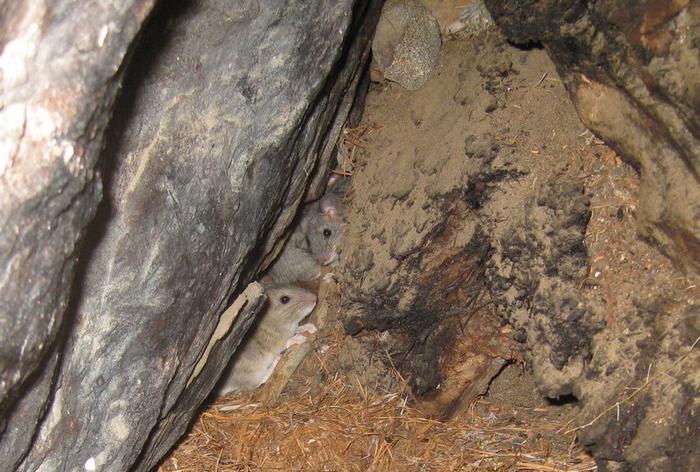
Packrats, also known as woodrats, are the original hoarders, collecting materials from their environment to make their nests, called middens. In deserts throughout western North America, for instance, packrat middens can preserve plants, insects, bones and other specimens for more than 50,000 years, offering scientists a snapshot into the past. Packrats and numerous other rodent species in dry environments around the world gather plants, insects, bones and other items into their nests from a radius of about 50 feet and urinate over them. The urine dries and crystallizes, hardening the fossils into rock-like masses and preserving the items inside.
Ancient rodent middens have allowed scientists to reconstruct the ecology and climate of semi-arid ecosystems in the Americas, Australia, Africa and the Arabian Peninsula. These natural time capsules are unparalleled archives for observing how plant, animal and microbial species and assemblages have responded over millennia as environmental conditions have changed. Researchers have learned how populations of plants and animals were impacted by climate change in the past, which can provide clues about how populations might respond to future rapid climate disruption.
Today, with advanced molecular technology, scientists can learn more than ever about the ancient organisms that once inhabited the area in and around these middens.

Now, scientists are calling for improved preservation of middens, new research in existing archives and a revival of field studies, according to a prospectus paper recently published online in Trends in Ecology & Evolution. The paper is the result of a multi-year effort involving collaborators from 10 different institutions in the United States, France and Chile, according to Katie Becklin, lead author and assistant professor of biology in Syracuse University’s College of Arts and Sciences.
“New technology in DNA and chemical analysis also allows us to get more information from smaller and smaller amounts of materials,” says Becklin. “We can start to understand what traits are important for predicting which species could do well in the future as climate change continues to impact natural systems.”
Sign up for the Daily Dose Newsletter and get every morning’s best science news from around the web delivered straight to your inbox? It’s easy like Sunday morning.
But most midden collections are stored at individual institutions where they could be lost or discarded as researchers retire. Midden fossils in the wild meanwhile are vulnerable to destruction by human development and ongoing climate change.
The authors recommend establishing regional depositories for midden materials, which could provide long-term access for researchers. Additional middens must be collected and preserved to stem accelerating losses from land-use conversion, mineral resource extraction, increased wildfire frequency and climate change.
“This is an invitation to the next generation of scientists to take advantage of these resources, to build on the legacy of midden research so far,” says Becklin. “We need to protect these records and make them accessible to the global scientific community and bring in new ideas and people to continue this work.”
IMAGE CREDIT: Syracuse University
If you enjoy the content we create and would like to support us, please consider becoming a patron on Patreon! By joining our community, you’ll gain access to exclusive perks such as early access to our latest content, behind-the-scenes updates, and the ability to submit questions and suggest topics for us to cover. Your support will enable us to continue creating high-quality content and reach a wider audience.
Join us on Patreon today and let’s work together to create more amazing content! https://www.patreon.com/ScientificInquirer



Leave a Reply