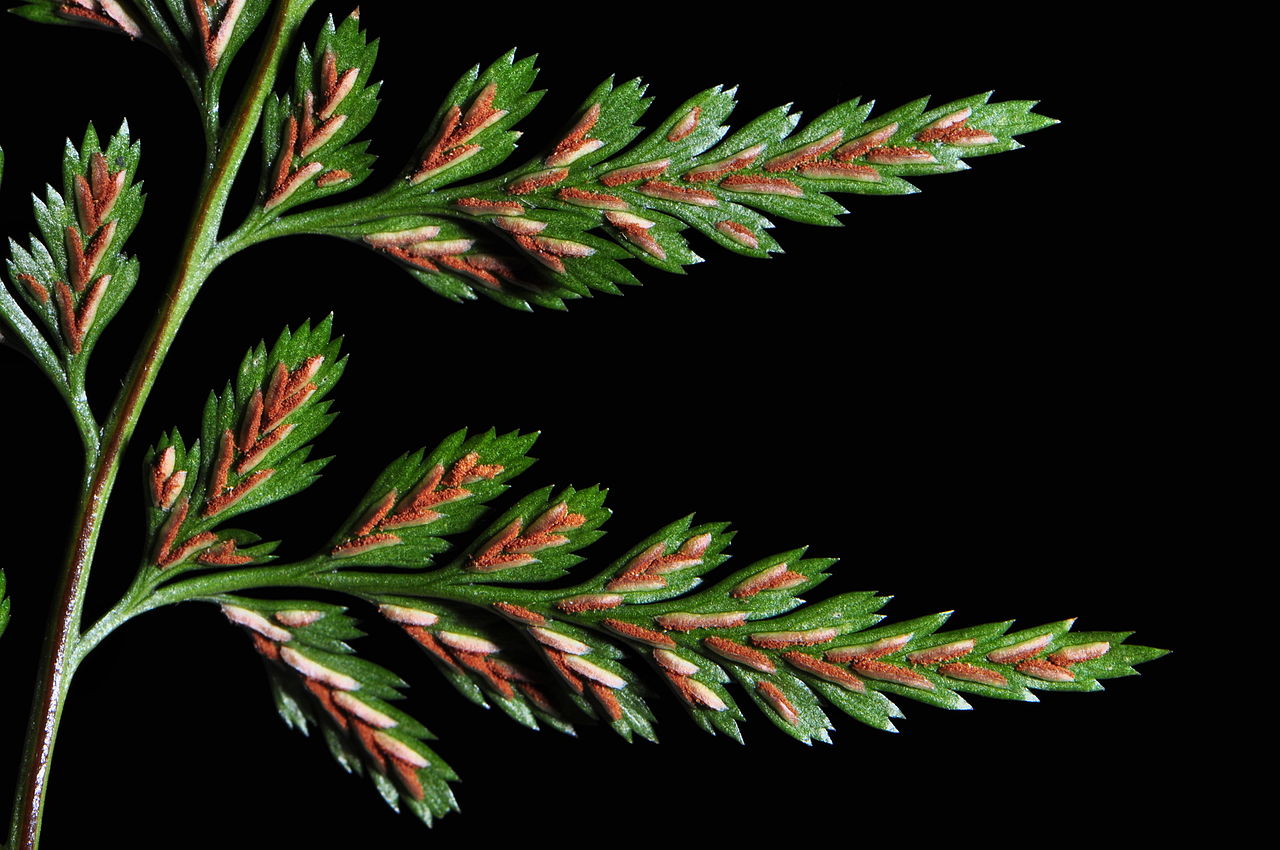

Asplenium adiantum-nigrum, commonly known as black spleenwort, is a fascinating fern species that exhibits intricate fractal-like patterns in its fronds. These patterns, which are self-similar at different scales, contribute to the plant’s unique appearance and have captured the attention of botanists and mathematicians alike.
The fronds of Asplenium adiantum-nigrum are characterized by their triangular shape and highly divided pinnae (leaflets). Upon closer inspection, one can observe that each pinna is further divided into smaller pinnules, which in turn are divided into even smaller segments. This recursive pattern of division and subdivision creates a fractal-like structure that is reminiscent of other natural phenomena, such as coastlines, snowflakes, and tree branches.
The fractal-like patterns in Asplenium adiantum-nigrum serve several purposes. Firstly, they increase the surface area of the fronds, allowing for more efficient photosynthesis and nutrient absorption. The highly divided structure also enables the fern to capture more light and adapt to varying environmental conditions. Additionally, the fractal-like patterns may help the fern to resist damage from wind and rain, as the complex structure can dissipate the force of impact more effectively than a simple, flat surface.
From a mathematical perspective, the fractal-like patterns in Asplenium adiantum-nigrum can be described using concepts such as self-similarity, scaling, and dimension. Self-similarity refers to the property of a structure being similar to itself at different scales, while scaling describes how the structure changes with increasing or decreasing size. The fractal dimension, which is often a non-integer value, quantifies the complexity and space-filling properties of the fern’s fronds.
The study of fractal-like patterns in Asplenium adiantum-nigrum and other ferns has implications beyond botany. Understanding these patterns can inspire new designs in architecture, engineering, and art, as well as contribute to the development of more efficient and resilient structures. Moreover, the presence of fractal-like patterns in nature serves as a reminder of the inherent beauty and complexity of the world around us.


Leave a Reply