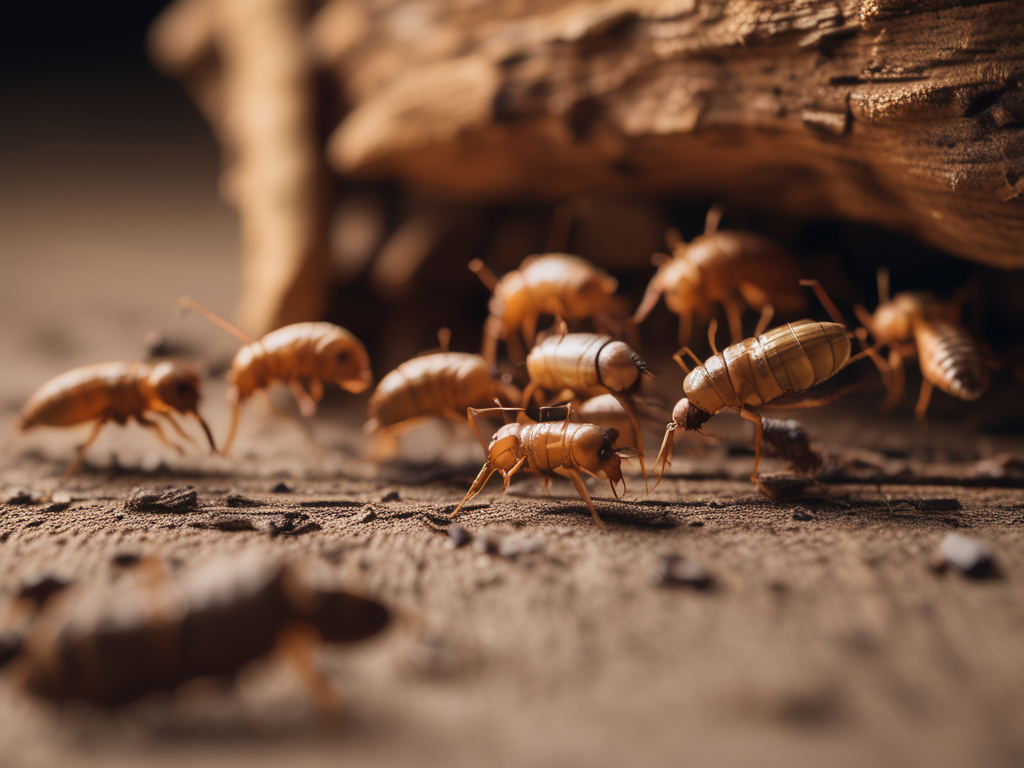
UC Riverside scientists have discovered a highly effective, nontoxic, and less expensive way to lure hungry termites to their doom.
The method, detailed in the Journal of Economic Entomology, uses a pleasant-smelling chemical released by forest trees called pinene that reminds western drywood termites of their food. They follow the scent to a spot of insecticide injected into wood.
“We saw significant differences in the death rates using insecticide alone versus the insecticide plus pinene,” said UCR entomologist Dong-Hwan Choe, who led the discovery. “Without pinene, we got about 70% mortality. When we added it in, it was over 95%.
Native to North America, western drywood termites are environmentally important. They are drawn to dead wood above ground, and consume it with the help of microorganisms in their guts. “They are recyclers,” Choe said. “And they’re very common.”
Unfortunately for humans, the insects are unable to distinguish between dead trees and the wood used to build homes. Of particular concern in California and Florida, as well as parts of Canada and Mexico, no dwelling is immune to them. “It’s only a matter of time before termites attack a house, especially in warmer parts of the states,” Choe said.
Fumigation is one of the most common drywood termite control techniques. Homes are covered with tents and then bombed with gas that kills the insects. In the U.S., California uses this method more than any other state.

The pest control industry is under pressure to find new methods because the chemical, sulfuryl fluoride, is both a greenhouse gas and is also toxic to humans. Additionally, fumigation is an expensive process that does not provide lasting protection against termites.
“Even though it is very thorough, a home can be infested again soon after fumigation is completed,” Choe said. “Some people fumigate every three to five years because it doesn’t protect structures from future infestations.”
Localized injection is an alternative strategy to control drywood termites that does not involve gas. Technicians drill holes into the infested wood to reach the termite “gallery” or lair, then inject poison into the hole to inundate the bugs.
“This is a more localized treatment, and in theory, it is a better strategy when you want to control drywood termites with fewer chemicals. It’s less expensive, and the treated wood may also stay protected from future infestations,” Choe said.
The challenge with localized injection is figuring out exactly where the bugs are hiding. Typically, this method uses a contact-based insecticide, meaning the insects must touch the poison for it to work.
Using an attractant like pinene eliminates the need to hunt for the termites. “Even at low concentrations, pinene is good at attracting termites from a distance,” Choe said.
“We don’t think it’s functioning as a pheromone,” Choe said. “We think the scent is more associated with their food. Smells nice… dinner time! That’s the concept that we had in mind.”
The insecticide they used, fipronil, is also used to control ant infestations. It can be toxic to aquatic insects and pollinators if it gets into the environment. In this case it is injected into the wood, so chances of off-target effects are low.
Choe’s laboratory generally studies the chemical communication systems of urban insect pests to develop strategies like this one for western drywood termites.
“Our study shows that if you understand insect behavior better, it’s interesting by itself,” Choe said. “Then there are also important implications for more effective pest management, so we can use fewer chemicals without compromising efficiency.”
Sign up for the Daily Dose Newsletter and get the morning’s best science news from around the web delivered straight to your inbox? It’s easy like Sunday morning.

Leave a Reply