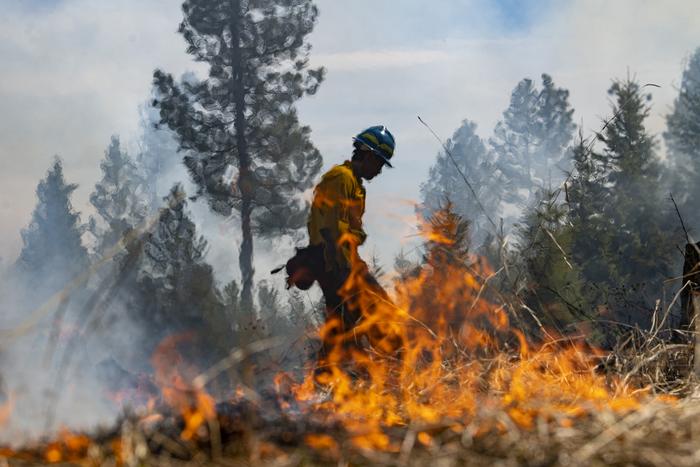
The escalation of extreme wildfires globally has prompted a critical examination of wildfire management strategies. A new study from the University of Montana reveals how fire suppression ensures that wildfires will burn under extreme conditions at high severity, exacerbating the impacts of climate change and fuel accumulation.
The study used computer simulations to show that attempting to suppress all wildfires results in fires burning with more severe ecological impacts, with accelerated increases in burned area beyond those expected from fuel accumulation or climate change.
“Fire suppression has unintended consequences,” said lead author Mark Kreider, a Ph.D. candidate in the forest and conservation sciences program at UM. “We’ve known for a long time that suppressing fires leads to fuel accumulation. Here, we show a separate counter-intuitive outcome.”
Though fire suppression reduces the overall area burned, it mainly eliminates low- and moderate-intensity fires. As a result, the remaining fires are biased to be more extreme, Kreider said. The new study published March 25 in Nature Communications, shows how this “suppression bias” causes average fire severity to increase substantially.
“Over a human lifespan, the modeled impacts of the suppression bias outweigh those from fuel accumulation or climate change alone,” he said. “This suggests that suppression may exert a significant and underappreciated influence on patterns of fire globally.”
Kreider led the research as part of his Ph.D. dissertation work with the support of a National Science Foundation Graduate Research Fellowship.

Fire suppression exacerbated the trends already caused by climate change and fuel accumulation, the study found, causing areas burned to increase three to five times faster over time relative to a world with no suppression.
Suppression, through preferentially removing low- and moderate-severity fire, also raised average fire severity by an amount equivalent to a century of fuel accumulation or climate change.
“By attempting to suppress all fires, we are bringing a more severe future to the present,” said Kreider.
Andrew Larson, Kreider’s Ph.D. adviser and a professor of forest ecology at UM, said this has significant impacts on ecosystems.
“Traditional suppression removes the low-severity fires that help perpetuate healthy forests by consuming fuels and preferentially killing thin-barked tree species,” Larson said. “I wonder how much we are altering natural selection with fire suppression by exposing plants and animals to relatively less low-severity fire and relatively more high-severity fire.”
However, the new findings also show that allowing more low- and moderate-intensity fire can reduce or reverse the impacts of the suppression bias. Suppression strategies that allow fire to burn under moderate weather conditions – while still suppressing fires during more dangerous fire weather – reduced average fire severity and moderated the rate of burned area increase, the team found.
“It may seem counterintuitive, but our work clearly highlights that part of addressing our nation’s fire crisis is learning how to accept more fires burning when safely possible,” said Philip Higuera, a co-author and UM professor of fire ecology. “That’s as important as fuels reduction and addressing global warming.”
Developing and implementing technologies and strategies to safely manage wildfires during moderate burning conditions is essential, Kreider said. This approach may be just as effective as other necessary interventions, like mitigating climate change and decreasing unintentional human-related ignitions.
The article, “Fire suppression makes wildfires more severe and accentuates impacts of climate change and fuel accumulation,” was co-authored by Kreider, Larson, Higuera, William Rice, and Nadia White from the University of Montana, as well as Sean Parks, an ecologist with the Aldo Leopold Wilderness Research Institute.
IMAGE CREDIT: University of Montana photo by Tommy Martino.
Sign up for the Daily Dose Newsletter and get the morning’s best science news from around the web delivered straight to your inbox? It’s easy like Sunday morning.




Leave a Reply