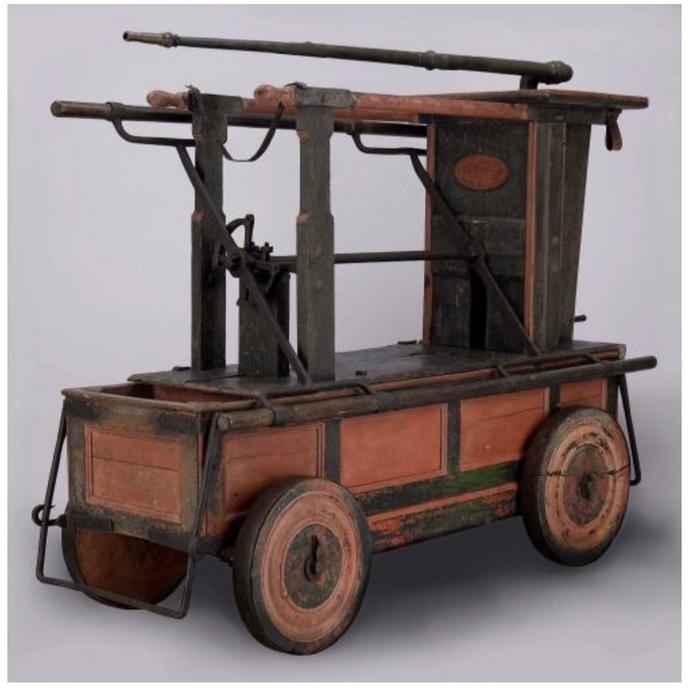
Today, water pressure technology is ubiquitous, and any person who showers, waters a garden, or fights fires is benefiting from the technology devised to harness it. In the 17th and 18th centuries, though, a steady stream of water not punctuated by pressure drops was a major breakthrough.
In 1666, when bucket brigades were the best line of defense, the Great Fire of London burned almost all of the city’s tightly packed, wooden structures. The disaster destroyed hundreds of thousands of homes and dozens of churches, demonstrating the need for better firefighting methods and equipment.
One landmark advancement was the invention “sucking worms,” leather hoses attached to manually operated pumps. Then came the Windkessel, a chamber in the bottom of a wooden wagon that compressed air to pump water continuously through a hose, creating a steady stream.

Inspired by a 1725 fire engine that pumped water at larger distances and higher speeds than previously possible, authors publishing in the American Journal of Physics, by AIP Publishing, analyzed the pressure chamber’s Windkessel effect to capture the physics behind this widely used, enduring technology.
“There are many fascinating physics problems hiding in plain sight within books and papers written centuries ago!” author Trevor Lipscombe said. “Recently we’ve been working on applying elementary fluid mechanics to biological systems, and came across a common description in medical journals: that the heart acts as a Windkessel. That begs the question of what, precisely, is a Windkessel? Following the trail, we found descriptions of Lofting’s ‘sucking worm’ device and, in Newsham’s fire engine, a lifesaving application.”
To pinpoint what factors are most influential in the Windkessel effect, the authors compared the initial state of the chamber, the rate at which bucket brigades could pour water in (volumetric inflow), the length of time pressure builds, and the effects on output flow rate.
“When faced with Lofting’s design, or the Newsham fire engine, a physicist wants to sort out the basic science involved – simply because it’s there,” Lipscombe said. “It’s the joy of doing physics. But also, there’s a pedagogical aspect. Our article builds a simple model that shows how a Newsham fire engine works. We’re partly answering the ‘when will I ever use this stuff?’ question.”
Next, the authors plan to examine the physiological Windkessel involved in the heart-aorta system.
“Knowledge of Bernoulli’s law, the ideal gas law, and isothermal expansion are the three ingredients we baked into a model to explore how this device worked,” Lipscombe said. “But if we understand this system better, we could look at the parameters that are important and see how changing them might improve the device.”
IMAGE CREDIT: The Colonial Williamsburg Foundation. Museum Purchase
Sign up for the Daily Dose Newsletter and get the morning’s best science news from around the web delivered straight to your inbox? It’s easy like Sunday morning.

Leave a Reply